
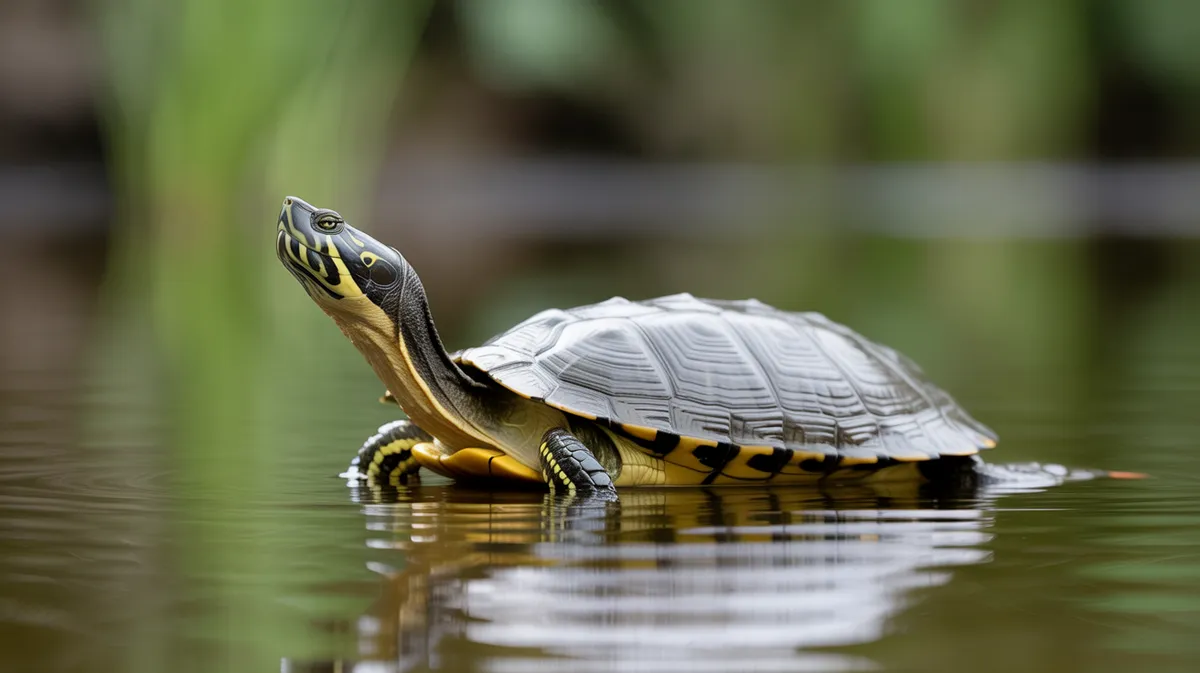
About the Eastern Long-necked Turtle
The Eastern Long-necked Turtle, also known as the snake-necked turtle, is a freshwater turtle native to southeastern Australia. It is easily recognized by its exceptionally long neck, which can be up to 60% the length of its shell. This species is highly aquatic but often ventures onto land to move between water bodies or to nest. It is an opportunistic feeder, consuming a variety of aquatic animals and occasionally plant matter. The turtle's unique defensive behavior includes releasing a foul-smelling fluid from its musk glands when threatened.
Fascinating facts
Unusually Long Neck
The Eastern Long-necked Turtle's neck can be almost as long as its carapace, giving it a snake-like appearance.
Aquatic Traveler
During dry periods or when searching for new water bodies, this turtle can travel significant distances overland.
Musk Defense
When threatened, it releases a strong-smelling fluid from musk glands near its tail to deter predators.
Detailed description
The Eastern Long-necked Turtle (Chelodina longicollis) is a medium-sized freshwater turtle, with adults typically measuring 20–30 cm in carapace length and weighing up to 1.5 kg. Its most distinctive feature is its elongated neck, which can be nearly as long as the carapace itself, allowing the turtle to strike rapidly at prey and breathe at the water’s surface while remaining mostly submerged. The carapace is generally dark brown to black, often with a pale yellow or cream plastron marked by dark seams. The skin is olive to brown, with a paler underside. This species is highly aquatic but is known for its overland migrations, especially during droughts or when seeking new water bodies. It is primarily solitary, exhibiting territoriality in some instances, but may aggregate in favorable habitats. Chelodina longicollis is an opportunistic carnivore, feeding on aquatic invertebrates, small fish, tadpoles, and carrion, but it may also consume some aquatic vegetation. Its unique defense mechanism involves secreting a pungent, musky odor from paired glands near the bridge of the shell when threatened, earning it the nickname 'stinker.' Reproduction occurs in spring and early summer, with females laying up to three clutches per season, each containing 4–20 eggs. Hatchlings emerge after an incubation period of 100–150 days, depending on temperature. The species is long-lived, with individuals known to survive for several decades in the wild. Its adaptability to a range of freshwater habitats, including ephemeral wetlands, has contributed to its widespread distribution across southeastern Australia.
Did you know?
Despite being highly aquatic, these turtles are frequently seen crossing land, sometimes traveling several kilometers to locate new habitats.
Research & sources
Behaviour & social structure
Eastern Long-necked Turtles are predominantly crepuscular, being most active during dawn and dusk. They spend much of their time submerged, surfacing intermittently to breathe by extending their long necks. When foraging, they employ a sit-and-wait strategy, remaining motionless before rapidly extending their neck to capture prey with a sideways sweep of the head. They are capable swimmers but often walk along the substrate in shallow water. During periods of drought or habitat desiccation, they undertake terrestrial migrations, sometimes traveling several kilometers to locate new water bodies. Social interactions are limited; individuals may display aggressive posturing or biting during encounters, particularly in confined spaces or during the breeding season. Basking behavior is observed, especially in cooler months, as they climb onto logs or banks to thermoregulate. In captivity and occasionally in the wild, they have been observed stacking atop one another while basking.
Reproduction & life cycle
Breeding occurs primarily from September to January (spring to early summer in Australia). Males court females through tactile stimulation and head bobbing. After mating, females leave the water to nest, often traveling considerable distances to find suitable sandy or loamy soil. Clutch size ranges from 4 to 20 eggs, with larger females producing more eggs. Females may lay up to three clutches per season, spaced several weeks apart. Eggs are oval, leathery-shelled, and incubate for 100–150 days, with temperature influencing the duration. There is no parental care post-oviposition; hatchlings are fully independent upon emergence, typically after heavy rains. Sex determination is genetic (GSD), not temperature-dependent, which is unusual among turtles. Hatchlings measure about 2.5–3.5 cm in carapace length and are vulnerable to predation by birds, mammals, and fish.
Adaptations & survival
Chelodina longicollis exhibits several notable adaptations. The elongated neck, supported by specialized cervical vertebrae, allows for rapid lateral strikes at prey and enables breathing at the surface with minimal exposure. The musk glands produce a foul-smelling secretion as a deterrent against predators. The species can tolerate brackish water and periods of low oxygen by reducing metabolic rate and utilizing cutaneous respiration. During droughts, individuals can aestivate by burrowing into mud and reducing activity until conditions improve. Their cryptic coloration provides camouflage among aquatic vegetation and detritus. The ability to travel overland between water bodies is a key adaptation to the variable Australian climate.
Cultural significance
The Eastern Long-necked Turtle holds a modest place in Australian culture. It is occasionally featured in Indigenous Australian stories and artwork, symbolizing resilience and adaptability. In some Aboriginal traditions, turtles are associated with water spirits and are considered indicators of water health. The species is sometimes kept as a pet, and its distinctive appearance makes it a subject of interest for naturalists and educators. However, it is not widely used for food or traditional medicine. Conservation campaigns have used the turtle as a flagship species to promote wetland preservation.
Recent research
Recent research has focused on the species’ movement ecology, revealing extensive terrestrial migrations and the importance of landscape connectivity for population persistence. Genetic studies have clarified the taxonomic relationships within the Chelodina genus, highlighting cryptic diversity and regional variation. Investigations into the effects of urbanization have documented increased road mortality and altered sex ratios in some populations. Studies on musk gland secretions have identified unique chemical compounds with potential antimicrobial properties. Ongoing research is examining the impacts of climate change on reproductive timing and hatchling survival, as well as the species’ role in aquatic ecosystem functioning as both predator and scavenger.
Sources
Chelodina longicollis (Eastern Long-necked Turtle) in: Rhodin, A.G.J., et al. (Eds.), Conservation Biology of Freshwater Turtles and Tortoises
Rhodin, A.G.J., et al. (2017)
scientificChelodina longicollis: The IUCN Red List of Threatened Species 2018
IUCN SSC Tortoise and Freshwater Turtle Specialist Group
conservationChelodina longicollis (Eastern Long-necked Turtle): Ecology, Behavior, and Conservation
Georges, A. & Thomson, S. (2010)
scientificChelodina longicollis: The IUCN Red List of Threatened Species 2018
Rhodin, A.G.J., et al.
conservationVideos
Habitat
Freshwater bodies such as ponds, lakes, rivers, and swamps

Conservation
The Eastern Long-necked Turtle is currently classified as Least Concern on the IUCN Red List.
Threats & challenges
While currently listed as Least Concern, Eastern Long-necked Turtles face several threats. Habitat loss and fragmentation due to urbanization, agriculture, and wetland drainage reduce available breeding and foraging sites. Road mortality is significant during overland migrations, particularly in peri-urban areas. Predation by introduced species such as foxes (Vulpes vulpes) and feral pigs (Sus scrofa) affects both eggs and adults. Water pollution, especially from agricultural runoff and urban waste, can degrade habitat quality and impact food availability. Climate change poses long-term risks through altered rainfall patterns and increased frequency of droughts. Despite these challenges, the species remains relatively abundant and adaptable, but localized declines have been reported in heavily modified landscapes.
Taxonomy
Scientific name
Chelodina longicollis
- Kingdom
- Animalia
- Phylum
- Chordata
- Class
- Reptilia
- Order
- Testudines
- Family
- Chelidae
- Genus
- Chelodina
- Species
- longicollis
Where to see an eastern long-necked turtle
2 zoos and aquariums in 1 country are recorded as keeping this species.

Community notes
Share your observations about the Eastern Long-necked Turtle.
No community notes yet. Be the first!
Discover more wildlife
More fascinating animals from the encyclopedia.