
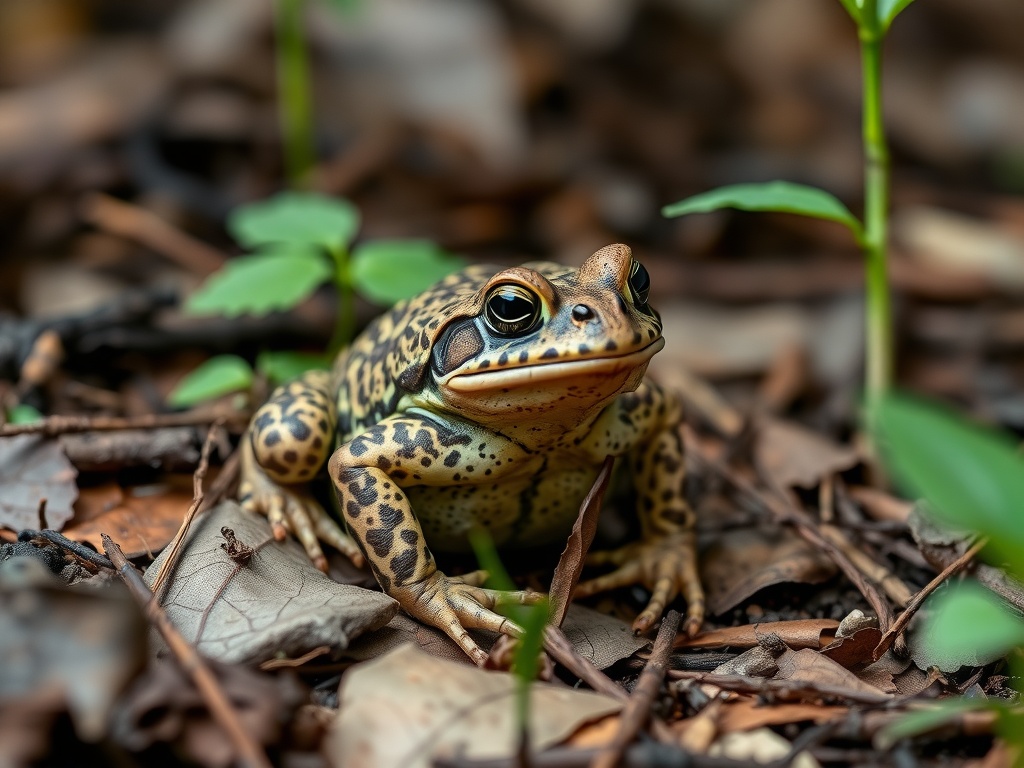
About the Eastern Narrow-mouthed Toad
The Eastern Narrow-mouthed Toad is a small, secretive amphibian known for its pointed snout and fold of skin located behind the eyes. Its coloration varies from gray to brown or reddish, often with mottled patterns that provide effective camouflage among leaf litter. This species spends much of its life hidden under logs, rocks, or debris in moist environments, emerging mainly during rainy weather to feed and breed. Despite being called a toad, it has smooth skin and lacks the typical warty texture of true toads.
Fascinating facts
Ant Specialist
This toad feeds primarily on ants and termites, using its narrow mouth to pick up small insects efficiently.
Rainy Day Breeder
Breeding usually occurs after heavy rains, when males gather at temporary pools and call to attract females.
Secretive Lifestyle
Eastern Narrow-mouthed Toads spend most of their time hidden under debris, logs, or stones, only coming out in wet conditions.
Detailed description
The Eastern Narrow-mouthed Toad (Gastrophryne carolinensis) is a diminutive amphibian, typically measuring 19–32 mm (0.75–1.25 in) in length, with females generally larger than males. Its body is distinctly squat and flattened, with a sharply pointed snout and a unique fold of skin running across the back of the head, which can be drawn forward to protect the eyes and nostrils from ant bites and desiccation. The skin is smooth and moist, lacking the warty texture of true toads, and coloration ranges from gray, brown, or reddish to nearly black, often with mottled or speckled patterns that provide camouflage among leaf litter. The ventral surface is usually lighter, sometimes with dark mottling. Unlike most frogs and toads, G. carolinensis lacks a visible tympanum (external eardrum), and its limbs are relatively short, with unwebbed fingers and toes adapted for burrowing. This species is highly fossorial, spending much of its life hidden beneath logs, rocks, or within loose soil and leaf litter in moist, shaded environments. Its secretive nature and cryptic coloration make it difficult to observe outside of breeding periods or after heavy rainfall. The Eastern Narrow-mouthed Toad is primarily nocturnal, emerging at dusk or during wet weather to forage and breed. Its call is a distinctive, nasal bleat, often compared to the sound of a sheep or a buzzing insect.
Did you know?
Unlike many amphibians, the Eastern Narrow-mouthed Toad often calls from hidden locations, making its loud, sheep-like bleat surprisingly difficult to trace.
Research & sources
Wikipedia summary
Gastrophryne carolinensis, the eastern narrow-mouthed toad, is a species of microhylid frog. It is a relatively small, toad-like amphibian found in damp, shady habitats. The species is highly fossorial, and feeds primarily on ants. These North American microhylids are distinguished from true toads, and other anurans by their moist, smooth skin, their lack of eardrums or tympana, their distinguishable squat body shape, and the unique fold of skin superior to their eyes. It is found in the United States, from southern Maryland to the Florida Keys, west to Missouri and Texas. While not a true toad, it is so called because it is terrestrial.
Behaviour & social structure
Gastrophryne carolinensis exhibits primarily solitary behavior, except during the breeding season when individuals congregate at temporary pools. It is a specialized myrmecophage, feeding predominantly on ants, but will also consume termites, small beetles, and other tiny invertebrates. The toad uses its narrow mouth and sticky tongue to capture prey, often foraging within ant nests or along ant trails. Its skin fold is an adaptation to ant bites, allowing it to feed on aggressive species with minimal harm. Activity is largely nocturnal, with individuals remaining hidden during the day to avoid desiccation and predation. When threatened, it may secrete a noxious skin toxin that deters predators, and it can rapidly burrow into loose substrate. Social interactions are limited outside of breeding, and there is little evidence of territoriality. During dry periods, the toad may aestivate underground, reducing metabolic activity until favorable conditions return.
Reproduction & life cycle
Breeding occurs primarily from late spring through summer, triggered by heavy rains that create temporary pools and flooded ditches. Males call from concealed positions at the water's edge, producing a loud, sheep-like bleat to attract females. Amplexus is axillary, with the male grasping the female behind her forelimbs. Females lay up to 850 eggs in shallow water, often in small clusters or strings attached to vegetation or debris. The eggs hatch within 2–3 days, and the tadpoles develop rapidly, completing metamorphosis in as little as 20–70 days depending on temperature and water availability. There is no parental care after egg-laying. Tadpoles are filter feeders, consuming algae, detritus, and microorganisms, and are adapted to ephemeral aquatic habitats that may dry quickly.
Adaptations & survival
The Eastern Narrow-mouthed Toad displays several key adaptations for its fossorial and myrmecophagous lifestyle. The pointed snout and narrow mouth facilitate feeding on ants within tight spaces, while the skin fold behind the head protects sensitive areas from ant bites and dehydration. Its smooth, moist skin aids in cutaneous respiration and water absorption, critical for survival in variable moisture conditions. The absence of a tympanum is thought to be an adaptation to a subterranean lifestyle, reducing vulnerability to soil-borne debris. The species produces skin toxins that deter predators and may also reduce fungal or bacterial infections. Rapid development of larvae is an adaptation to breeding in temporary pools that may evaporate quickly.
Cultural significance
The Eastern Narrow-mouthed Toad holds limited direct significance in human culture, largely due to its secretive nature and small size. It is sometimes referenced in regional folklore as a 'sheep frog' due to its distinctive call. In ecological terms, it plays an important role in controlling ant populations and serves as prey for a variety of predators, including snakes and birds. Its presence is considered an indicator of healthy, moist forest and wetland ecosystems.
Recent research
Recent research has focused on the species' specialized diet and chemical defenses, with studies documenting the composition of its skin secretions and their effectiveness against predators and pathogens. Genetic studies have clarified relationships within the Microhylidae family and confirmed the distinctiveness of G. carolinensis. Ongoing research includes monitoring responses to habitat alteration and climate change, as well as studies on larval development and adaptation to ephemeral aquatic habitats. Bioacoustic studies have characterized the variability and function of its breeding calls.
Videos
Habitat
Moist forests, grasslands, wetlands, and areas with abundant leaf litter
 Various Continental Regions
Grassland
Open areas dominated by grasses rather than trees, supporting numerous herbivores and their predators.
 Global
Forest
Wooded areas with significant tree cover and diverse plant and animal communities.
 Global
Freshwater
Lakes, rivers, and wetlands with diverse aquatic ecosystems.
Conservation
The Eastern Narrow-mouthed Toad is currently classified as Least Concern on the IUCN Red List.
Threats & challenges
Currently classified as Least Concern by the IUCN, Gastrophryne carolinensis maintains stable populations across its range. However, localized threats include habitat loss from urbanization, agriculture, and wetland drainage. Pesticide use may reduce prey availability and directly harm individuals. Road mortality during breeding migrations and climate change-induced alterations in rainfall patterns could impact breeding success. Despite these threats, the species' secretive habits, broad distribution, and adaptability to disturbed habitats have buffered it from significant declines. Ongoing monitoring is recommended to detect potential population changes.
Taxonomy
Scientific name
Gastrophryne carolinensis
- Kingdom
- Animalia
- Phylum
- Chordata
- Class
- Amphibia
- Order
- Anura
- Family
- Microhylidae
- Genus
- Gastrophryne
- Species
- carolinensis
Community notes
Share your observations about the Eastern Narrow-mouthed Toad.
No community notes yet. Be the first!
Discover more wildlife
More fascinating animals from the encyclopedia.