
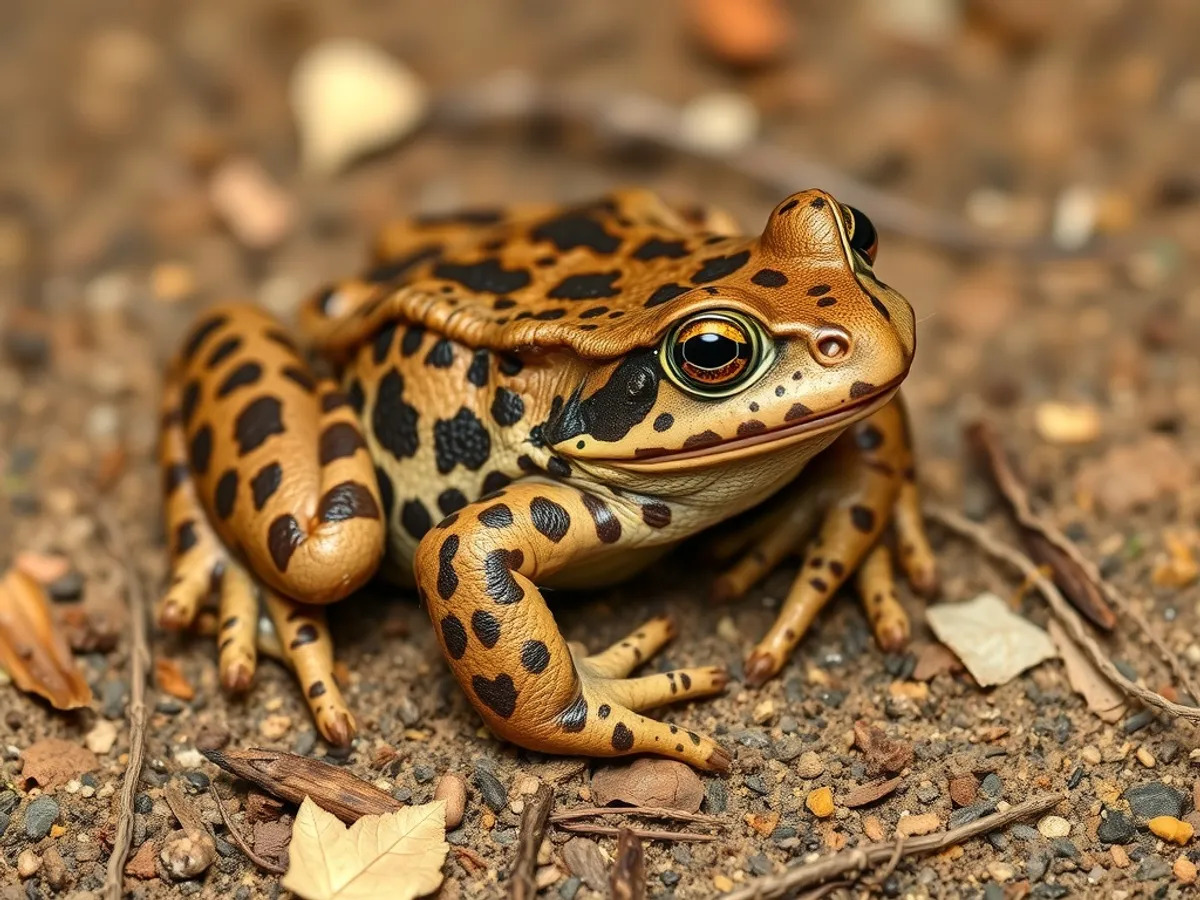
About the Eastern Spadefoot Toad
The Eastern Spadefoot Toad is a secretive amphibian native to the eastern United States, recognized for its smooth, warty skin and distinctive vertical pupils. Its olive to brown coloration, often with yellowish lines running down its back, provides excellent camouflage in sandy soils. This nocturnal toad spends most of its life underground, emerging primarily after heavy rains to breed in temporary pools. Its hind feet are equipped with hardened, spade-like projections that aid in rapid burrowing, allowing it to escape predators and desiccation.
Fascinating facts
Master Burrowers
Eastern Spadefoot Toads use a sharp, black 'spade' on each hind foot to dig rapidly backwards into loose soil, often disappearing within seconds when threatened.
Rain-Driven Breeding
These toads breed explosively after heavy rains, sometimes completing their entire breeding cycle in just a few days to take advantage of temporary pools.
Unique Pupils
Their eyes have vertical, elliptical pupils—a rare trait among North American toads—helping them see better at night and underground.
Detailed description
The Eastern Spadefoot Toad (Scaphiopus holbrookii) is a medium-sized amphibian, typically measuring 4.5–7.5 cm (1.8–3 in) in length, with a robust, squat body and relatively short limbs. Its skin is smooth but dotted with small warts, and its dorsal coloration ranges from olive to brown, often adorned with two distinct yellowish or golden stripes running from the eyes down the back, forming a lyre-shaped pattern. The ventral surface is pale and unmarked. One of its most distinctive anatomical features is the keratinized, sickle-shaped 'spade' on each hind foot, which is black and used for rapid burrowing into sandy or loose soils. The eyes are large and prominent, with vertical, cat-like pupils—a rare trait among North American toads. Eastern Spadefoots are primarily nocturnal and highly secretive, spending the majority of their lives underground in self-excavated burrows, emerging mainly during periods of heavy rainfall. Their bodies are adapted for explosive, short-distance jumps rather than long hops. They are solitary outside of the breeding season and are rarely encountered except during mass breeding events. Their skin secretes mild toxins that can deter some predators. The species is well adapted to ephemeral habitats, with rapid larval development that allows them to exploit temporary pools that dry quickly.
Did you know?
Unlike most toads, the Eastern Spadefoot has vertical, cat-like pupils instead of horizontal ones.
Research & sources
Wikipedia summary
Eastern spadefoot or Eastern spadefoot toad may refer to:Scaphiopus holbrookii or eastern spadefoot, a toad found in North America Pelobates syriacus or eastern spadefoot, a toad found in Eastern Europe and the Middle East Eastern spadefoot toads (Leptobrachium), a genus of Southeast Asian toads, from family Megophryidae, unrelated to the above species
Behaviour & social structure
Eastern Spadefoot Toads are predominantly nocturnal, emerging from their burrows at night to forage and breed. They are opportunistic sit-and-wait predators, feeding on a variety of invertebrates such as beetles, ants, spiders, moths, and earthworms. Their hunting strategy involves remaining motionless and ambushing prey that comes within reach. Outside of the breeding season, individuals are solitary and show little social interaction. During breeding events, which are triggered by heavy rains, large numbers may congregate at temporary pools, where males call with a distinctive low-pitched, explosive 'waaa' to attract females. When not breeding, they spend up to 90% of their time underground, minimizing water loss and avoiding extreme temperatures. Their burrowing behavior is facilitated by their spade-like hind feet, and they can dig backwards into the soil within seconds when threatened.
Reproduction & life cycle
Breeding in Scaphiopus holbrookii is highly explosive and opportunistic, typically occurring after intense rainfall, often in spring or early summer but potentially at any time of year given suitable conditions. Males arrive at ephemeral pools first and produce loud, resonant calls to attract females. Amplexus (the mating embrace) is axillary, and females lay up to 2,000–4,000 eggs in gelatinous strings attached to submerged vegetation or debris. The eggs hatch rapidly, usually within 2–3 days, and the tadpoles undergo an exceptionally fast metamorphosis, often completing development in as little as 14–21 days—an adaptation to the fleeting nature of their breeding pools. There is no parental care after egg-laying. Tadpoles are omnivorous, feeding on algae, detritus, and occasionally other tadpoles, which can accelerate their growth in drying pools.
Adaptations & survival
Key adaptations of the Eastern Spadefoot Toad include its keratinized metatarsal spade for rapid burrowing, vertical pupils for enhanced nocturnal vision, and a highly permeable skin that facilitates cutaneous respiration but also necessitates a subterranean lifestyle to avoid desiccation. Its explosive breeding strategy and rapid larval development are evolutionary responses to the unpredictability of temporary aquatic habitats. The toad's cryptic coloration and ability to remain motionless provide camouflage from predators. Its skin secretes mild toxins, which offer some protection against predation. Physiologically, it can tolerate periods of drought by entering a state of estivation underground, reducing metabolic rate and water loss.
Cultural significance
The Eastern Spadefoot Toad has limited direct cultural significance in North America, but its sudden, mass appearances after rains have contributed to local folklore and perceptions of toads as weather predictors. In some Native American traditions, toads and frogs are associated with rain and fertility. The species is occasionally referenced in environmental education as an example of adaptation to unpredictable habitats and the importance of ephemeral wetlands.
Recent research
Recent research on Scaphiopus holbrookii has focused on its remarkable developmental plasticity, particularly the rapid metamorphosis of its tadpoles in response to environmental cues such as pool drying. Studies have also examined its genetic diversity across fragmented landscapes, revealing significant population structure and limited dispersal. Conservation biologists are investigating the effects of habitat loss and climate change on breeding success and population viability. Bioacoustic research has characterized the species' unique mating calls and their role in reproductive isolation. Ongoing studies are exploring the physiological mechanisms underlying estivation and drought tolerance.
Videos
Habitat
Sandy or loose soil areas in forests, grasslands, fields, and coastal plains
 Various Continental Regions
Grassland
Open areas dominated by grasses rather than trees, supporting numerous herbivores and their predators.
 Global
Forest
Wooded areas with significant tree cover and diverse plant and animal communities.
 Global
Freshwater
Lakes, rivers, and wetlands with diverse aquatic ecosystems.
Conservation
The Eastern Spadefoot Toad is currently classified as Least Concern on the IUCN Red List.
Threats & challenges
While currently listed as Least Concern by the IUCN, Eastern Spadefoot Toad populations face several localized threats. Habitat loss and fragmentation due to urbanization, agriculture, and road construction reduce the availability of suitable breeding sites and terrestrial habitats. The destruction or alteration of ephemeral wetlands is particularly detrimental. Road mortality during breeding migrations and exposure to pesticides and pollutants are additional concerns. Climate change may alter rainfall patterns, potentially reducing the frequency and duration of suitable breeding conditions. Despite these challenges, the species' secretive habits and broad range help buffer it against widespread decline, but some populations are considered vulnerable or declining at the local level.
Taxonomy
Scientific name
Scaphiopus holbrookii
- Kingdom
- Animalia
- Phylum
- Chordata
- Class
- Amphibia
- Order
- Anura
- Family
- Scaphiopodidae
- Genus
- Scaphiopus
- Species
- holbrookii
Community notes
Share your observations about the Eastern Spadefoot Toad.
No community notes yet. Be the first!
Discover more wildlife
More fascinating animals from the encyclopedia.