
About the Eastern Tiger Salamander
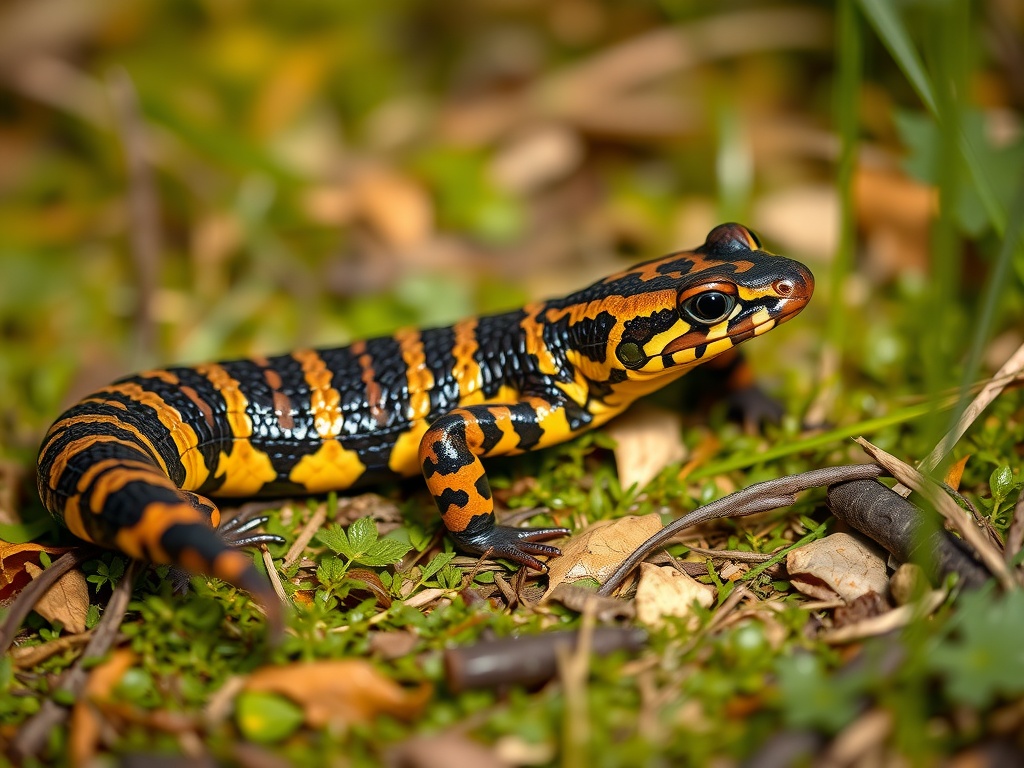
The Eastern Tiger Salamander is one of the largest terrestrial salamanders in North America, known for its striking yellow or olive blotches on a dark background. This secretive amphibian spends most of its life underground, surfacing mainly during rainy nights to breed in temporary ponds and wetlands. Its robust body, broad head, and long tail make it well-suited for burrowing. The species plays a significant ecological role by preying on insects and other small invertebrates, thus helping control their populations.
Fascinating facts
Rainy Breeders
Eastern Tiger Salamanders migrate en masse to breeding ponds during rainy spring nights, sometimes traveling long distances from their burrows.
Impressive Regeneration
They can regenerate lost limbs, tails, and even parts of internal organs, making them a subject of medical research.
Burrowing Experts
These salamanders are excellent diggers, constructing deep burrows to escape predators and harsh weather, often using tunnels made by small mammals.
Detailed description
The Eastern Tiger Salamander (Ambystoma tigrinum) is a robust, stocky amphibian, typically measuring 18–25 cm (7–10 in) in length, with some individuals reaching up to 33 cm (13 in), making it one of the largest terrestrial salamanders in North America. Its coloration is highly variable but generally consists of irregular yellow, olive, or cream blotches or bars on a dark brown to black background, providing effective camouflage among leaf litter and soil. The skin is smooth and moist, aiding in cutaneous respiration, which is critical for amphibians. The broad, flattened head houses large, lidless eyes adapted for low-light vision, while the muscular tail, comprising about one-third of the body length, assists in both locomotion and defense. Limbs are stout with well-developed digits, facilitating efficient burrowing. The species is primarily fossorial, spending most of its life in self-dug or mammal-made burrows up to 60 cm (2 ft) underground, which helps regulate moisture and temperature. Eastern Tiger Salamanders are solitary outside the breeding season, exhibiting nocturnal activity patterns. Their life span in the wild is typically 10–16 years, though captive individuals have lived over 20 years. This salamander is a keystone predator in its ecosystem, influencing invertebrate populations and serving as prey for larger animals.
Did you know?
Despite their large size and bold coloration, Eastern Tiger Salamanders are rarely seen because they spend up to 95% of their lives hidden underground.
Research & sources
Wikipedia summary
The tiger salamander is a species of mole salamander and one of the largest terrestrial salamanders in North America.
Behaviour & social structure
Eastern Tiger Salamanders are predominantly nocturnal, emerging from underground refuges during humid or rainy nights, especially in the breeding season. They are opportunistic carnivores, feeding on a wide range of invertebrates such as earthworms, insects, slugs, and occasionally small vertebrates like frogs or other salamanders. Hunting is primarily ambush-based; they rely on stealth and a rapid tongue flick to capture prey. Outside the breeding season, individuals are highly territorial and avoid conspecifics, minimizing competition and cannibalism. During the day, they remain hidden to avoid desiccation and predation. In breeding aggregations, some social interactions occur, including courtship displays and competition among males. Cannibalistic behavior is documented, particularly among larvae in ephemeral ponds where food is scarce.
Reproduction & life cycle
Breeding occurs in late winter to early spring (typically February to April), triggered by warm rains and rising temperatures. Adults migrate en masse to temporary vernal pools or fishless ponds, sometimes traveling over 1 km (0.6 mi) from their burrows. Males arrive first and engage in courtship rituals, including tail undulations and nudging. Fertilization is internal; males deposit spermatophores (sperm packets) on the substrate, which females pick up with their cloaca. Females lay 100–1,000 eggs in small clusters attached to submerged vegetation or debris. Embryonic development lasts 2–5 weeks, depending on water temperature. Larvae are fully aquatic, possessing external gills and a finned tail, and undergo metamorphosis after 2–5 months. In some populations, paedomorphosis occurs, where individuals retain larval features and remain aquatic as sexually mature adults. There is no parental care after egg deposition.
Adaptations & survival
Eastern Tiger Salamanders possess several adaptations for a fossorial lifestyle, including a robust body, strong limbs, and a wedge-shaped head for digging. Their skin secretes mucous to prevent desiccation and contains mild toxins as a deterrent to predators. The ability to absorb oxygen through the skin allows survival in low-oxygen burrows. Their breeding strategy—using ephemeral, fishless pools—reduces predation on eggs and larvae. Larvae exhibit facultative cannibalism, developing larger heads and teeth when food is scarce, which increases survival in crowded or resource-limited environments. Paedomorphosis allows persistence in permanent aquatic habitats where terrestrial migration is risky or impossible.
Cultural significance
Tiger salamanders have appeared in North American folklore and indigenous traditions, often symbolizing transformation and renewal due to their metamorphic life cycle. They are sometimes kept as pets and used in educational settings to demonstrate amphibian biology. In some regions, they have been used as fishing bait, though this practice is discouraged due to conservation concerns. Their striking appearance and secretive habits have inspired local myths, and they are occasionally featured in environmental campaigns highlighting the importance of wetland conservation.
Recent research
Recent research has focused on the genetic diversity and population structure of Ambystoma tigrinum, revealing significant regional variation and ongoing hybridization with related species, such as the Barred Tiger Salamander (A. mavortium). Studies on larval development have elucidated the environmental triggers and genetic mechanisms underlying paedomorphosis and cannibalistic morphs. Conservation genetics work is helping to identify isolated or vulnerable populations. Ongoing monitoring tracks the impacts of disease outbreaks and habitat alteration. The species is also used as a model organism for studying vertebrate limb regeneration, as salamanders possess remarkable regenerative abilities.
Videos
Habitat
Woodlands, grasslands, and marshy areas near temporary ponds or slow-moving freshwater bodies
 Various Continental Regions
Grassland
Open areas dominated by grasses rather than trees, supporting numerous herbivores and their predators.
 Global
Forest
Wooded areas with significant tree cover and diverse plant and animal communities.
 Global
Freshwater
Lakes, rivers, and wetlands with diverse aquatic ecosystems.
Conservation
The Eastern Tiger Salamander is currently classified as Least Concern on the IUCN Red List.
Threats & challenges
Although currently listed as Least Concern, Eastern Tiger Salamander populations face several threats. Habitat loss and fragmentation due to agriculture, urbanization, and road construction disrupt migration routes and breeding sites. Pollution, particularly from pesticides and fertilizers, can degrade aquatic habitats and reduce larval survival. Introduction of fish to breeding ponds increases predation on eggs and larvae. Emerging infectious diseases, such as chytridiomycosis and ranavirus, pose significant risks. Road mortality during breeding migrations is a documented concern. Climate change may alter precipitation patterns, affecting the availability and duration of breeding ponds.
Taxonomy
Scientific name
Ambystoma tigrinum
- Kingdom
- Animalia
- Phylum
- Chordata
- Class
- Amphibia
- Order
- Urodela
- Family
- Ambystomatidae
- Genus
- Ambystoma
- Species
- tigrinum
Where to see an eastern tiger salamander
5 zoos and aquariums in 2 countries are recorded as keeping this species.
 Calgary Zoo🇨🇦 Calgary, Canada
- 🦁The Maryland Zoo in Baltimore🇺🇸 Baltimore, United States
 Louisville Zoo🇺🇸 United States
 Santa Ana Zoo at Prentice Park🇺🇸 Santa Ana, United States
- 🦁Lake Superior Zoo🇺🇸 Duluth, United States
Community notes
Share your observations about the Eastern Tiger Salamander.
No community notes yet. Be the first!
Discover more wildlife
More fascinating animals from the encyclopedia.