
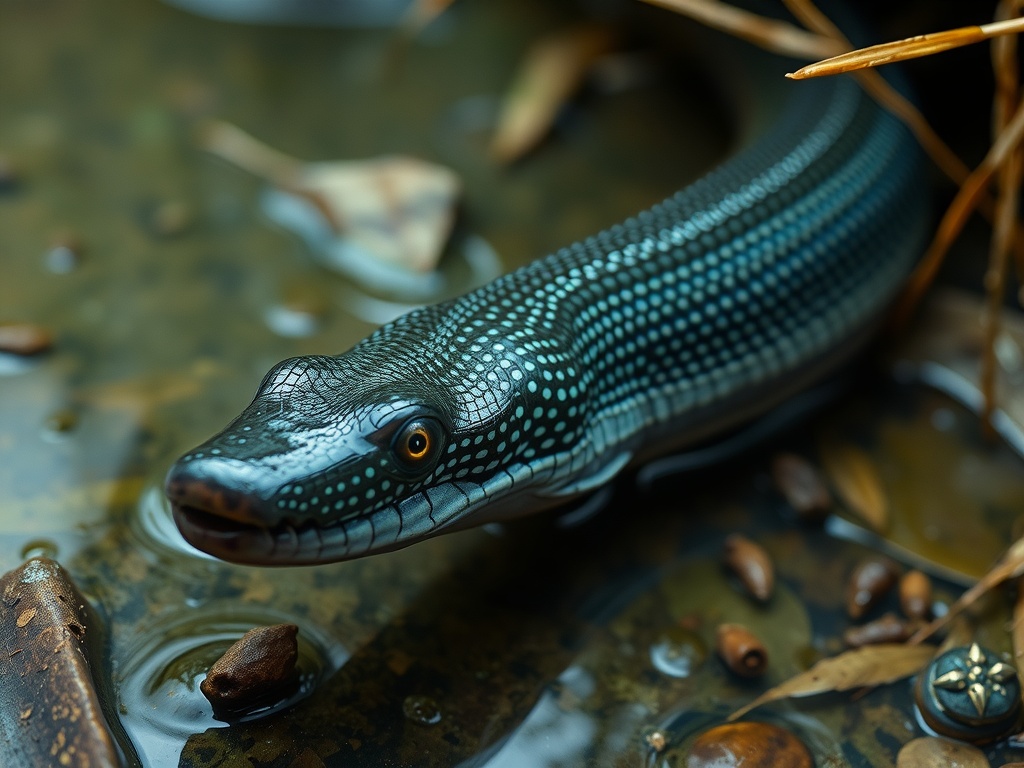
About the Electric eel
The electric eel is not an eel — it is a knifefish, more closely related to catfish — and its electricity does far more than stun. Three specialised organs, built from stacked cells called electrocytes that discharge like batteries wired in series, run most of the length of its body. Low-voltage pulses fire constantly for electrolocation and communication, letting it navigate and hunt in muddy Amazonian water where eyesight is close to useless. The high-voltage discharge, which can exceed eight hundred volts, is the weapon — and the eel does not merely electrocute. It fires paired pulses that remotely trigger the motor neurons of hidden fish, forcing an involuntary twitch that betrays their position, then delivers a volley that locks the prey in whole-body cramp so it cannot flee. Its own vital organs are packed into a small section behind the head and much of its body is insulated, so it is largely unharmed by its own discharge. Cornered by a large land animal, it will leap from the water and press its chin against the threat, driving the shock directly into it rather than losing it to the surrounding water.
Fascinating facts
Electrifying Power
An electric eel can release a shock of up to 600 volts, making it one of the most powerful bioelectric generators in the animal kingdom.
Air Breather
Electric eels must surface every 10-15 minutes to gulp air because they absorb about 80% of their oxygen through a highly vascularized mouth lining.
Not a True Eel
Despite their name and appearance, electric eels are actually knifefish and are more closely related to catfish than to true eels.
Detailed description
The electric eel (Electrophorus electricus) is a large, elongated freshwater fish native to the river systems of northern South America, particularly the Amazon and Orinoco basins. Despite its common name, it is not a true eel but a member of the knifefish order (Gymnotiformes), distinguished by its cylindrical, scaleless body, flattened head, and a long anal fin that runs nearly the entire length of its body, allowing for precise backward and forward movement. Adult electric eels can reach lengths of up to 2.5 meters (8.2 feet) and weigh over 20 kilograms (44 pounds). The species is renowned for its three pairs of specialized abdominal organs—the main organ, Hunter's organ, and Sachs' organ—which together comprise about 80% of its body and are responsible for generating powerful electric discharges. These organs contain thousands of electrocytes, modified muscle cells that can produce both high-voltage (up to 860 volts) and low-voltage electrical pulses. Electric eels are obligate air-breathers, surfacing every 10–15 minutes to gulp air due to the low oxygen content of their habitats. Their skin is thick and mucous-covered, providing some protection against their own electric shocks. The species is primarily nocturnal, relying on electrolocation to navigate and hunt in turbid waters. Their coloration is typically dark gray to brown dorsally, with a lighter yellow or orange ventral side. Electric eels are solitary and territorial, especially during the breeding season, and are apex predators within their ecological niche.
Did you know?
Despite their name, electric eels are not true eels but belong to the knifefish family.
Research & sources
Wikipedia summary
The electric eels are a genus, Electrophorus, of neotropical freshwater fish from South America in the family Gymnotidae, of which they are the only members of the subfamily Electrophorinae. They are known for their ability to stun their prey by generating electricity, delivering shocks at up to 860 volts. Their electrical capabilities were first studied in 1775, contributing to the invention of the electric battery in 1800.
Behaviour & social structure
Electric eels are predominantly solitary and display crepuscular to nocturnal activity patterns, becoming most active at dusk and during the night. They use low-voltage electric fields for navigation, communication, and passive electrolocation, constantly emitting weak pulses to sense their environment and detect prey or obstacles. When hunting, electric eels employ a unique strategy: they deliver rapid bursts of high-voltage discharges to stun or immobilize prey such as fish, amphibians, crustaceans, and occasionally small mammals. They often use a 'doublet'—two quick high-voltage pulses—to induce involuntary muscle contractions in prey, making them easier to locate and capture. Social interactions are minimal outside of the breeding season, and individuals are known to be aggressive toward conspecifics, especially in confined spaces. Electric eels spend much of their day resting in submerged vegetation or muddy bottoms, surfacing periodically to breathe. They are capable of leaping partially out of the water to deliver shocks to potential threats, a behavior documented in defensive encounters with predators or humans.
Reproduction & life cycle
Breeding in electric eels typically occurs during the dry season (June to December), when receding water levels concentrate individuals in smaller pools. Males construct nests in soft mud or among submerged vegetation, where females deposit between 1,200 and 17,000 eggs, depending on their size and condition. After spawning, males guard the nest and provide parental care, aerating the eggs by fanning them with their bodies and defending the site from intruders. Incubation lasts approximately 7 to 10 days, after which the larvae hatch and remain in the nest for several days, absorbing their yolk sacs. The male may continue to protect the fry for a short period, but parental care is generally limited. Sexual maturity is reached at around 1.5 to 2 years of age, with growth rates influenced by environmental conditions and food availability.
Adaptations & survival
Electric eels possess several remarkable adaptations for survival in their challenging habitat. Their most notable adaptation is the development of large electric organs, which allow for both high-voltage discharges (for predation and defense) and low-voltage pulses (for navigation and communication). The ability to generate electricity evolved as a response to the murky, low-visibility waters of the Amazon, where vision is limited. Their elongated, flexible bodies and long anal fin enable precise maneuvering in dense aquatic vegetation. As obligate air-breathers, they have highly vascularized buccal cavities that facilitate oxygen uptake from air, an adaptation to hypoxic (low-oxygen) environments. Their thick, mucous-covered skin provides some insulation against their own electric shocks and helps prevent dehydration. Behavioral adaptations include nocturnal activity to avoid diurnal predators and the use of electrolocation to detect prey hidden in mud or under debris.
Cultural significance
Electric eels have fascinated humans for centuries, featuring prominently in indigenous folklore and early scientific inquiry. In Amazonian cultures, they are often regarded with awe and caution, sometimes associated with supernatural powers or used as metaphors for strength and danger. The study of electric eels by European naturalists in the 18th century, notably by Alexander von Humboldt and Michael Faraday, contributed to foundational discoveries in bioelectricity and inspired the invention of the Voltaic pile, the precursor to the modern battery. Today, electric eels are popular exhibits in public aquariums and continue to inspire research in bioengineering and robotics.
Recent research
Recent genetic studies have revealed that what was once considered a single species, Electrophorus electricus, is actually a complex of at least three distinct species: E. electricus, E. voltai, and E. varii, each with unique geographic ranges and electrical capabilities (de Santana et al., 2019). Ongoing research is focused on the molecular mechanisms of electrocyte function, the evolution of electric organs, and the ecological role of electric eels in shaping fish communities. Studies have also explored the potential biomedical applications of electric eel-derived proteins and the development of bio-inspired power sources. Behavioral experiments have documented sophisticated hunting strategies, including the use of high-frequency electrical pulses to track and manipulate prey movement.
Sources
Videos
Habitat
Freshwater rivers and swamps

Conservation
The Electric eel is currently classified as Least Concern on the IUCN Red List.
Threats & challenges
Currently, the electric eel is classified as 'Least Concern' by the IUCN, with stable populations across its range. However, localized threats exist, including habitat degradation from deforestation, dam construction, water pollution, and the draining of wetlands. Overfishing and capture for the aquarium trade are minor concerns but are not believed to significantly impact wild populations. Climate change poses a potential long-term threat by altering hydrological cycles and reducing suitable habitat. Despite these challenges, the species' broad distribution and adaptability to a range of freshwater environments help buffer it against significant population declines.
Taxonomy
Scientific name
Electrophorus electricus
- Kingdom
- Animalia
- Phylum
- Chordata
- Class
- Actinopterygii
- Order
- Gymnotiformes
- Family
- Gymnotidae
- Genus
- Electrophorus
- Species
- electricus
Where to see an electric eel
7 zoos and aquariums in 1 country are recorded as keeping this species.
 Dallas World Aquarium🇺🇸 Dallas, United States
 Georgia Aquarium🇺🇸 Atlanta, United States
 National Aquarium🇺🇸 Baltimore, United States
 New England Aquarium🇺🇸 Boston, United States
 Memphis Zoo🇺🇸 Memphis, United States
Community notes
Share your observations about the Electric eel.
No community notes yet. Be the first!
Discover more wildlife
More fascinating animals from the encyclopedia.