
About the Emperor Tamarin
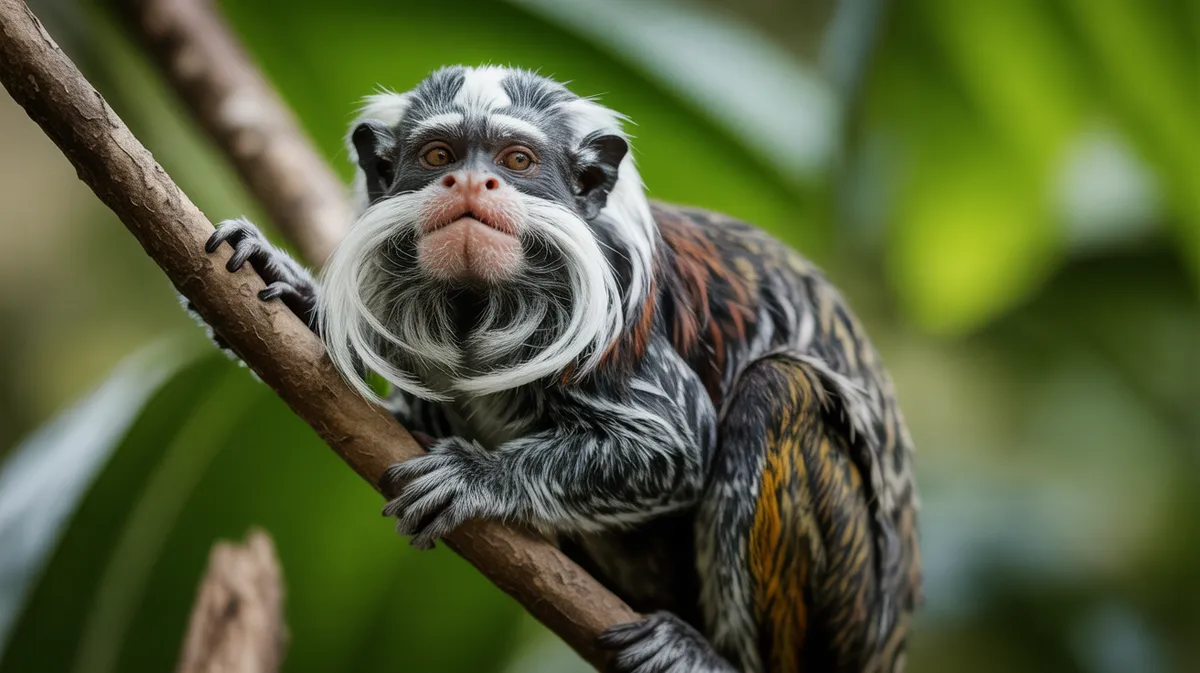
Saguinus imperator is a squirrel-sized Amazonian monkey with a long white handlebar moustache that sweeps down past its shoulders, and the name really was a joke — the type specimen's whiskers reminded nineteenth-century naturalists of Kaiser Wilhelm II, and the mock-imperial name stuck. Beyond the moustache, its most interesting behaviour is social and it involves another species entirely: emperor tamarins routinely travel, forage and sleep in permanent mixed troops with saddleback tamarins. The two are not competing, because they exploit different levels of the forest — the emperor works the higher, thinner branches while the saddleback searches trunks and the understorey — and both benefit because each has learned to respond to the other's alarm calls, effectively doubling the number of eyes watching for hawks. Emperor tamarins have claws instead of nails on most digits, which lets them cling to bark, and they eat fruit, nectar, tree sap and insects. Their breeding system is unusual for a primate: a single female typically mates with more than one male, gives birth to twins that are heavy relative to her own body, and the males do most of the carrying, handing the infants back only to nurse.
Fascinating facts
Iconic Mustache
The Emperor Tamarin’s long, curling white mustache is present in both males and females and is believed to play a role in social communication.
Arboreal Lifestyle
They are highly arboreal, rarely descending to the forest floor, and use their long tails for balance while leaping between branches.
Cooperative Parenting
Entire family groups, including fathers and older siblings, participate in caring for the young, which is unusual among primates.
Detailed description
The Emperor Tamarin (Saguinus imperator) is a diminutive New World monkey, measuring approximately 23–26 cm (9–10 in) in body length, with a tail that can reach up to 35–41.5 cm (14–16.3 in). Adults typically weigh between 500 and 600 grams (1.1–1.3 lbs). Its most striking feature is the long, white, drooping mustache, which extends beyond the shoulders and is present in both sexes, although males may have slightly more pronounced facial hair. The fur is predominantly grayish with yellowish speckles, a reddish-brown tail, and black hands and feet. Emperor Tamarins are highly arboreal, spending most of their lives in the dense upper and middle canopies of Amazonian rainforests, where their slender bodies and long tails aid in agile movement through the branches. Social by nature, they live in cohesive groups of 2–15 individuals, often composed of a dominant breeding female, several males, and their offspring. Communication is complex, involving high-pitched whistles, trills, and visual displays. Their diet is omnivorous, consisting of fruits, nectar, flowers, insects, small vertebrates, and bird eggs. Emperor Tamarins exhibit cooperative breeding, with group members assisting in the care of young. Their keen vision and tactile sensitivity are crucial for foraging and navigating their three-dimensional environment.
Did you know?
Both male and female Emperor Tamarins help care for the offspring, with fathers and siblings often carrying the young on their backs almost as much as the mothers do.
Research & sources
Wikipedia summary
The emperor tamarin is a species of tamarin monkey allegedly named for its beard's resemblance to the German emperor Wilhelm II. It lives in the north Brazilian states of Acre and Amazonas and the southwest Amazon Basin, in east Peru, north Bolivia.
Behaviour & social structure
Emperor Tamarins are diurnal, with activity peaking shortly after sunrise and tapering off before dusk. They spend the majority of their day foraging, traveling up to 2 km (1.2 mi) daily in search of food. Foraging is a group activity, with individuals using their dexterous hands to extract insects from bark crevices or pluck fruit. Social grooming is frequent and serves to reinforce group cohesion and hierarchy. The species is known for its playful behavior, including chasing, wrestling, and vocalizing. Territorial boundaries are maintained through scent marking and vocal displays, though home ranges may overlap with those of other tamarin species, leading to occasional mixed-species associations. Alarm calls are used to warn of predators such as raptors, snakes, and felids. At night, groups sleep together in dense foliage or tree hollows for protection.
Reproduction & life cycle
Emperor Tamarins exhibit a polyandrous mating system, where one dominant female mates with multiple males within the group. The breeding season varies geographically but often coincides with the rainy season when food is abundant. Gestation lasts about 140–145 days, typically resulting in twins, though singletons and triplets can occur. The dominant female is the primary breeder, and subordinate females are often reproductively suppressed through social and pheromonal cues. All group members, including males and juveniles, participate in infant care, carrying the young and sharing food. Infants are weaned at around 2–3 months and reach sexual maturity at 16–20 months. Cooperative care increases infant survival and allows the dominant female to reproduce more frequently.
Adaptations & survival
Emperor Tamarins have several adaptations for arboreal life, including elongated fingers and claws (tegulae) instead of nails, which provide a strong grip on branches. Their lightweight bodies and long, non-prehensile tails aid in balance and agile leaping between trees. Keen color vision helps them identify ripe fruits and detect predators. Social cooperation, particularly in rearing young and foraging, enhances group survival. Their vocal repertoire is adapted for dense forest environments, with high-frequency calls that travel well through thick vegetation. Scent glands on the chest and genitalia are used for marking territory and communicating reproductive status.
Cultural significance
The Emperor Tamarin is named for its mustache, which is said to resemble that of German Emperor Wilhelm II. This distinctive appearance has made it a popular subject in zoos and wildlife documentaries, often symbolizing the unique biodiversity of the Amazon. In local folklore, tamarins are sometimes regarded as playful spirits of the forest, though there is limited evidence of direct use in indigenous rituals or traditional medicine. Their charismatic appearance has contributed to conservation awareness campaigns in South America and beyond.
Recent research
Recent studies have focused on the genetic diversity and phylogeography of Saguinus imperator, revealing significant variation between subspecies (S. i. imperator and S. i. subgrisescens). Research on their vocal communication has uncovered a complex system of calls used for group coordination and predator alerts. Ongoing fieldwork investigates the ecological role of Emperor Tamarins in seed dispersal and forest regeneration. Behavioral ecologists are examining the dynamics of cooperative breeding and the hormonal mechanisms underlying reproductive suppression among females. Conservation biologists are monitoring population trends using camera traps and genetic sampling to inform management strategies.
Videos
Habitat
Tropical rainforest


Conservation
The Emperor Tamarin is currently classified as Least Concern on the IUCN Red List.
Threats & challenges
While currently listed as Least Concern by the IUCN, Emperor Tamarins face ongoing threats from habitat loss due to deforestation, logging, and agricultural expansion in the Amazon Basin. Fragmentation of forest habitats can isolate populations, reducing genetic diversity and increasing vulnerability to disease. Illegal pet trade and hunting, though less significant than habitat destruction, also pose risks. Climate change may alter the distribution of food resources and suitable habitat. Conservation challenges include enforcing protected areas, promoting sustainable land use, and mitigating human-wildlife conflict. Population trends are stable in some regions but declining in areas with intense human activity.
Taxonomy
Scientific name
Saguinus imperator
- Kingdom
- Animalia
- Phylum
- Chordata
- Class
- Mammalia
- Order
- Primates
- Family
- Callitrichidae
- Genus
- Saguinus
- Species
- imperator
Where to see an emperor tamarin
13 zoos and aquariums in 5 countries are recorded as keeping this species.
 Belfast Zoo🇬🇧 Belfast, United Kingdom
 Leipzig Zoological Garden🇩🇪 Leipzig, Germany
 Zoo am Meer🇩🇪 Bremerhaven, Germany
 Zoo Dresden🇩🇪 Dresden, Germany
 Birmingham Wildlife Conservation Park🇬🇧 Birmingham, United Kingdom
Community notes
Share your observations about the Emperor Tamarin.
No community notes yet. Be the first!
Discover more wildlife
More fascinating animals from the encyclopedia.