
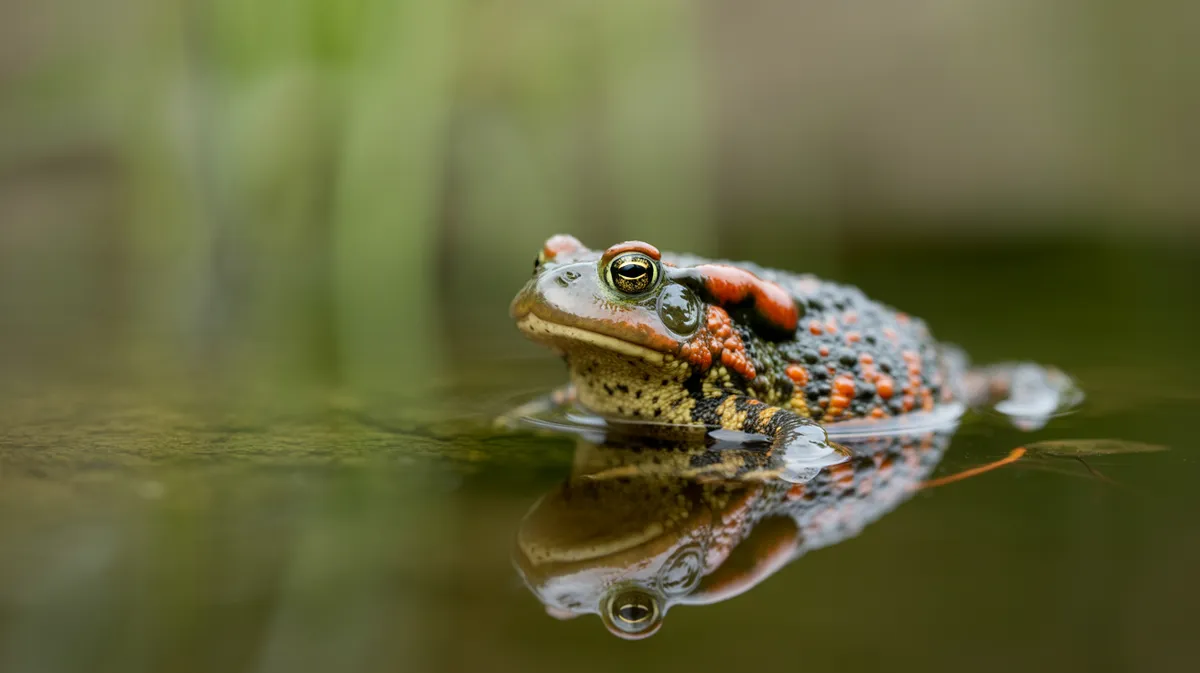
About the European Fire-bellied Toad
The European Fire-bellied Toad is a small, brightly colored amphibian known for its vibrant orange-red belly, which it displays as a warning to predators. Its back is covered in warty, olive-green skin with dark spots, providing excellent camouflage in its aquatic habitat. This species is semi-aquatic, spending much of its life in shallow ponds, marshes, and slow-moving streams across Eastern and Central Europe. European Fire-bellied Toads are famous for their distinctive 'unken reflex,' where they arch their bodies to show off their warning coloration when threatened.
Fascinating facts
Warning Colors
The toad's fiery belly coloration is a classic example of aposematism, warning predators of its toxic skin secretions.
Aquatic Lifestyle
European Fire-bellied Toads spend most of their time in water, preferring shallow wetlands and ponds with abundant vegetation.
Unique Call
Males produce a low, melodic call during mating season that can sound like a musical whistle echoing over ponds and marshes.
Detailed description
The European Fire-bellied Toad (Bombina bombina) is a small, robust amphibian, typically measuring 3.5–5.0 cm in length, with females generally larger than males. Its dorsal surface is olive-green to brownish, mottled with dark spots and covered in prominent warts, which secrete mild toxins. The ventral side is strikingly colored with irregular patches of bright red, orange, or yellow on a dark bluish-black background, serving as a warning to potential predators (aposematism). The head is broad with protruding eyes and a short, rounded snout. This species possesses partially webbed toes, facilitating efficient swimming in its preferred aquatic habitats. Bombina bombina is semi-aquatic, spending much of its life in shallow, stagnant or slow-moving water bodies such as ponds, marshes, and oxbow lakes, but it is also capable of limited terrestrial activity. Its skin is kept moist through frequent immersion, and it relies on cutaneous respiration in addition to lungs. The species is known for its distinctive 'unken reflex,' where it arches its back and limbs to display its vivid belly when threatened. European Fire-bellied Toads are primarily crepuscular, being most active at dawn and dusk, and their unique 'whoop' call is used by males during the breeding season to attract females and establish territories. Lifespan in the wild is typically 10–12 years, though individuals in captivity may live up to 20 years.
Did you know?
The bright belly of the European Fire-bellied Toad acts as a warning sign, signaling to predators that it is toxic and unpalatable.
Research & sources
Wikipedia summary
The European fire-bellied toad is a species of fire-bellied toad native to eastern parts of mainland Europe, where it can be found near waterbodies such as ponds and marshes. It is known for its red colored belly used to ward off predators, an example of aposematism, and its distinctive "whoop" call.
Behaviour & social structure
European Fire-bellied Toads are opportunistic carnivores, feeding on a variety of invertebrates such as insects, spiders, worms, and small crustaceans. They employ a sit-and-wait hunting strategy, remaining motionless until prey comes within range, then striking rapidly with their sticky tongues. Social interactions are generally limited outside the breeding season, with individuals displaying territoriality, especially males during mating periods. Aggressive encounters are rare but may involve vocalizations and physical posturing. These toads are most active during twilight hours, spending daylight hidden among aquatic vegetation or submerged. They exhibit seasonal behaviors, including hibernation during colder months, typically burrowing into mud at the bottom of ponds or in damp terrestrial refuges. Group basking has been observed, likely for thermoregulation. Their skin secretions deter most predators, but some birds and snakes have developed partial resistance.
Reproduction & life cycle
Breeding occurs from late April to July, triggered by rising water temperatures and increased daylight. Males congregate in shallow water and produce a melodic, repetitive 'whoop' call to attract females. Amplexus (mating embrace) is axillary, with the male grasping the female behind her forelimbs. Females lay between 80 and 300 eggs per season, depositing them singly or in small clusters on submerged vegetation. Embryonic development is rapid, with eggs hatching within 2–10 days depending on temperature. Larval (tadpole) stage lasts 6–12 weeks, during which tadpoles feed on algae, detritus, and small aquatic organisms. Metamorphosis into juvenile toads occurs by late summer. There is no parental care post-oviposition; survival is largely dependent on environmental conditions and predation rates.
Adaptations & survival
Bombina bombina exhibits several adaptations for its semi-aquatic lifestyle. Its bright ventral coloration, combined with the unken reflex, is a classic example of aposematism, warning predators of its toxic skin secretions containing bombesin and other peptides. The toad's warty dorsal skin provides camouflage and additional protection. Webbed hind feet enhance swimming ability, while its flattened body allows for easy movement in shallow water. Cutaneous respiration supplements lung breathing, especially during hibernation or when submerged. The species' call is adapted for transmission over water, and its reproductive strategy of laying eggs on vegetation reduces predation risk. Hibernation in mud or damp terrestrial sites allows survival through harsh winters.
Cultural significance
The European Fire-bellied Toad has featured in local folklore and mythology, often associated with rain and fertility due to its aquatic habits and distinctive calls. In some Eastern European cultures, its bright coloration and toxicity have led to beliefs about magical or medicinal properties, though there is no scientific basis for such uses. The species is occasionally kept in captivity as an educational or display animal, valued for its striking appearance and relatively hardy nature. Its role as a bioindicator of wetland health has increased its importance in conservation education and ecological monitoring.
Recent research
Recent research on Bombina bombina has focused on hybrid zones with Bombina variegata, providing insights into speciation, gene flow, and reproductive isolation. Studies on skin peptides have revealed antimicrobial properties, with potential biomedical applications. Conservation genetics work is ongoing to assess population structure and the impacts of habitat fragmentation. Ecotoxicological studies have examined the effects of agricultural pollutants on larval development and adult health. Acoustic studies continue to analyze the evolution and function of mating calls. Long-term monitoring projects are tracking population trends in response to climate change and land-use alterations.
Videos
Habitat
Freshwater wetlands


Conservation
The European Fire-bellied Toad is currently classified as Least Concern on the IUCN Red List.
Threats & challenges
Although currently classified as Least Concern by the IUCN, Bombina bombina faces several threats. Habitat loss and fragmentation due to agricultural expansion, drainage of wetlands, and urbanization are primary concerns. Pollution from pesticides, fertilizers, and industrial runoff negatively impacts water quality and larval development. Introduction of predatory fish and invasive species, such as the American mink, increases predation pressure. Hybridization with the closely related Yellow-bellied Toad (Bombina variegata) in overlapping ranges may affect genetic integrity. Climate change poses additional risks by altering hydrological regimes and breeding phenology. Despite these challenges, some populations remain stable, but localized declines have been documented, particularly in Western Europe.
Taxonomy
Scientific name
Bombina bombina
- Kingdom
- Animalia
- Phylum
- Chordata
- Class
- Amphibia
- Order
- Anura
- Family
- Bombinatoridae
- Genus
- Bombina
- Species
- bombina
Where to see an european fire-bellied toad
1 zoo and aquarium in 1 country are recorded as keeping this species.

Community notes
Share your observations about the European Fire-bellied Toad.
No community notes yet. Be the first!
Discover more wildlife
More fascinating animals from the encyclopedia.