
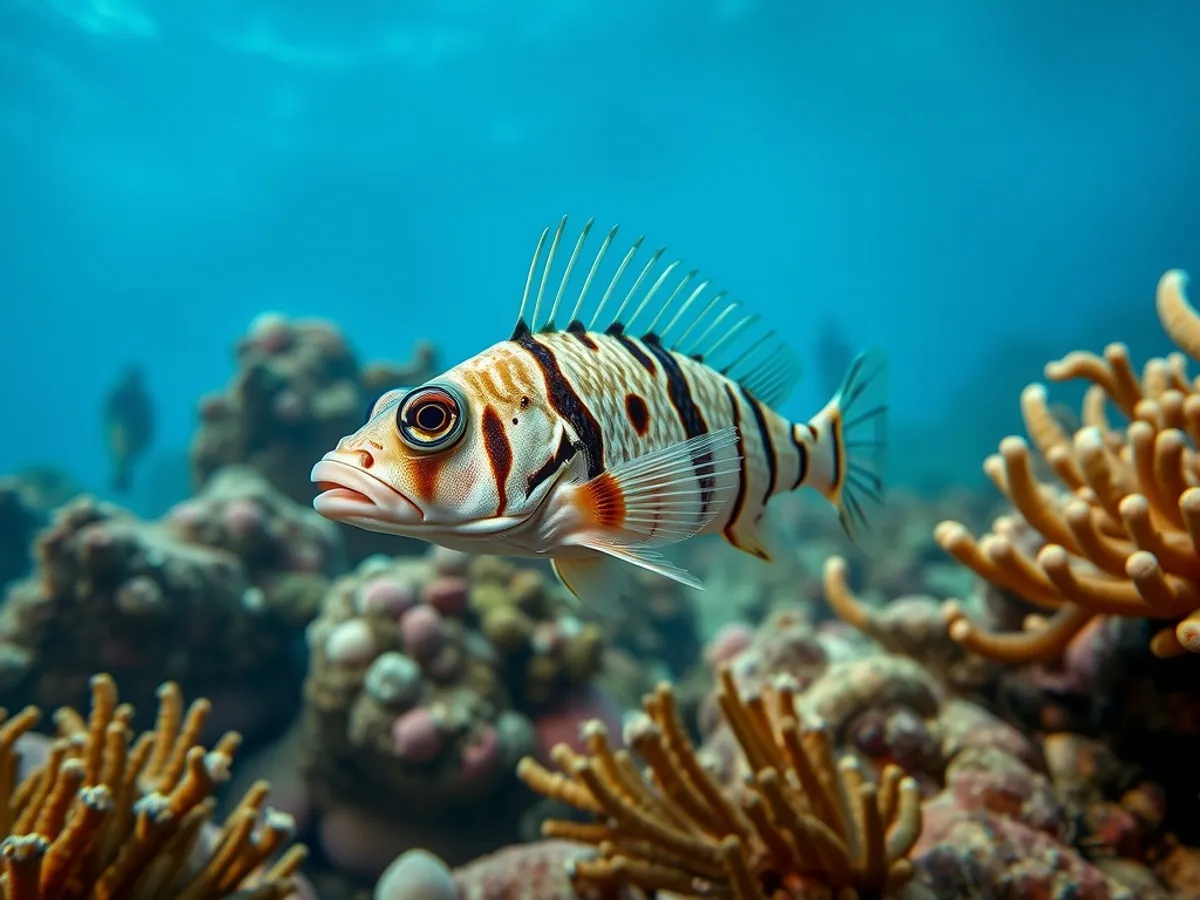
About the False cleanerfish
The false cleanerfish is a small, slender marine fish known for its extraordinary mimicry of the bluestreak cleaner wrasse. Sporting a similar blue and black stripe, it deceives other reef fish into approaching, expecting cleaning services. Instead of removing parasites, the false cleanerfish often takes advantage of the trust by nipping at the fins, skin, or scales of its 'clients.' This mimicry is a unique example of aggressive mimicry in the animal kingdom. It is commonly found on coral reefs throughout the Indo-Pacific region.
Fascinating facts
Master of Disguise
The false cleanerfish closely mimics the appearance and swimming behavior of the bluestreak cleaner wrasse to deceive other reef fish.
Aggressive Mimicry
Instead of cleaning, the false cleanerfish takes sneaky bites out of the fins, skin, or scales of fish that approach it.
Wide Distribution
False cleanerfish are found on coral reefs throughout the tropical Indo-Pacific, from East Africa to the central Pacific islands.
Detailed description
The false cleanerfish (Aspidontus taeniatus) is a slender, elongated marine blenny reaching up to 11–14 cm in length. Its body is laterally compressed and displays a striking color pattern: a prominent black lateral stripe bordered by electric blue, closely mimicking the coloration of the bluestreak cleaner wrasse (Labroides dimidiatus). The mouth is terminal and slightly upturned, equipped with comb-like teeth typical of blennies, adapted for scraping and nipping. The dorsal fin is long and continuous, running nearly the length of the back, while the pectoral and pelvic fins are well-developed for maneuvering among coral branches. This species is diurnal, spending daylight hours actively swimming in open water or hovering near cleaning stations on coral reefs. Unlike true cleaner wrasses, A. taeniatus does not form cleaning symbioses but instead exploits the trust of other reef fish through aggressive mimicry. Socially, it is usually solitary or found in loose aggregations, with individuals maintaining small home ranges. Reproduction is oviparous, with males guarding demersal eggs laid in crevices. The species is distributed widely across the Indo-Pacific, from the Red Sea and East Africa to the central Pacific, inhabiting shallow coral reefs at depths of 1–30 meters.
Did you know?
Despite their deceptive behavior, false cleanerfish rarely cause serious harm to their 'victims,' allowing them to maintain their ruse on the busy reef.
Research & sources
Wikipedia summary
The false cleanerfish is a species of combtooth blenny, a mimic that copies both the dance and appearance of Labroides dimidiatus, a similarly colored species of cleaner wrasse. It likely mimics that species to avoid predation, as well as to occasionally bite the fins of its victims rather than consume parasites. Most veiled attacks occur on juvenile fish, as adults that have been attacked in the past may avoid or even attack A. taeniatus.
Behaviour & social structure
Aspidontus taeniatus exhibits a highly specialized form of aggressive mimicry, closely imitating both the appearance and characteristic 'dance' of the bluestreak cleaner wrasse to deceive potential 'clients.' It approaches larger fish with a quivering motion, signaling a cleaning service, but instead delivers rapid bites to fins, scales, or skin, often removing tissue rather than parasites. This behavior is most successful with juvenile or naïve fish; experienced adults may recognize and avoid or even attack the mimic. Feeding is opportunistic, consisting primarily of fin and skin nips, but may also include small invertebrates. The false cleanerfish is territorial, defending small patches of reef, and is generally solitary outside of breeding periods. It is most active during daylight, retreating to crevices at night to avoid predators.
Reproduction & life cycle
Breeding in Aspidontus taeniatus occurs throughout the year in tropical regions, with peaks often correlated to lunar cycles and water temperature. Males establish and defend nesting sites within crevices or under rocks. Females lay adhesive, demersal eggs in these nests, and males provide sole parental care by guarding and aerating the eggs until hatching, which typically occurs within 5–7 days depending on temperature. There is no further parental involvement post-hatching; larvae are planktonic and undergo a pelagic phase before settling onto the reef as juveniles. Sexual maturity is reached at approximately 1 year of age.
Adaptations & survival
The most notable adaptation of A. taeniatus is its near-perfect mimicry of the bluestreak cleaner wrasse, both in coloration and behavior. This mimicry provides dual benefits: reducing predation risk by resembling a species with mutualistic relationships with larger fish, and facilitating access to prey by deceiving potential hosts. The comb-like dentition is adapted for scraping and nipping, ideal for its feeding strategy. Its slender, flexible body allows it to maneuver quickly among coral branches, aiding both in escape from predators and in approaching target fish. Behavioral plasticity enables it to adjust its mimicry based on local cleaner wrasse abundance and client fish recognition.
Cultural significance
While A. taeniatus does not have direct significance in human culture or mythology, its remarkable mimicry has made it a subject of fascination in scientific literature and public aquaria. It is frequently cited as a classic example of aggressive mimicry in evolutionary biology and is used in educational contexts to illustrate complex ecological interactions and the evolution of deceptive strategies.
Recent research
Recent research has focused on the cognitive abilities of reef fish in distinguishing between true cleaners and mimics, revealing that learning and memory play significant roles in client fish behavior. Studies using field observations and experimental manipulations have documented that the frequency and success of mimic attacks are influenced by local abundance of cleaner wrasse and prior experience of client fish. Ongoing research is investigating the genetic basis of mimicry and the ecological consequences of mimic abundance on reef community dynamics. There is also interest in the potential impacts of environmental change on the stability of mimic-model systems.
Videos
Habitat
Coral reefs

Conservation
The False cleanerfish is currently classified as Least Concern on the IUCN Red List.
Threats & challenges
Currently, Aspidontus taeniatus is classified as Least Concern by the IUCN, with stable populations across its range. However, it faces indirect threats from coral reef degradation due to climate change, ocean acidification, and anthropogenic impacts such as overfishing and pollution. Habitat loss may reduce available shelter and nesting sites. Additionally, overexploitation of cleaner wrasse for the aquarium trade could disrupt the mimicry system, potentially affecting the false cleanerfish's survival strategy.
Taxonomy
Scientific name
Aspidontus taeniatus
- Kingdom
- Animalia
- Phylum
- Chordata
- Class
- Actinopterygii
- Order
- Blenniiformes
- Family
- Blenniidae
- Genus
- Aspidontus
- Species
- taeniatus
Community notes
Share your observations about the False cleanerfish.
No community notes yet. Be the first!
Discover more wildlife
More fascinating animals from the encyclopedia.