
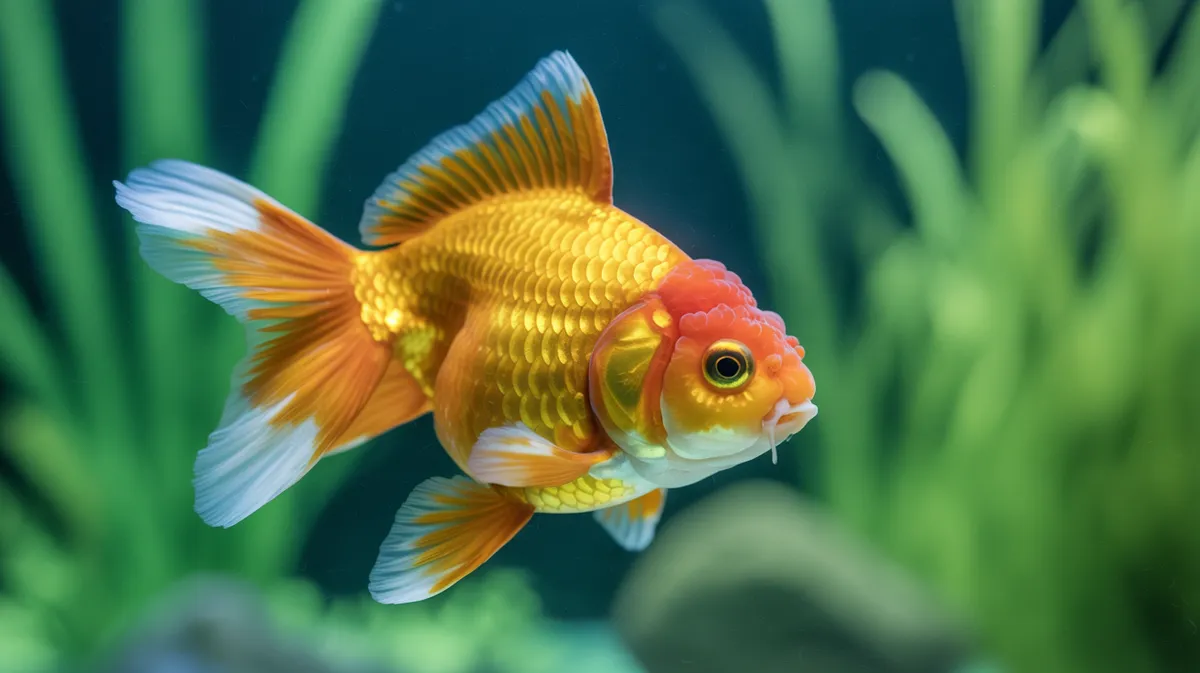
About the Fancy Goldfish
Fancy Goldfish are a group of ornamental varieties of the common goldfish, selectively bred for their unique shapes, colors, and fin configurations. They are characterized by features such as double tails, round or egg-shaped bodies, and vibrant hues ranging from orange and red to white, black, and calico. Popular varieties include the Oranda, Ryukin, Ranchu, and Telescope Eye. Fancy Goldfish are gentle, social fish that thrive in aquariums or outdoor ponds and require clean, well-oxygenated water. Due to their specialized body shapes, they often swim more slowly than other fish and are best kept with similar companions.
Fascinating facts
Colorful Varieties
Fancy Goldfish come in a dazzling array of colors and patterns, including metallic, matte, and calico types, making them popular among aquarium enthusiasts.
Special Care Needs
Due to their delicate fins and bodies, Fancy Goldfish should be kept in aquariums with smooth decorations and gentle filtration to prevent injury.
Social Nature
Fancy Goldfish are peaceful and social, often thriving in small groups with others of similar size and temperament.
Detailed description
Fancy Goldfish (Carassius auratus) are a domesticated form of the wild Prussian carp, selectively bred over centuries to produce a remarkable diversity of ornamental varieties. Anatomically, they are distinguished by their compact, often rounded or egg-shaped bodies, which can reach lengths of 15–20 cm (6–8 in) in captivity, though some varieties remain smaller. Their fins are highly variable, with many exhibiting elaborate double caudal (tail) fins, long flowing dorsal and anal fins, or unique features such as the bubble-like eye sacs of the Bubble Eye or the hooded cranial growths of the Oranda. Coloration is equally diverse, ranging from metallic gold, red, and orange to white, black, blue, chocolate, and calico patterns. Internally, Fancy Goldfish possess a single-chambered swim bladder, which, due to their body shape, can predispose them to buoyancy disorders. Behaviorally, they are gentle, social fish that thrive in groups and display complex social hierarchies. They are diurnal, actively foraging during the day and resting at night. Their sensory systems are well-developed, with acute vision and chemoreception aiding in food detection and social interactions. Reproductively, they are egg scatterers, with external fertilization and little to no parental care. Fancy Goldfish are highly adaptable to a range of freshwater environments but are sensitive to poor water quality due to their specialized anatomy. Their longevity is notable, with lifespans of 10–15 years common in well-maintained environments, and some individuals documented to live over 20 years.
Did you know?
Fancy Goldfish are descendants of wild Prussian carp and have been selectively bred for ornamental purposes in China for over 1,000 years.
Research & sources
Wikipedia summary
The goldfish is a freshwater fish in the family Cyprinidae of order Cypriniformes. It is commonly kept as a pet in indoor aquariums, and is one of the most popular aquarium fish. Goldfish released into the wild have become an invasive pest in parts of North America and Australia.
Behaviour & social structure
Fancy Goldfish are primarily bottom and mid-water foragers, using their sensitive barbels and olfactory senses to locate food particles among substrate and aquatic plants. In aquaria, they exhibit inquisitive, exploratory behaviors, often interacting with tank decorations and displaying learned responses to feeding routines, such as recognizing their caretakers. Socially, they form loose hierarchies, with dominant individuals often first to access food. Aggression is rare, but mild competition can occur, especially during feeding or breeding. They are known to engage in shoaling, preferring the company of conspecifics or similarly tempered fish. Daily routines include periods of active foraging interspersed with rest, typically at the bottom of the tank. Fancy Goldfish are not predatory but will consume small invertebrates, plant material, and detritus, reflecting their omnivorous diet. They may occasionally uproot plants or disturb substrate while searching for food.
Reproduction & life cycle
Breeding in Fancy Goldfish is typically triggered by seasonal changes in water temperature and photoperiod, simulating spring conditions. Males develop breeding tubercles (small white nodules) on their gill covers and pectoral fins, while females become visibly plumper with eggs. Courtship involves males chasing and nudging females to stimulate egg release. Spawning is external: females scatter hundreds to thousands of adhesive eggs onto plants or spawning mops, which are then fertilized by the males. Incubation lasts 3–7 days depending on temperature (optimal: 20–24°C/68–75°F). There is no parental care; adults may consume eggs and fry if not separated. Fry are initially transparent and develop coloration over several weeks. Selective breeding for specific traits requires careful management of breeding pairs and culling of offspring that do not meet desired standards.
Adaptations & survival
Fancy Goldfish exhibit several adaptations resulting from both natural and artificial selection. Their bright coloration and elaborate fins are products of selective breeding, serving no survival function in the wild but enhancing their appeal in captivity. Anatomically, their pharyngeal teeth are adapted for grinding a variety of foods, supporting their omnivorous diet. Behavioral plasticity allows them to thrive in diverse captive environments, and their tolerance for a range of water temperatures (4–30°C/39–86°F) is notable. However, their modified body shapes can impair swimming efficiency and buoyancy, making them less agile than wild-type goldfish. Enhanced social behaviors, such as shoaling and learned feeding responses, are advantageous in the context of captivity. Their ability to survive low-oxygen conditions for short periods is due to efficient gill function and, in extreme cases, the capacity for anaerobic metabolism.
Cultural significance
Goldfish have deep cultural roots, especially in East Asia, where they have been bred for over a thousand years. In China, they are symbols of wealth, prosperity, and good fortune, often featured in art, literature, and traditional celebrations. Japanese varieties, such as the Ranchu and Ryukin, are central to the practice of 'kingyo sukui' (goldfish scooping) at festivals. In Western cultures, goldfish are popular pets and have become symbols of domesticity and childhood. Their presence in mythology and folklore often associates them with transformation, luck, and abundance. Selective breeding has also made them a subject of scientific interest in genetics and developmental biology.
Recent research
Recent research on Fancy Goldfish has focused on the genetic basis of their morphological diversity, with studies identifying key genes involved in fin development, coloration, and cranial growths. Genome sequencing projects have provided insights into their domestication history and the effects of artificial selection. Behavioral studies have demonstrated their capacity for associative learning and memory, challenging assumptions about fish cognition. Veterinary research continues to address common health issues, such as swim bladder disease and infectious pathogens. Environmental impact studies monitor the spread and ecological effects of feral goldfish populations, informing management strategies.
Videos
Habitat
Freshwater aquariums and ponds

Conservation
The Fancy Goldfish is currently classified as Least Concern on the IUCN Red List.
Threats & challenges
In captivity, Fancy Goldfish face challenges related to their specialized anatomy, including susceptibility to swim bladder disorders, digestive issues, and fin damage. Poor water quality, overcrowding, and inadequate nutrition are significant threats to their health. In the wild, escaped or released goldfish can become invasive, outcompeting native species and disrupting local ecosystems, as observed in North America and Australia. Hybridization with wild Carassius species can also threaten native genetic diversity. While the species as a whole is listed as Least Concern by the IUCN, responsible pet ownership and prevention of releases are ongoing conservation challenges. Overbreeding for extreme traits can lead to compromised health and reduced lifespan in some varieties.
Taxonomy
Scientific name
Carassius auratus
- Kingdom
- Animalia
- Phylum
- Chordata
- Class
- Actinopterygii
- Order
- Cypriniformes
- Family
- Cyprinidae
- Genus
- Carassius
- Species
- auratus
Community notes
Share your observations about the Fancy Goldfish.
No community notes yet. Be the first!
Discover more wildlife
More fascinating animals from the encyclopedia.