
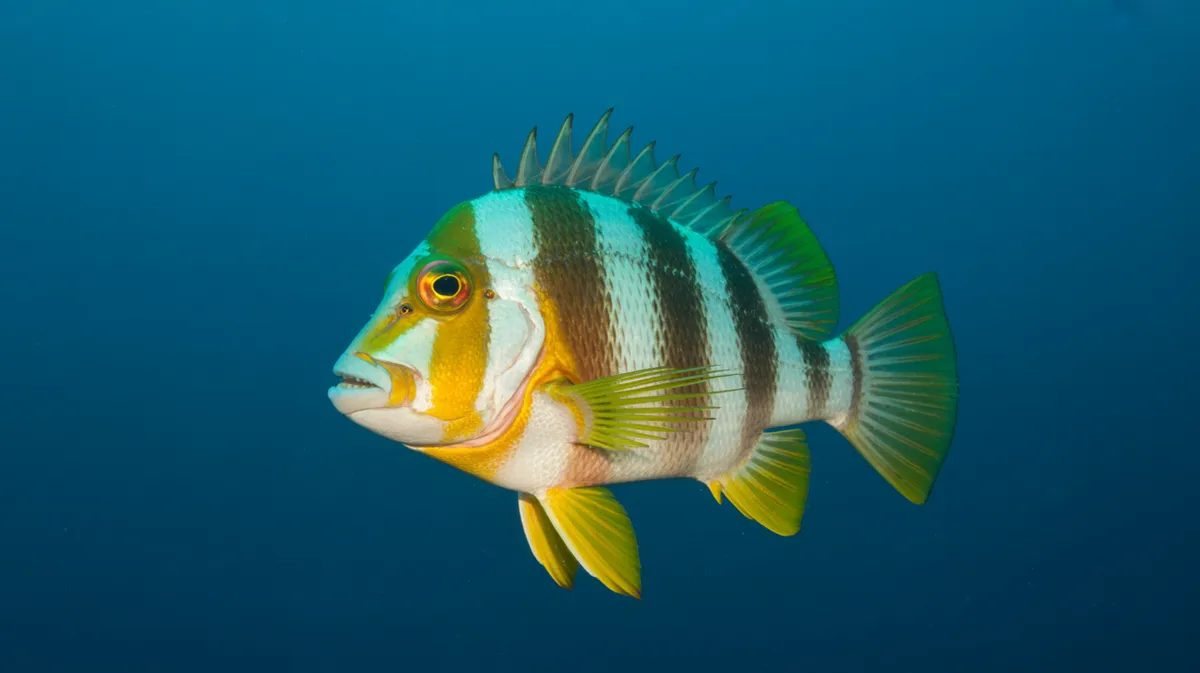
About the Fanfin Angler
The Fanfin Angler is a deep-sea anglerfish renowned for its extraordinary appearance, featuring long, filamentous fin rays and a bioluminescent lure used to attract prey in the darkness of the ocean depths. This species exhibits extreme sexual dimorphism, with tiny males attaching themselves to much larger females for reproduction. The fanfin angler is rarely observed due to its habitat at depths of up to 2,000 meters below the ocean surface. It is one of the most bizarre and elusive fish in the world, with a mouth full of sharp teeth and a soft, gelatinous body well adapted to high-pressure environments.
Fascinating facts
Bioluminescent Lure
The fanfin angler has a glowing lure protruding from its head, which it wiggles to attract unsuspecting prey in the pitch-black depths.
Extreme Sexual Dimorphism
Males are tiny compared to females and attach permanently to their mate, providing sperm in exchange for nutrients.
Deep Sea Specialist
Fanfin anglers are found at depths of 500 to 2,000 meters, in some of the most inhospitable regions of the ocean.
Detailed description
The Fanfin Angler (Caulophryne jordani) is a deep-sea anglerfish distinguished by its globular, soft-bodied form and an array of long, trailing fin rays that can extend several times the length of its body. Females, which can reach up to 24 cm in length, possess a prominent bioluminescent lure (esca) at the end of a modified dorsal fin spine (illicium) that is used to attract prey in the perpetual darkness of the deep ocean, typically between 500 and 2,000 meters. Their skin is gelatinous and lacks scales, an adaptation to the high-pressure, low-energy environment. The mouth is large and equipped with recurved, needle-like teeth, allowing them to consume prey nearly as large as themselves. Males are dramatically smaller, rarely exceeding 2-3 cm, and have reduced digestive systems; they are obligate sexual parasites, fusing permanently to the body of a female for reproduction. The female’s body supports the male, providing nutrients via a shared circulatory system. The Fanfin Angler is solitary except during the reproductive phase, and its slow metabolism is suited to the sparse food resources of the deep sea. Its coloration is typically dark brown or black, providing camouflage in the abyssal depths. Despite their bizarre appearance, fanfin anglers are highly specialized predators, playing a unique role in deep-sea ecosystems.
Did you know?
The male fanfin angler fuses with the female, sharing her bloodstream and essentially becoming a permanent parasite for reproduction.
Research & sources
Behaviour & social structure
Fanfin Anglers are ambush predators, remaining motionless and using their bioluminescent lure to attract small fish, crustaceans, and cephalopods. The light produced by symbiotic bacteria in the esca is manipulated by the fish, which can wiggle or pulse the lure to mimic the movements of prey or to attract curious animals. When prey approaches, the angler rapidly expands its jaws and creates a vacuum to engulf the target. They are primarily solitary, with no evidence of social grouping beyond the reproductive attachment of males to females. Their activity levels are very low, conserving energy in the nutrient-poor deep sea. There is no evidence of daily routines or migrations; they are thought to be largely sedentary, drifting or hovering just above the seafloor or in the water column.
Reproduction & life cycle
Reproduction in Caulophryne jordani is characterized by extreme sexual dimorphism and parasitic attachment. Tiny, free-swimming males use highly developed olfactory organs to locate females, attracted by pheromones or possibly the bioluminescent lure. Upon finding a female, the male bites into her skin and releases enzymes that dissolve the tissues at the point of contact, eventually fusing their circulatory systems. The male becomes dependent on the female for nutrition, losing his digestive organs and functioning solely as a sperm-producing appendage. Females may carry multiple males (up to eight have been recorded). Fertilization is external; the female releases eggs into the water, which are then fertilized by the attached male(s). Little is known about the development of eggs or larvae, but it is presumed that eggs are buoyant and hatch into free-living larvae before settling into deeper waters as they mature. There is no parental care beyond the provisioning of sperm by attached males.
Adaptations & survival
Fanfin Anglers exhibit several remarkable adaptations for deep-sea survival. Their gelatinous, low-density bodies aid in buoyancy and withstand immense hydrostatic pressures. The bioluminescent lure, powered by symbiotic bacteria, is a key adaptation for attracting prey in total darkness. Their expandable stomachs and large mouths allow them to exploit rare feeding opportunities by consuming prey up to half their own size. Reduced musculature and a slow metabolism minimize energy expenditure. The extreme sexual dimorphism and male parasitism ensure reproductive success in an environment where encounters with mates are exceedingly rare. Their dark coloration provides camouflage from both predators and prey in the abyssal zone.
Cultural significance
The Fanfin Angler has limited direct cultural significance due to its inaccessibility and rarity. However, it has become an icon of deep-sea biodiversity and adaptation, frequently featured in documentaries, scientific illustrations, and popular media as an example of the bizarre and alien life forms inhabiting the ocean's depths. It symbolizes the mysteries of the deep sea and the extremes of evolutionary adaptation. There are no known traditional uses or mythological associations.
Recent research
Recent research has focused on the unique reproductive biology of Caulophryne jordani, particularly the mechanisms of male-female fusion and the genetic basis of sexual dimorphism. Advances in deep-sea submersible technology have allowed for rare in situ observations, including the first video footage of a mating pair in 2016 (Widder et al., 2016). Studies on the microbiome of the bioluminescent lure have identified specific bacterial symbionts responsible for light production. Ongoing research aims to understand the ecological role of fanfin anglers in deep-sea food webs and the impacts of environmental change on their populations.
Sources
Deep-sea anglerfishes of the family Caulophrynidae: morphology, systematics, and reproductive biology
Theodore W. Pietsch (2009)
scientificFirst in situ observation of a deep-sea anglerfish pair: Caulophryne jordani
NOAA Okeanos Explorer (2016)
scientificFirst In Situ Observation of a Deep-Sea Anglerfish Pair: Caulophryne jordani
Ted Pietsch et al., Monterey Bay Aquarium Research Institute (2016)
scientificDeep-sea anglerfishes of the family Caulophrynidae: taxonomy, morphology, and reproductive biology
Theodore W. Pietsch (2009)
scientificVideos
Habitat
Deep ocean

Conservation
The Fanfin Angler is currently classified as Least Concern on the IUCN Red List.
Threats & challenges
Currently, Caulophryne jordani faces few direct threats due to its deep-sea habitat, which is largely inaccessible to fisheries and human activities. However, emerging threats include deep-sea trawling, mining, and pollution, which can disrupt fragile abyssal ecosystems. Climate change and ocean acidification may also impact deep-sea food webs and the distribution of prey species. Population trends are unknown due to the species' rarity and inaccessibility, but it is currently listed as Least Concern by the IUCN. The greatest conservation challenge is the lack of data on population size, reproductive rates, and ecological role.
Taxonomy
Scientific name
Caulophryne jordani
- Kingdom
- Animalia
- Phylum
- Chordata
- Class
- Actinopterygii
- Order
- Lophiiformes
- Family
- Caulophrynidae
- Genus
- Caulophryne
- Species
- jordani
Community notes
Share your observations about the Fanfin Angler.
No community notes yet. Be the first!
Discover more wildlife
More fascinating animals from the encyclopedia.