
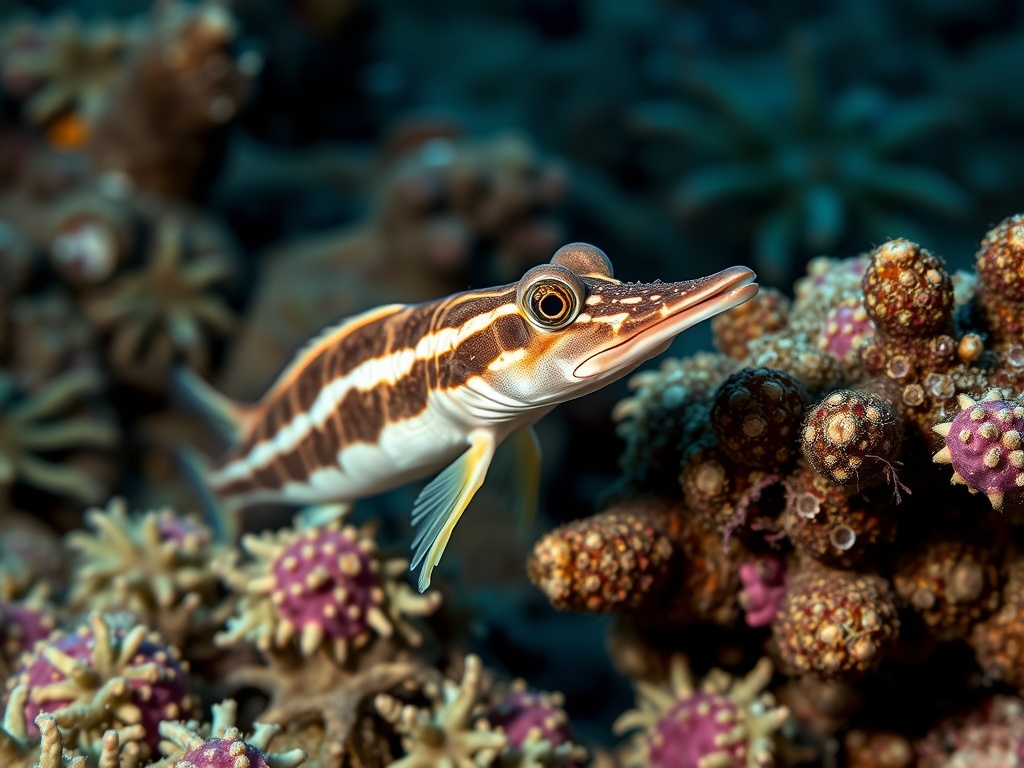
About the Fang blenny
The fang blenny is a small, vibrantly colored marine fish known for its elongated body and striking horizontal stripes. Native to the coral reefs of the Indo-Pacific region, this fish is renowned for its unique defense mechanism: venomous fangs located in its lower jaw. Fang blennies are generally peaceful but will defend themselves if threatened, utilizing their venom to deter predators. These fish are often found hiding among crevices and coral, making quick dashes to forage for food.
Fascinating facts
Venomous Fangs
Fang blennies are among the few fish that possess venomous fangs, which they use for self-defense rather than hunting.
Colorful Appearance
They display bold horizontal stripes and vibrant coloration, which can serve as both camouflage among reefs and a warning to predators.
Mimicry Masters
Some fang blenny species mimic non-venomous fish to get close to prey or avoid detection by predators.
Detailed description
The fang blenny (Meiacanthus grammistes), also known as the striped poison-fang blenny, is a small, slender marine fish reaching up to 11 cm in length. Its elongated body is adorned with bold, horizontal black stripes running from the snout to the caudal fin, set against a yellowish or whitish background, providing effective camouflage among coral branches. The head is slightly blunt with large, expressive eyes adapted for acute vision in complex reef environments. Most distinctive are its enlarged, grooved canine teeth in the lower jaw, which are connected to venom glands—a rare adaptation among small reef fishes. Fang blennies possess a continuous dorsal fin and a rounded caudal fin, aiding in agile, darting movements. Their skin secretes a protective mucus layer, which may play a role in chemical defense and reducing drag. Typically found at depths of 1–15 meters, they inhabit the outer slopes and lagoons of coral reefs across the Indo-West Pacific, from the Maldives and Indonesia to northern Australia and the Solomon Islands. Fang blennies are diurnal, spending daylight hours actively foraging and retreating to crevices when threatened. Their coloration and behavior make them both cryptic and conspicuous, serving as a warning to potential predators of their venomous capability.
Did you know?
Fang blenny venom is being studied for its potential use in developing new painkillers for humans.
Research & sources
Behaviour & social structure
Fang blennies are primarily solitary, though they may be observed in loose aggregations where shelter is abundant. They are territorial, defending small home ranges centered around crevices or holes in the reef. When foraging, they employ a rapid, darting swimming style, feeding on a varied diet that includes small crustaceans, zooplankton, and algae. Their omnivorous habits allow them to exploit a wide range of food resources. Fang blennies exhibit a unique defensive behavior: when threatened, they display their open mouths to reveal the prominent fangs, deterring would-be predators. If attacked, they can deliver a venomous bite, which causes hypotension and pain in predators, discouraging further predation. Social interactions are generally limited to brief territorial disputes or courtship displays, with males performing fin displays and body undulations to attract females. They are most active during the day, spending nights concealed within the reef structure.
Reproduction & life cycle
Meiacanthus grammistes is oviparous, with external fertilization. Breeding typically occurs during the warmer months, coinciding with increased food availability. Males establish and defend nesting sites within crevices or holes, where females are enticed to lay adhesive eggs. A single clutch may contain several hundred eggs, which the male guards and aerates by fanning with his fins. Incubation lasts approximately 5–7 days, after which the larvae hatch and become planktonic, drifting with currents for several weeks before settling onto the reef. Parental care is provided exclusively by the male, who continues to guard the eggs until hatching. There is no further parental investment once the larvae disperse.
Adaptations & survival
The most remarkable adaptation of the fang blenny is its venomous bite. The venom, delivered via grooved canine teeth, contains opioid-like peptides (grammistin and enkephalins) that induce a rapid drop in blood pressure and pain in predators, rather than causing tissue damage. This unique mechanism is thought to deter predation by making the blenny unpalatable and discouraging repeat attacks. Their bold coloration serves as aposematic (warning) signaling, advertising their venomous nature. Morphologically, their slender, flexible bodies and continuous fins enable rapid, agile movements through complex reef structures. Chemoreception and acute vision aid in locating food and detecting threats. Their ability to consume both animal and plant matter is an adaptation to the fluctuating availability of resources on coral reefs.
Cultural significance
Fang blennies have gained popularity in the marine aquarium trade due to their striking appearance and unique behaviors. They are often featured in public aquaria as examples of venomous reef fish and are used in educational programs to illustrate the diversity of reef adaptations. While they do not hold significant roles in traditional folklore or mythology, their venom has attracted scientific interest for its potential biomedical applications, particularly in pain management research.
Recent research
Recent studies have focused on the composition and function of fang blenny venom, revealing the presence of opioid-like peptides that act on vertebrate pain receptors, a rare trait among fish venoms. This discovery has sparked interest in the potential development of novel analgesics based on blenny venom components. Behavioral research has documented the effectiveness of aposematic coloration and mimicry in deterring predation, with some non-venomous reef fish evolving similar patterns to exploit the blenny's reputation. Ongoing research includes ecological studies on their role in reef food webs and the impact of environmental changes on their populations.
Videos
Habitat
Coral reefs

Conservation
The Fang blenny is currently classified as Least Concern on the IUCN Red List.
Threats & challenges
Currently, Meiacanthus grammistes is listed as Least Concern by the IUCN, with stable populations across its range. However, like many reef-associated species, it faces indirect threats from habitat degradation due to coral bleaching, ocean acidification, and destructive fishing practices. Collection for the aquarium trade is localized and not considered a major threat, as the species breeds readily in captivity. Climate change and declining reef health pose the most significant long-term risks, potentially reducing available habitat and food resources. There is no evidence of significant population decline at present, but ongoing monitoring is recommended.
Taxonomy
Scientific name
Meiacanthus grammistes
- Kingdom
- Animalia
- Phylum
- Chordata
- Class
- Actinopterygii
- Order
- Blenniiformes
- Family
- Blenniidae
- Genus
- Meiacanthus
- Species
- grammistes
Community notes
Share your observations about the Fang blenny.
No community notes yet. Be the first!
Discover more wildlife
More fascinating animals from the encyclopedia.