
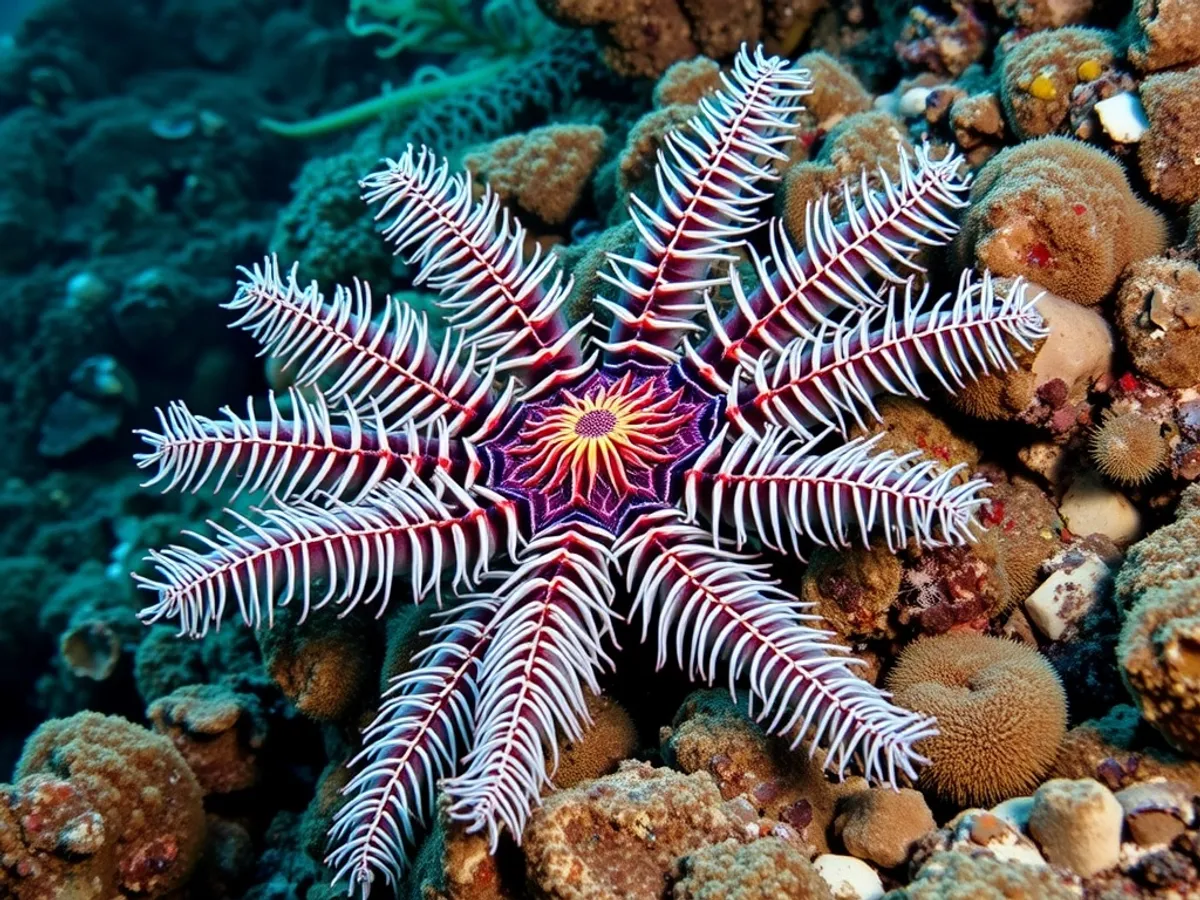
About the Feather Star
The Feather Star is a striking marine invertebrate known for its feathery, radiating arms that resemble a delicate underwater fern. Belonging to the class Crinoidea, it inhabits a variety of marine environments, from shallow reefs to deep-sea slopes. These animals are suspension feeders, using their branched arms to capture plankton and organic particles from the water. Remarkably, Feather Stars can move by crawling or even swimming short distances, a rare trait among echinoderms. Their vibrant colors and intricate body structures make them a fascinating and important part of marine biodiversity.
Fascinating facts
Regeneration Ability
Feather Stars can regenerate lost or damaged arms, an adaptation that helps them survive predator attacks.
Masters of Suspension Feeding
Their feathery arms are covered in sticky tube feet that trap plankton and organic matter drifting in the water.
Underwater Refuge
Small fish and shrimp often hide among the arms of Feather Stars for protection from predators.
Detailed description
Antedon bifida, commonly known as the Feather Star, is a distinctive crinoid echinoderm characterized by a central disc from which 10 highly branched, feathery arms radiate, reaching lengths of up to 10–15 cm. The arms are lined with pinnules, giving them a delicate, fern-like appearance and greatly increasing the surface area for filter feeding. Unlike their stalked relatives (sea lilies), adult Feather Stars are unstalked and attach themselves to substrates using claw-like cirri on their underside, which also allow for remarkable mobility. They are capable of both crawling and swimming by coordinated arm movements, a rare ability among echinoderms. The mouth is located on the upper (oral) surface, surrounded by ambulacral grooves that transport captured food particles. Feather Stars are primarily nocturnal, often hiding in crevices during the day and extending their arms at night to feed. Their coloration varies widely, from pale yellow and orange to deep red and brown, often providing camouflage among corals and algae. The species exhibits remarkable regenerative abilities, able to regrow lost arms, which is a key adaptation to predation. Antedon bifida is found in temperate northeastern Atlantic waters, from shallow subtidal zones down to about 200 meters, favoring rocky substrates, kelp forests, and occasionally seagrass beds.
Did you know?
Despite their plant-like appearance, Feather Stars are actually animals closely related to sea stars and sea urchins.
Research & sources
Wikipedia summary
Crinoids are marine invertebrates that make up the class Crinoidea. Crinoids that remain attached to the sea floor by a stalk in their adult form are commonly called sea lilies, while the unstalked forms, called feather stars or comatulids, are members of the largest crinoid order, Comatulida. Crinoids are echinoderms in the phylum Echinodermata, which also includes the starfish, brittle stars, sea urchins and sea cucumbers. They live in both shallow water and in depths of over 9,000 metres (30,000 ft).
Behaviour & social structure
Feather Stars are suspension feeders, positioning themselves in areas with moderate to strong currents to maximize plankton capture. They extend their arms and pinnules into the water column, using tube feet coated with mucus to trap microscopic organisms and organic detritus, which are then transported via ciliated grooves to the mouth. During daylight hours, they often retract into crevices or under overhangs to avoid predators such as fish and sea urchins. At night, they emerge and climb to elevated positions to feed. While generally solitary, individuals may aggregate in areas with optimal current flow. Locomotion is achieved by coordinated arm movements, allowing them to crawl or swim short distances, particularly when disturbed. Feather Stars are sensitive to touch and can rapidly contract their arms in response to threats.
Reproduction & life cycle
Antedon bifida exhibits separate sexes (dioecious), with external fertilization. Gonads are located on the pinnules, and gametes are released directly into the water column, typically during spring and early summer. Fertilized eggs develop into free-swimming, ciliated larvae (doliolaria), which settle after several days and temporarily attach to the substrate via a short stalk. Juvenile Feather Stars undergo metamorphosis, eventually losing the stalk and developing cirri for adult mobility. There is no parental care; survival of larvae is subject to predation and environmental factors. Sexual maturity is reached within 1–2 years, and individuals may live for several years under favorable conditions.
Adaptations & survival
Feather Stars possess several key adaptations for survival in dynamic marine environments. Their highly branched arms and pinnules maximize feeding efficiency by increasing surface area for plankton capture. The presence of cirri enables secure attachment to substrates and allows for rapid relocation in response to changing currents or predation threats. Their regenerative capacity allows them to recover from arm loss, a common occurrence due to predation or environmental hazards. Color polymorphism provides camouflage against various backgrounds, reducing predation risk. The ability to swim, though limited, is a unique evolutionary trait among crinoids, enhancing escape from benthic predators.
Cultural significance
Feather Stars have limited direct cultural significance but are admired for their beauty and are sometimes featured in marine aquaria and educational exhibits. In some cultures, crinoids as a group have been associated with ancient marine fossils, inspiring curiosity and contributing to the study of evolutionary biology. Their intricate forms have influenced decorative arts and jewelry, particularly in regions where fossilized crinoids are found.
Recent research
Recent research on Antedon bifida and related crinoids has focused on their regenerative biology, with studies elucidating the molecular pathways involved in arm regrowth. Advances in larval ecology have improved understanding of dispersal and recruitment patterns, important for predicting population resilience. Genetic studies have revealed significant cryptic diversity within the genus Antedon, suggesting the presence of multiple closely related species. Ongoing ecological monitoring assesses the impacts of environmental stressors, such as ocean acidification, on feeding efficiency and reproductive success. Feather Stars are also used as model organisms for studying echinoderm evolution and the development of suspension feeding strategies.
Sources
Antedon bifida (Pennant, 1777): Taxonomy, Distribution, and Biology
World Register of Marine Species (WoRMS) (2023)
scientificIUCN Red List of Threatened Species: Crinoidea
International Union for Conservation of Nature (IUCN)
conservationVideos
Habitat
Ocean reefs and rocky substrates

Conservation
The Feather Star is currently classified as Least Concern on the IUCN Red List.
Threats & challenges
Currently, Antedon bifida is not considered threatened and is listed as Least Concern. However, local populations may be affected by habitat degradation, particularly from bottom trawling, coastal development, and pollution, which can damage rocky substrates and reduce water quality. Climate change poses additional risks through ocean warming and acidification, potentially impacting larval development and food availability. While not targeted by fisheries, Feather Stars are occasionally collected for the aquarium trade or as curios. Population trends are generally stable, but ongoing monitoring is recommended due to their sensitivity to environmental changes.
Taxonomy
Scientific name
Antedon bifida
- Kingdom
- Animalia
- Phylum
- Echinodermata
- Class
- Crinoidea
- Order
- Comatulida
- Family
- Antedonidae
- Genus
- Antedon
- Species
- bifida
Community notes
Share your observations about the Feather Star.
No community notes yet. Be the first!
Discover more wildlife
More fascinating animals from the encyclopedia.