
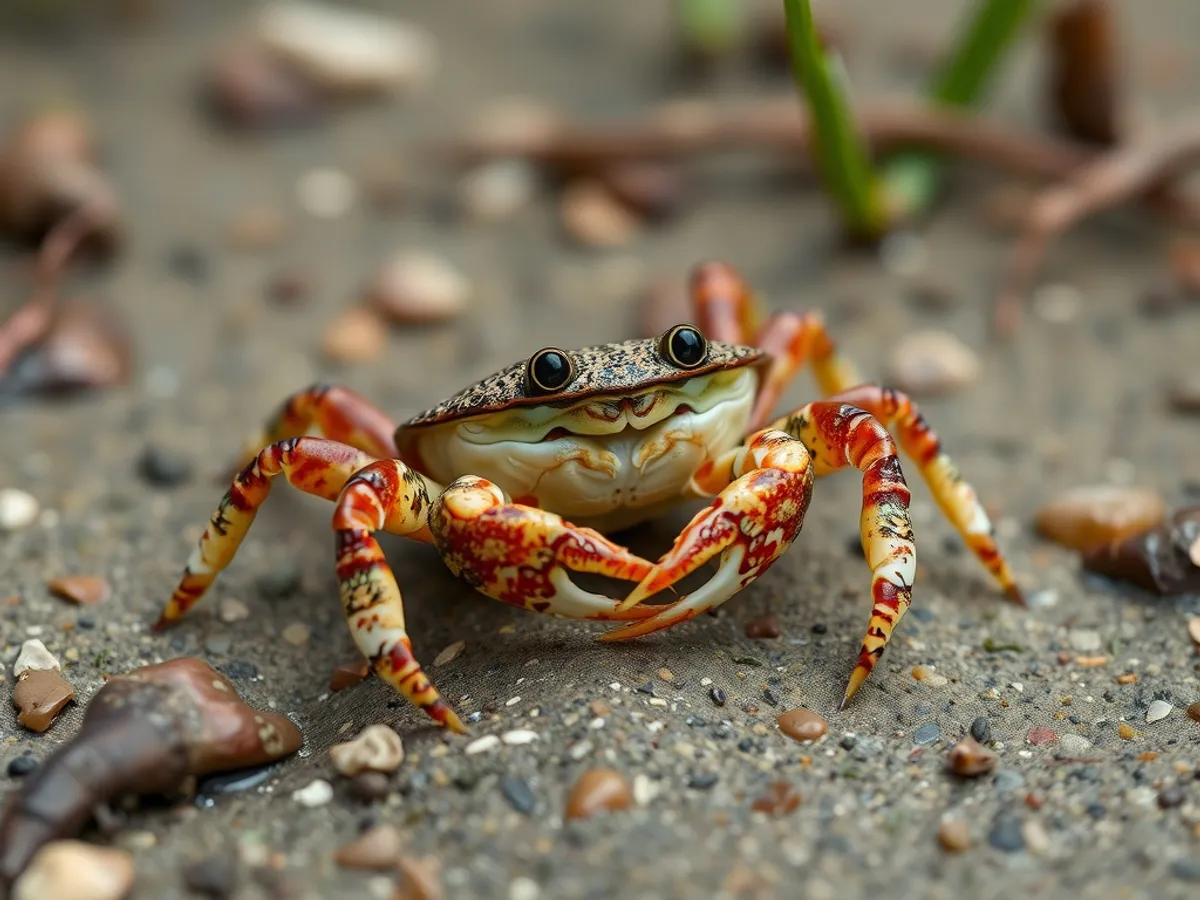
About the Fiddler Crab
A male fiddler crab has one claw that is grotesquely, uselessly large — in some species it makes up close to half his entire body weight — and one small ordinary one. The big claw cannot feed him. Only the small claw can perform the crab's actual meal, which is a delicate sorting operation: it scoops up a pinch of sediment, passes it to specialised mouthparts that float off algae and organic particles in a mouthful of water, and spits out the cleaned mineral grains as a neat pellet. Males therefore eat at half the rate of females and have to work twice as long. What the great claw buys them is display: it is waved in a species-specific rhythm at the burrow entrance to attract females and to warn rivals, and males will fight with it, grappling and levering each other away from the burrow. If a male loses the claw he regrows one on the next moult, but the replacement is often a lighter, hollower "cheap" claw that looks the part and performs the wave convincingly while being far weaker in a fight — an evolved bluff. Fiddlers live on tropical and subtropical mudflats, run a tidal clock that anticipates the water's return, and their long stalked eyes give them almost complete panoramic vision.
Fascinating facts
Distinctive Claw
Male fiddler crabs have one greatly enlarged claw, which they wave to attract females and intimidate rivals.
Tidal Life
Fiddler crabs are adapted to live in the intertidal zone, spending part of their lives underwater and part on land.
Burrow Builders
They dig burrows up to two feet deep, which provide shelter from predators, extreme temperatures, and dehydration.
Detailed description
The fiddler crab (Uca pugnax) is a small, semi-terrestrial crustacean native to the Atlantic coasts of North America, ranging from Massachusetts to northern Florida. Adult males typically measure 2–2.5 cm across the carapace, while females are slightly smaller. The most striking feature is the pronounced sexual dimorphism: males possess one greatly enlarged cheliped (claw), which can be up to twice the width of their body, used for signaling and combat, while females have two small, symmetrical claws. The carapace is generally square-shaped and olive-brown to bluish in color, often camouflaged with mud. Fiddler crabs inhabit intertidal mudflats, salt marshes, and mangrove forests, where they excavate complex burrow systems up to 60 cm deep. These burrows provide refuge from predators, desiccation, and extreme temperatures, and serve as sites for mating and molting. Socially, fiddler crabs are highly gregarious, forming dense colonies where individuals interact through a rich repertoire of visual and vibrational signals. Their daily activity is closely tied to tidal cycles, emerging at low tide to forage and retreating to their burrows as the tide rises. As ecosystem engineers, fiddler crabs play a crucial role in sediment turnover, aeration, and nutrient cycling, significantly influencing the structure and productivity of coastal habitats.
Did you know?
Despite their small size, fiddler crabs are crucial ecosystem engineers—by burrowing, they improve soil aeration and nutrient cycling in coastal habitats.
Research & sources
Wikipedia summary
The fiddler crab or calling crab can be one of the hundred species of semiterrestrial marine crabs in the family Ocypodidae. These crabs are well known for their extreme sexual dimorphism, where the male crabs have a major claw significantly larger than their minor claw, whilst females claws are both the same size. The name fiddler crab comes from the appearance of their small and large claw together, looking similar to a fiddle.
Behaviour & social structure
Fiddler crabs are diurnal and synchronize their activity with the ebb and flow of tides. During low tide, they emerge from their burrows to feed on detritus, algae, and microorganisms by sifting surface sediments with their smaller claw. Males are highly territorial, defending their burrow entrances with displays of claw waving and, if necessary, physical combat. The waving display serves dual purposes: deterring rival males and attracting females. Social hierarchies are established based on size and claw strength, with dominant males occupying the most desirable burrow locations. Fiddler crabs communicate through a combination of visual signals (waving, posturing) and substrate-borne vibrations produced by drumming or tapping behaviors. Group foraging is common, but individuals maintain personal space to avoid conflict. At high tide or when threatened, crabs retreat to their burrows, sealing the entrance with mud to prevent predation and desiccation.
Reproduction & life cycle
Breeding in Uca pugnax is strongly seasonal, typically peaking in late spring and summer when temperatures and food availability are optimal. Males court females by performing species-specific waving displays near their burrow entrances. If a female is receptive, she enters the male's burrow, where mating occurs. Females carry fertilized eggs (up to several thousand) attached to their abdomen (pleopods) for about two weeks, during which embryonic development takes place. Upon hatching, the female releases the larvae into the outgoing tide, where they become planktonic zoeae. These larvae undergo several molts over 3–4 weeks before settling back to the substrate as juvenile crabs. There is no parental care after larval release, and juveniles are independent from hatching.
Adaptations & survival
Fiddler crabs exhibit several remarkable adaptations to their intertidal environment. Their gills are modified to allow gas exchange both in water and air, enabling them to survive extended periods out of water. The enlarged male claw, though cumbersome for feeding, is a specialized adaptation for sexual selection, used in ritualized displays and combat. Their burrowing behavior provides protection from predators, temperature extremes, and dehydration. Fiddler crabs can rapidly close their burrow entrances with mud plugs to maintain humidity and deter intruders. Their compound eyes are mounted on long stalks, providing a wide field of vision to detect predators and rivals. Additionally, they possess the ability to regenerate lost limbs over successive molts.
Cultural significance
Fiddler crabs have long fascinated naturalists and are frequently used as model organisms in studies of animal behavior, sexual selection, and communication. Their distinctive claw-waving displays have inspired local folklore and are sometimes featured in coastal art and storytelling. In some cultures, fiddler crabs are collected for bait in recreational fishing, though they are not a major food source. Their presence is often seen as an indicator of healthy intertidal ecosystems, and they play a role in environmental education and ecotourism in coastal communities.
Recent research
Recent research has focused on the biomechanics and evolution of the male claw, revealing trade-offs between signaling effectiveness and feeding efficiency. Studies using high-speed video and acoustic monitoring have detailed the complex communication strategies involving both visual and vibrational signals. Genetic analyses have clarified species boundaries within the Uca genus, leading to taxonomic revisions. Ongoing research is investigating the impact of rising sea levels and marsh migration on fiddler crab distribution, as well as their role in carbon cycling and sediment stabilization. Fiddler crabs are also being studied as bioindicators of environmental contamination due to their sensitivity to pollutants.
Videos
Habitat
Coastal mudflats and mangrove forests
Conservation
The Fiddler Crab is currently classified as Least Concern on the IUCN Red List.
Threats & challenges
While Uca pugnax is currently listed as Least Concern, local populations face threats from habitat loss due to coastal development, pollution (especially heavy metals and pesticides), and climate change-induced sea level rise. Alteration of tidal regimes and destruction of salt marshes and mangroves can significantly reduce suitable habitat. Invasive species and increased predation from birds and fish in disturbed areas also pose risks. Despite these challenges, the species remains relatively resilient due to its broad distribution and high reproductive output, but localized declines have been documented in heavily urbanized regions.
Taxonomy
Scientific name
Uca pugnax
- Kingdom
- Animalia
- Phylum
- Arthropoda
- Class
- Malacostraca
- Order
- Decapoda
- Family
- Ocypodidae
- Genus
- Uca
- Species
- pugnax
Community notes
Share your observations about the Fiddler Crab.
No community notes yet. Be the first!
Discover more wildlife
More fascinating animals from the encyclopedia.