
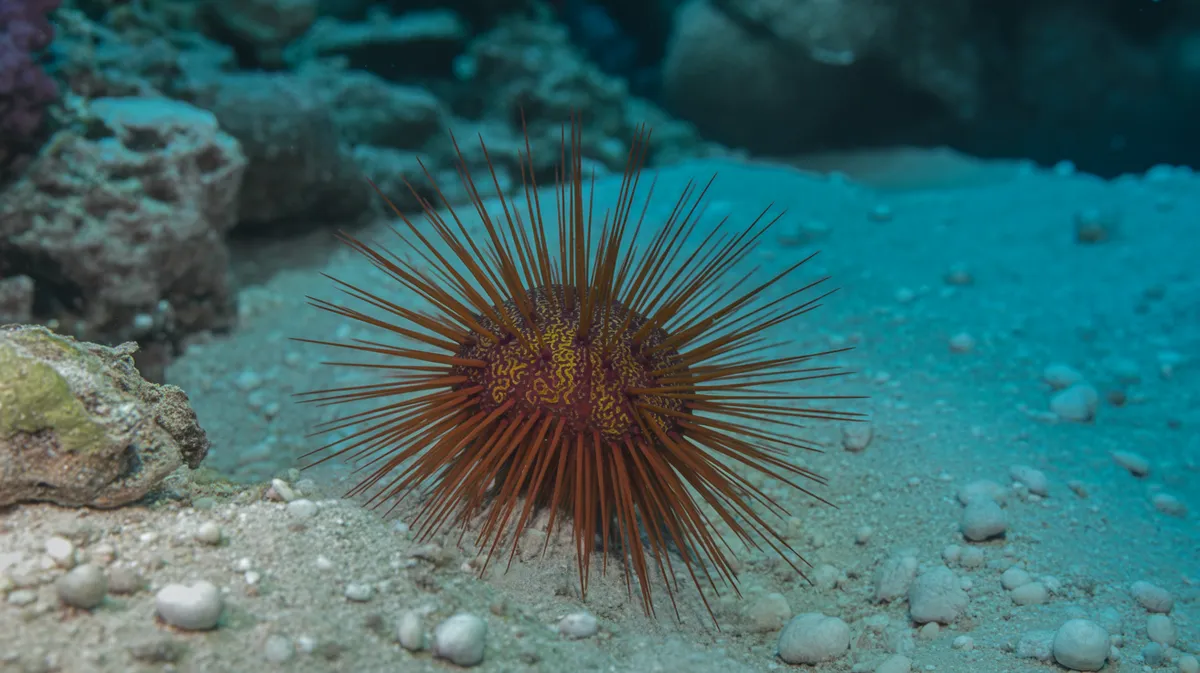
About the Fire Urchin
The Fire Urchin is a strikingly colorful sea urchin known for its vivid red, orange, and purple hues, adorned with long, venomous spines and shorter, iridescent pedicellariae. Found primarily in the Indo-Pacific region, it inhabits sandy or rubble areas of coral reefs and lagoons, often at depths ranging from 3 to 90 meters. This invertebrate is both admired and feared by divers due to its potent venom, which is delivered through specialized spines used for defense. The Fire Urchin plays an important role in the reef ecosystem by grazing on algae and detritus, helping to maintain the balance of the reef environment.
Fascinating facts
Venomous Spines
The Fire Urchin has long, venomous spines and specialized pedicellariae that can inject toxins, deterring predators and causing painful stings to humans.
Dazzling Colors
Its vivid coloration, ranging from bright reds to purples, acts as aposematic warning coloration, signaling its toxicity to would-be predators.
Protective Partnerships
Small animals like Coleman shrimp and zebra crabs often live among Fire Urchin spines, gaining protection from predators due to the urchin's venom.
Detailed description
Asthenosoma varium, commonly known as the Fire Urchin, is a visually striking echinoderm characterized by its dense covering of long, venomous spines interspersed with shorter, iridescent pedicellariae. Adults typically reach a diameter of 8–20 cm, with spines extending up to 5 cm in length. The coloration is highly variable but generally features a vivid mosaic of red, orange, purple, and sometimes blue hues, serving as both a warning to predators and camouflage among corals and rubble. The body, or test, is globular and covered with tubercles from which the spines and pedicellariae arise. Fire Urchins possess specialized venom glands at the base of their spines, which can deliver painful stings to potential threats. Their tube feet, located in ambulacral grooves, are used for locomotion and manipulating food particles. The species is nocturnal, often hiding under rocks or within crevices during the day and emerging at night to feed. Fire Urchins are solitary but may aggregate in areas with abundant food resources. They are known to host commensal organisms, such as the Coleman shrimp (Periclimenes colemani) and zebra crab (Zebrida adamsii), which find refuge among their spines. Their role as grazers helps regulate algal growth and recycle detritus, contributing to coral reef health.
Did you know?
Despite their formidable defenses, Fire Urchins are sometimes preyed upon by specialized sea stars and triggerfish.
Research & sources
Wikipedia summary
Fire urchin may refer to one of several sea urchins including:Astropyga radiata Asthenosoma ijimai Asthenosoma marisrubri Asthenosoma varium
Behaviour & social structure
Fire Urchins are primarily nocturnal foragers, emerging from shelter at dusk to graze on algae, detritus, and occasionally sessile invertebrates such as sponges and bryozoans. They use their tube feet and spines to maneuver across the substrate and to manipulate food toward their centrally located mouth, known as Aristotle’s lantern. While generally solitary, they may be found in loose aggregations where food is plentiful. Defensive behaviors include raising and orienting spines toward perceived threats and releasing venom through specialized pedicellariae. The Fire Urchin’s commensal relationships with shrimp and crabs are mutualistic: the crustaceans gain protection from predators, while the urchin benefits from cleaning services as these animals remove parasites and debris from its surface.
Reproduction & life cycle
Asthenosoma varium is gonochoric, with separate male and female individuals. Reproduction occurs via external fertilization, typically synchronized with lunar cycles and seasonal water temperature changes, often peaking during warmer months. During spawning events, both sexes release gametes into the water column, where fertilization takes place. The resulting planktonic larvae, known as echinopluteus, drift with ocean currents for several weeks before settling onto the substrate and metamorphosing into juvenile urchins. There is no parental care post-fertilization. Recruitment success is influenced by environmental factors such as current patterns, predation on larvae, and availability of suitable habitat for settlement.
Adaptations & survival
The Fire Urchin’s most notable adaptation is its array of venomous spines and pedicellariae, which provide effective defense against predators such as triggerfish and sea stars. The vivid aposematic coloration serves as a warning signal, deterring visually oriented predators. Its tube feet are highly sensitive to chemical and tactile cues, aiding in navigation and food detection, even in low-light conditions. The ability to host commensal species is a unique ecological adaptation, as it enhances the urchin’s defense and cleanliness. The nocturnal lifestyle reduces predation risk and competition for food with diurnal reef inhabitants. The robust test structure and regenerative capabilities of spines and tube feet allow the urchin to recover from physical damage.
Cultural significance
While not widely featured in traditional folklore, Fire Urchins are well known among indigenous coastal communities and divers throughout the Indo-Pacific for their striking appearance and potent sting. In some regions, they are occasionally harvested for their roe, though this is less common than with other urchin species. The species is popular in the marine aquarium trade, valued for its vivid coloration and unique commensal associations. Fire Urchins also serve as educational ambassadors in public aquaria, highlighting the diversity and complexity of coral reef ecosystems.
Recent research
Recent studies have focused on the chemical composition and pharmacological potential of Fire Urchin venom, with bioactive compounds showing promise for biomedical applications, including pain management and antimicrobial agents. Research into the symbiotic relationships between A. varium and commensal crustaceans has provided insights into coevolution and mutualistic interactions on coral reefs. Genetic studies are clarifying population structure and connectivity across the Indo-Pacific, informing conservation strategies. Ongoing ecological monitoring is assessing the species’ role in reef resilience, particularly in areas affected by coral bleaching and algal overgrowth.
Videos
Habitat
Coral reefs and sandy rubble in tropical ocean waters

Conservation
The Fire Urchin is currently classified as Least Concern on the IUCN Red List.
Threats & challenges
Currently assessed as Least Concern, the Fire Urchin faces localized threats from habitat degradation, particularly coral reef destruction due to climate change, ocean acidification, and destructive fishing practices. Collection for the aquarium trade and incidental bycatch in fisheries may impact some populations. Pollution and sedimentation can reduce suitable habitat and food availability. However, the species’ broad distribution and adaptability to various reef and rubble environments buffer it against widespread decline. Ongoing monitoring is necessary to detect potential future threats, especially as reef ecosystems face increasing anthropogenic pressures.
Taxonomy
Scientific name
Asthenosoma varium
- Kingdom
- Animalia
- Phylum
- Echinodermata
- Class
- Echinoidea
- Order
- Temnopleuroida
- Family
- Echinothuriidae
- Genus
- Asthenosoma
- Species
- varium
Community notes
Share your observations about the Fire Urchin.
No community notes yet. Be the first!
Discover more wildlife
More fascinating animals from the encyclopedia.