
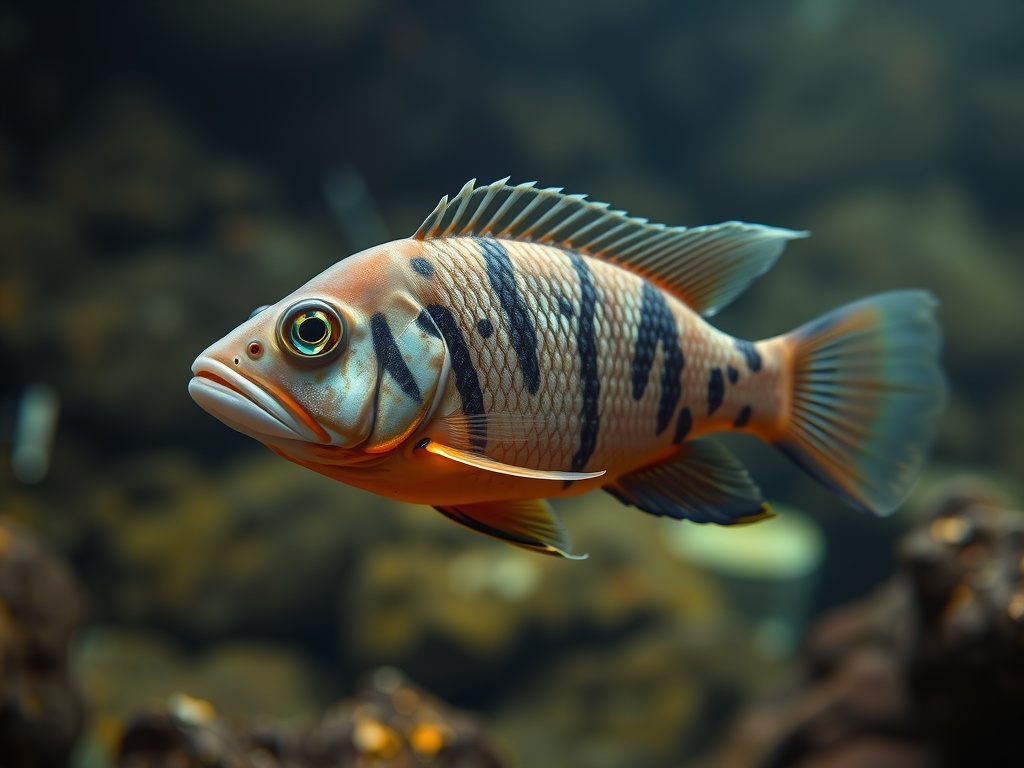
About the Firemouth cichlid
The Firemouth cichlid is a striking freshwater fish native to Central America, recognized for its vivid red-orange coloration along the throat and underside. Males are especially colorful and display their fiery throats as a form of territorial and courtship behavior. Firemouth cichlids are relatively hardy and popular in the aquarium trade due to their attractive appearance and manageable size. In the wild, they inhabit slow-moving rivers, lagoons, and floodplains with sandy or muddy bottoms. Their social behavior includes complex mating rituals and dedicated parental care of their offspring.
Fascinating facts
Fiery Display
Male Firemouth cichlids expand their gill covers and flare their bright red throats as a threat display to deter intruders and attract mates.
Dedicated Parents
Both male and female Firemouth cichlids guard their eggs and fry, often moving them to multiple locations to ensure their safety.
Adaptable Habitat
This species thrives in slow-moving waters with sandy or muddy substrates, often seeking shelter among submerged roots and rocks.
Detailed description
The Firemouth cichlid (Thorichthys meeki) is a medium-sized cichlid, typically reaching 12–15 cm (4.7–5.9 in) in total length, with males generally larger and more vividly colored than females. Its most distinctive feature is the bright red to orange coloration on the lower jaw, throat, and belly, which intensifies during breeding and territorial displays. The body is laterally compressed, with a silvery-gray to olive background marked by faint vertical bars and a prominent black spot on the operculum (gill cover). Dorsal and anal fins are elongated and often tipped with red or blue iridescence. The species possesses robust pharyngeal teeth adapted for crushing, and its mouth is slightly subterminal, aiding in substrate sifting. Firemouth cichlids are highly adaptable, thriving in a range of water conditions (pH 6.5–8.0, temperature 23–30°C/73–86°F), and are found in slow-moving rivers, floodplains, and lagoons with sandy or muddy substrates and ample submerged vegetation. They are known for their complex social behaviors, including pronounced territoriality, ritualized threat displays (notably flaring of the gill covers to expose the red throat), and cooperative parental care. In the wild, they form loose aggregations outside of the breeding season but become highly territorial during reproduction. Their diet is omnivorous, consisting of aquatic invertebrates, detritus, algae, and occasionally small fish. Firemouth cichlids play a significant ecological role as both predators and prey within their native freshwater ecosystems.
Did you know?
During breeding, Firemouth cichlids become highly territorial and will fiercely defend their nest—even against much larger fish.
Research & sources
Wikipedia summary
The firemouth cichlid is a species of cichlid fish native to Central America. They occur in rivers of the Yucatán Peninsula, Mexico, south through Belize and into northern Guatemala.
Behaviour & social structure
Firemouth cichlids exhibit diurnal activity patterns, being most active during daylight hours. They are opportunistic feeders, foraging by sifting through substrate to extract insect larvae, crustaceans, and organic debris, while also grazing on algae and plant matter. Socially, they display a hierarchical structure, with dominant individuals establishing and defending territories, especially during breeding. Males engage in elaborate threat displays, flaring their gill covers and extending their fins to appear larger and more intimidating to rivals. Aggression is typically ritualized, with physical combat being rare. Outside of the breeding season, they may form small, loose groups, but during reproduction, pairs become highly territorial and exclude conspecifics from their nesting area. Parental care is biparental, with both sexes actively guarding eggs and fry. Daily routines include periods of foraging, territory patrol, and maintenance of nesting sites, such as clearing debris from chosen spawning substrates.
Reproduction & life cycle
Firemouth cichlids are monogamous substrate spawners, forming stable breeding pairs. Courtship involves synchronized swimming, fin displays, and mutual cleaning of a flat surface (often a rock or submerged wood) selected for egg deposition. Spawning typically occurs at the onset of the rainy season (late spring to early summer), though in captivity, they may breed year-round. Females lay 100–500 adhesive eggs in a single clutch, which are fertilized externally by the male. Both parents guard the eggs, which hatch after 2–3 days at 26–28°C (79–82°F). The larvae are moved to shallow pits excavated by the parents, where they remain under close supervision. Fry become free-swimming after 4–5 days and are actively herded and protected by both parents for several weeks, until they are large enough to fend for themselves. This high level of parental investment increases offspring survival in the wild.
Adaptations & survival
Thorichthys meeki exhibits several adaptations for survival in variable freshwater environments. Its laterally compressed body and strong pectoral fins allow for agile maneuvering among submerged roots and vegetation. The species' bright red throat patch serves as a visual signal in social and reproductive interactions, reducing the need for physical conflict. Substrate-sifting behavior, aided by specialized pharyngeal teeth, enables efficient exploitation of benthic food resources. Firemouth cichlids tolerate a broad range of water parameters, reflecting adaptation to the seasonal fluctuations of their native habitats. Their cooperative breeding and biparental care are evolutionary strategies that enhance reproductive success in environments with high predation pressure on eggs and fry.
Cultural significance
The Firemouth cichlid is highly valued in the ornamental fish trade for its striking appearance and dynamic behaviors, making it a popular species among aquarium enthusiasts worldwide. In its native range, it holds no known significant role in folklore or traditional practices, but it contributes to local economies through sustainable collection and export. Its vivid coloration and interesting social behaviors have made it a subject of educational programs and public aquarium exhibits, promoting awareness of Central American freshwater biodiversity.
Recent research
Recent research on Thorichthys meeki has focused on its behavioral ecology, particularly the role of visual signals in territorial and mating displays. Studies have examined the hormonal and neural mechanisms underlying aggression and parental care. Genetic analyses have clarified its phylogenetic relationships within the Heroini tribe, supporting its placement in the genus Thorichthys. Environmental tolerance studies have highlighted its resilience to fluctuating water parameters, informing conservation strategies for Central American cichlids. Ongoing research includes the impact of habitat modification on population structure and the potential for hybridization with related species in disturbed environments.
Videos
Habitat
Freshwater rivers and lagoons

Conservation
The Firemouth cichlid is currently classified as Least Concern on the IUCN Red List.
Threats & challenges
Currently assessed as Least Concern by the IUCN, the Firemouth cichlid faces localized threats from habitat degradation, water pollution, and the introduction of invasive species. Agricultural runoff and deforestation in Central America can lead to increased sedimentation and reduced water quality in their native rivers and lagoons. Overcollection for the aquarium trade is not considered a significant threat due to the species' widespread distribution and ease of captive breeding. Climate change, with its potential to alter rainfall patterns and water temperatures, may pose future challenges. Population trends are considered stable, but ongoing habitat monitoring is recommended.
Taxonomy
Scientific name
Thorichthys meeki
- Kingdom
- Animalia
- Phylum
- Chordata
- Class
- Actinopterygii
- Order
- Cichliformes
- Family
- Cichlidae
- Genus
- Thorichthys
- Species
- meeki
Community notes
Share your observations about the Firemouth cichlid.
No community notes yet. Be the first!
Discover more wildlife
More fascinating animals from the encyclopedia.