
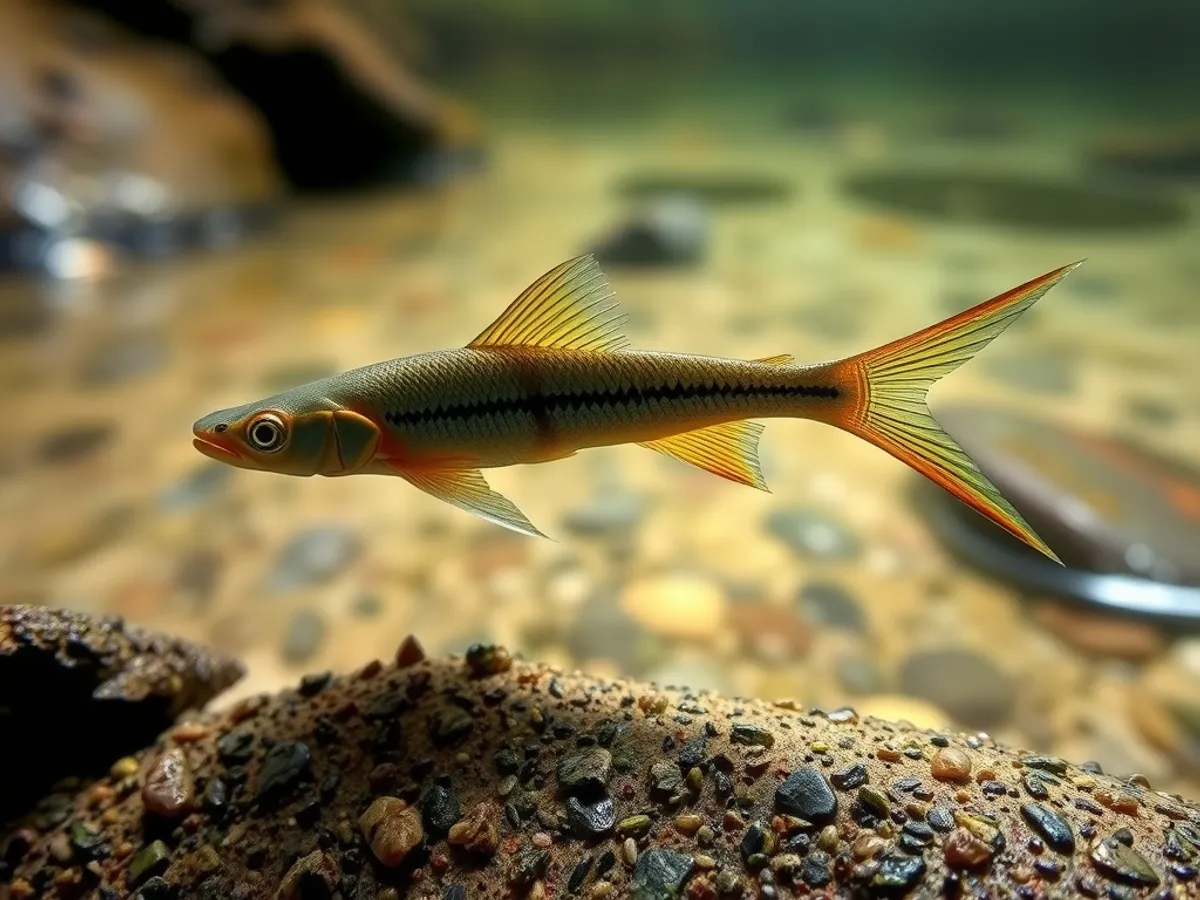
About the Flagtail prochilodus
The flagtail prochilodus is a medium-sized freshwater fish native to the rivers and floodplains of South America, particularly within the Amazon and Orinoco basins. Recognized for its distinctive forked tail adorned with striking black and yellow-orange bands, it is an important migratory species that travels long distances during the rainy season to spawn. Flagtail prochilodus play a vital ecological role as detritivores, helping to recycle nutrients in aquatic ecosystems. Their robust bodies and specialized mouths are well-adapted for scraping organic material and algae from submerged surfaces.
Fascinating facts
Long-Distance Migrator
Flagtail prochilodus migrate upstream for spawning, sometimes covering distances of over 400 kilometers.
Nature’s Recycler
Their diet of detritus and algae helps break down and recycle organic matter in river ecosystems.
Vital to Local Fisheries
They are a major source of protein and income for many Amazonian and South American communities.
Detailed description
The flagtail prochilodus (Prochilodus margarita) is a robust, medium-sized characiform fish, typically reaching lengths of 25–35 cm, with some individuals documented up to 40 cm. Its body is laterally compressed and covered in large, cycloid scales, displaying a silvery sheen with olive or bronze dorsal hues. The most distinctive feature is its deeply forked caudal fin, marked by alternating black and yellow-orange bands, which gives the species its common name. The mouth is subterminal and highly protractile, equipped with specialized, fleshy lips and numerous papillae, adaptations for scraping periphyton, algae, and detritus from submerged surfaces. The species possesses a muscular, streamlined body suited for long-distance migrations against strong river currents. Flagtail prochilodus are known for their remarkable migratory behavior, forming large schools that travel hundreds of kilometers during the rainy season to reach upstream spawning grounds. Socially, they are gregarious, often seen in dense aggregations, which may provide protection from predators and facilitate synchronized spawning. Their digestive system is elongated, reflecting their detritivorous and herbivorous diet, and they play a critical role in nutrient cycling within their ecosystems. The species is an ecological keystone in South American riverine food webs, supporting both aquatic and terrestrial predators.
Did you know?
During migration, vast schools of flagtail prochilodus can dramatically alter river environments by stirring up sediments and aiding in nutrient cycling.
Research & sources
Behaviour & social structure
Flagtail prochilodus exhibit pronounced migratory behavior, undertaking seasonal upstream movements in response to hydrological cues such as rising water levels at the onset of the rainy season. These migrations, known as potamodromous movements, are often synchronized among large groups, forming schools that can number in the thousands. Feeding primarily occurs during daylight hours; individuals graze on biofilm, algae, and detritus by scraping submerged rocks, woody debris, and aquatic vegetation with their specialized lips. They exhibit a high degree of sociality, maintaining loose shoals outside of the breeding season, which helps reduce predation risk. During migration and feeding, they display coordinated swimming and rapid bursts of speed to evade predators. At night, flagtail prochilodus tend to rest in deeper or slower-moving waters. They are not aggressive and display minimal territoriality, relying on group cohesion for survival.
Reproduction & life cycle
Reproduction in Prochilodus margarita is closely tied to seasonal flooding cycles. Spawning typically occurs at the onset of the rainy season (November to March, depending on region), when adults migrate upstream to reach suitable spawning habitats—often shallow, inundated floodplains with sandy or muddy substrates. Spawning is group-synchronous, with females releasing thousands of small, adhesive eggs into the water column, which are then externally fertilized by males. There is no parental care; eggs and larvae are left to drift downstream with the current, eventually settling in nursery areas within floodplains or slow-moving channels. The rapid development of larvae is an adaptation to the dynamic floodplain environment, with juveniles reaching independence within a few days. Sexual maturity is typically reached at 2–3 years of age.
Adaptations & survival
Flagtail prochilodus possess several key adaptations for survival in dynamic riverine environments. Their streamlined, muscular bodies and deeply forked tails enable sustained long-distance swimming and rapid bursts of speed, essential for migration and predator evasion. The protractile, papillose lips and subterminal mouth are specialized for scraping and ingesting periphyton and detritus, allowing them to exploit a food resource that is abundant but requires specialized feeding mechanisms. Their elongated intestines facilitate the efficient digestion of plant material and organic detritus. Physiologically, they exhibit tolerance to fluctuating oxygen levels and turbidity, common in floodplain habitats. Behaviorally, their schooling and migratory habits reduce predation risk and maximize reproductive success by ensuring larvae are dispersed across suitable nursery habitats.
Cultural significance
Flagtail prochilodus holds significant economic and cultural value for riverine communities throughout the Amazon and Orinoco basins. It is a staple in local fisheries, providing a major source of protein and income. Traditional fishing techniques, such as netting during migratory runs, are often timed to coincide with spawning migrations. In some indigenous cultures, the species is associated with seasonal cycles and river health, symbolizing abundance and renewal. Its ecological role is recognized in local folklore, and it is occasionally featured in art and storytelling. However, there are no major ritual or mythological associations documented.
Recent research
Recent research has focused on the genetic population structure of Prochilodus margarita, revealing significant connectivity among populations across large river basins, underscoring the importance of maintaining free-flowing rivers for genetic exchange. Telemetry and otolith microchemistry studies have provided detailed insights into migration routes, spawning periodicity, and habitat use. Ecological investigations highlight the species' role in nutrient cycling, particularly in transferring nutrients from floodplain detritus to higher trophic levels. Ongoing studies are assessing the impacts of dam construction and climate change on migratory behavior and reproductive success. Conservation biologists are also exploring the potential for managed fisheries and habitat restoration to sustain populations.
Sources
Migratory patterns and ecological role of Prochilodus species in South American rivers
Barthem, R.B. & Goulding, M. (2007)
scientificMigratory Patterns and Population Structure of Prochilodus margarita in the Orinoco Basin
Lasso, C.A., et al. (2016)
scientificVideos
Habitat
Large rivers, floodplains, and freshwater streams

Conservation
The Flagtail prochilodus is currently classified as Least Concern on the IUCN Red List.
Threats & challenges
While currently listed as Least Concern by the IUCN, Prochilodus margarita faces several emerging threats. Large-scale hydroelectric dam construction and river regulation disrupt migratory routes, fragment populations, and alter natural flood regimes critical for spawning. Overfishing, particularly during migration and spawning aggregations, can locally deplete stocks. Habitat degradation from deforestation, agricultural runoff, and mining increases sedimentation and pollution, impacting water quality and food resources. Climate change poses additional risks by altering rainfall patterns and floodplain dynamics. Despite these challenges, the species remains abundant in many regions, but ongoing monitoring is essential to detect population declines and inform management.
Taxonomy
Scientific name
Prochilodus margarita
- Kingdom
- Animalia
- Phylum
- Chordata
- Class
- Actinopterygii
- Order
- Characiformes
- Family
- Prochilodontidae
- Genus
- Prochilodus
- Species
- margarita
Community notes
Share your observations about the Flagtail prochilodus.
No community notes yet. Be the first!
Discover more wildlife
More fascinating animals from the encyclopedia.