
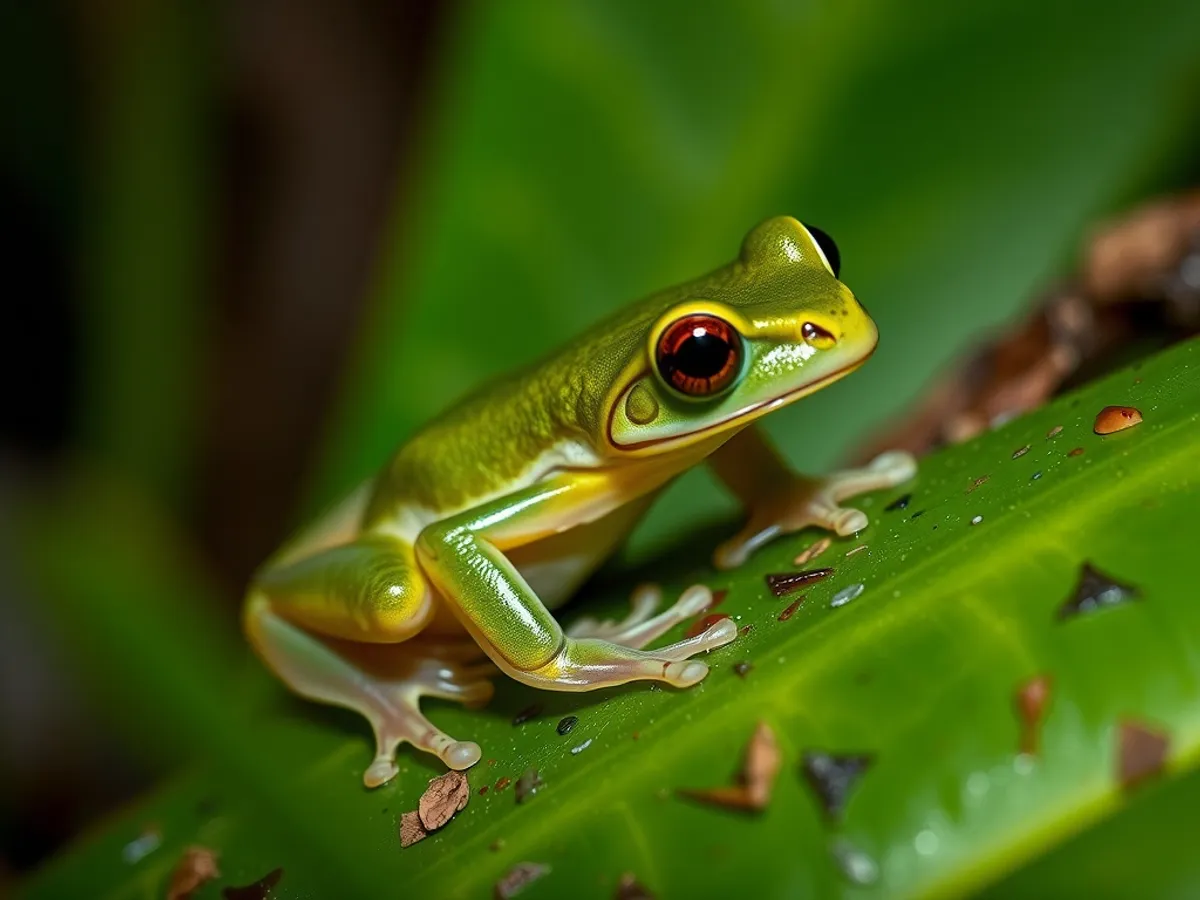
About the Fleischmann's Glass Frog
Fleischmann's Glass Frog is a small, nocturnal amphibian renowned for its remarkable translucent skin on the underside, which reveals its internal organs. This species inhabits humid lowland and montane forests, often residing near fast-flowing streams in Central America. It is primarily arboreal, spending most of its life in the foliage above water, where it lays its eggs on leaves overhanging streams. The frog's delicate appearance and unique transparency make it a fascinating subject for scientific study and conservation efforts.
Fascinating facts
See-Through Skin
The underside of Fleischmann's Glass Frog is so translucent that you can observe its internal organs, including the heart and eggs in females.
Parental Care
Male frogs vigilantly guard their eggs on leaves above streams, protecting them from predators and ensuring they remain moist until they hatch.
Nocturnal Lifestyle
This species is primarily active at night, when it hunts for small insects and avoids diurnal predators.
Detailed description
Fleischmann's Glass Frog (Hyalinobatrachium fleischmanni) is a small, delicate amphibian typically measuring 20–26 mm in snout-vent length. Its dorsal skin is bright to yellowish-green, often adorned with tiny pale yellow spots, while the ventral surface is almost completely transparent, allowing clear visibility of the heart, liver, and gastrointestinal tract—a hallmark of the 'glass frog' group. The frog's eyes are large, forward-facing, and possess horizontal pupils, providing excellent binocular vision for detecting prey and predators in its arboreal habitat. The species is primarily nocturnal and arboreal, spending daylight hours hidden on the undersides of leaves, where its coloration and translucency offer camouflage against both aerial and terrestrial predators. Its slender limbs and expanded toe pads facilitate agile movement on wet foliage. Males are known for their distinctive high-pitched, bell-like calls, which are used to attract females and establish territories. The species is found in humid lowland and montane forests from southern Mexico through Central America to Ecuador, typically near fast-flowing streams, which are essential for reproduction. Its unique reproductive strategy involves laying eggs on the undersides of leaves overhanging streams, a behavior that reduces predation risk and ensures immediate access to water for hatching tadpoles. The combination of cryptic coloration, transparency, and specialized reproductive behaviors make H. fleischmanni an exceptional example of adaptation to a complex neotropical environment.
Did you know?
Despite its delicate appearance, Fleischmann's Glass Frog can leap impressive distances to escape predators.
Research & sources
Wikipedia summary
Hyalinobatrachium fleischmanni, also known as Fleischmann's glass frog or the northern glass frog, is a species of frog in the family Centrolenidae. It is found in the tropical Americas from southern Mexico to Ecuador. Specifically, these frogs occur in Mexico, Belize, Costa Rica, El Salvador, Guatemala, Honduras, Nicaragua, and Panama, Colombia, and Ecuador. It has often been confused with related species, and the exact distribution depends on the source. This frog tends to have green skin, pale yellowish spots, yellow fingertips and translucent skin covering its stomach.
Behaviour & social structure
Hyalinobatrachium fleischmanni is predominantly nocturnal, becoming active shortly after dusk. Males establish and defend small territories on leaves above streams, where they emit repetitive, high-frequency calls to attract females and deter rival males. Calling activity peaks during the rainy season, coinciding with increased reproductive opportunities. The species is insectivorous, feeding mainly on small arthropods such as ants, spiders, and flies, which it captures using a rapid tongue flick. Foraging occurs primarily at night, with individuals moving slowly and deliberately through the foliage. Social interactions are generally limited to the breeding season, with males occasionally engaging in physical confrontations or call duels to maintain territories. Outside of the breeding season, individuals are solitary and highly cryptic, relying on their coloration and stillness to avoid detection.
Reproduction & life cycle
Breeding in Fleischmann's Glass Frog is closely tied to the rainy season, which varies regionally but generally occurs from May to October. Males select leaves overhanging streams and call to attract females. After amplexus, females lay clutches of 18–30 eggs on the underside of leaves. The male often remains nearby to guard the clutch, a behavior that includes moistening the eggs with his body and deterring predators or parasitic flies. Embryonic development lasts 10–14 days, depending on temperature and humidity. Upon hatching, tadpoles drop directly into the stream below, where they continue development in an aquatic environment. Parental care, especially by males, is well-documented and includes active defense against egg predators and maintenance of egg moisture, which is critical for successful embryogenesis.
Adaptations & survival
Hyalinobatrachium fleischmanni exhibits several remarkable adaptations. Its ventral transparency provides camouflage from predators below, blending with the dappled light of the forest canopy and the leaf substrate. The green dorsal coloration, enhanced by guanine crystals in the skin, matches the surrounding foliage, further aiding concealment. Enlarged toe pads and webbed feet allow for efficient climbing and adherence to wet, slippery leaves. The species' reproductive strategy—laying eggs on leaves overhanging streams—minimizes aquatic egg predation and ensures immediate access to water for hatching tadpoles. Males' parental care, including egg hydration and defense, increases offspring survival. The frog's acute vision and sensitivity to vibrations help detect both prey and approaching threats in a complex, three-dimensional environment.
Cultural significance
While not a major figure in indigenous mythology, Fleischmann's Glass Frog has become an emblematic species for neotropical biodiversity and conservation. Its striking appearance and unique transparency have made it a popular subject in ecotourism, environmental education, and scientific outreach in Central and South America. The species is occasionally featured in local folklore as a symbol of invisibility or the hidden wonders of the rainforest. In recent years, glass frogs have also appeared in art and media, highlighting the importance of amphibian conservation.
Recent research
Recent research on Hyalinobatrachium fleischmanni has focused on its reproductive behaviors, particularly the evolution of male parental care and the ecological factors influencing clutch survival. Molecular studies have clarified its phylogenetic relationships within Centrolenidae, helping to resolve historical taxonomic confusion with similar species. Ongoing investigations examine the adaptive significance of skin transparency, with some studies suggesting it reduces predation by making the frog less conspicuous to visually hunting predators. Conservation genetics research is underway to assess population structure and connectivity across its range, which is important for long-term management. Additionally, the species is used as a model for studying the effects of environmental change on stream-dependent amphibians.
Sources
The Evolution of Parental Care in Glass Frogs: Ecological and Phylogenetic Perspectives
Delia, J.R.J., Bravo-Valencia, L., Warkentin, K.M. (2017)
scientificTransparency in Glass Frogs: Mechanisms and Ecological Significance
Barnett, J.B., et al. (2020)
scientificVideos
Habitat
Tropical and subtropical moist lowland forests, usually near streams
 Tropical Regions
Rainforest
Dense, wet forests with the highest biodiversity on Earth, containing more than half of the world's plant and animal species.
 Global
Forest
Wooded areas with significant tree cover and diverse plant and animal communities.
 Global
Freshwater
Lakes, rivers, and wetlands with diverse aquatic ecosystems.
Conservation
The Fleischmann's Glass Frog is currently classified as Least Concern on the IUCN Red List.
Threats & challenges
Although currently listed as Least Concern by the IUCN, Hyalinobatrachium fleischmanni faces several localized threats. Habitat loss due to deforestation, agricultural expansion, and urbanization is the primary concern, especially in lowland areas. Water pollution and sedimentation from human activities can degrade breeding streams, impacting reproductive success. Climate change poses additional risks by altering precipitation patterns and stream flow, potentially disrupting breeding cycles. The species is also susceptible to chytridiomycosis, a fungal disease affecting amphibians globally, though its impact on H. fleischmanni populations is not fully understood. Despite these challenges, the species remains relatively widespread and adaptable, but continued monitoring is essential.
Taxonomy
Scientific name
Hyalinobatrachium fleischmanni
- Kingdom
- Animalia
- Phylum
- Chordata
- Class
- Amphibia
- Order
- Anura
- Family
- Centrolenidae
- Genus
- Hyalinobatrachium
- Species
- fleischmanni
Community notes
Share your observations about the Fleischmann's Glass Frog.
No community notes yet. Be the first!
Discover more wildlife
More fascinating animals from the encyclopedia.