
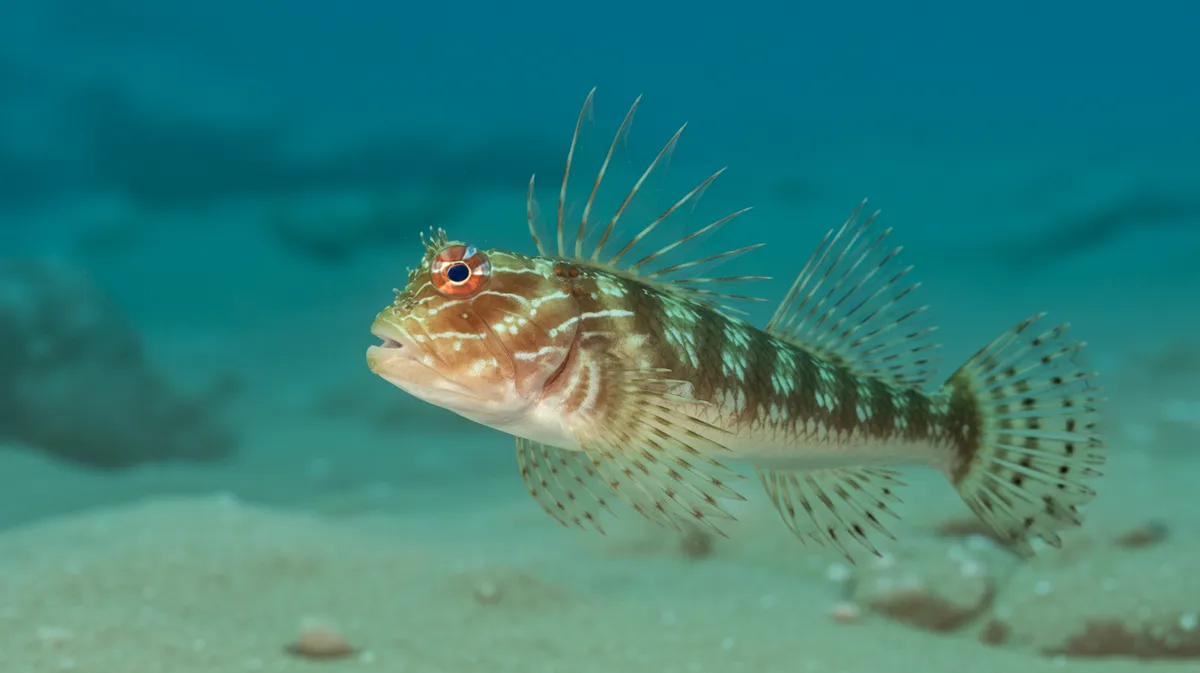
About the Flying gurnard
The flying gurnard is a distinctive marine fish known for its large, wing-like pectoral fins that can flare out like a fan, often displaying vibrant blue edges. Despite its name, it does not actually fly, but it uses its fins to glide along the sea floor and startle predators. This species inhabits shallow coastal waters, sandy or muddy bottoms, and seagrass beds in the Atlantic Ocean, including the Caribbean Sea and the Mediterranean. Flying gurnards feed primarily on small crustaceans, mollusks, and other invertebrates, using their finger-like pelvic fins to probe the substrate. Their unusual appearance and fascinating behavior make them a favorite among divers and underwater photographers.
Fascinating facts
Spectacular Fins
The flying gurnard's pectoral fins can spread dramatically, often reaching almost as long as its body, creating a striking display.
Unusual Locomotion
This fish uses its finger-like pelvic fins to 'walk' along the sea floor while searching for food.
Makes Grunting Sounds
Flying gurnards are capable of producing grunting noises by manipulating their swim bladder, possibly to communicate or deter predators.
Detailed description
The flying gurnard (Dactylopterus volitans) is a medium-sized demersal fish, typically reaching lengths of 30–40 cm, with some individuals reported up to 50 cm. Its most striking feature is the pair of enormous, fan-shaped pectoral fins, which can extend to nearly the length of its body and are vividly marked with blue and green spots and bands along the edges. The body is elongated, armored with bony plates and ridges, and colored in mottled browns and grays for camouflage against sandy or muddy substrates. The head is broad and helmet-like, with a blunt snout and large, upward-facing eyes adapted for scanning the sea floor. The pelvic fins are modified into finger-like rays, which the fish uses to 'walk' along the substrate and probe for prey. Flying gurnards are solitary or found in small, loose aggregations, spending most of their time resting or slowly moving over the bottom. When threatened, they rapidly flare their pectoral fins to startle predators and may produce audible grunting sounds by vibrating their swim bladder. They are benthic carnivores, feeding on small crustaceans, mollusks, worms, and occasionally small fish. Reproduction is oviparous, with external fertilization; females release pelagic eggs into the water column. Larvae are planktonic and undergo a dramatic transformation as they develop. The species is distributed across both sides of the Atlantic, from temperate to tropical waters, and is commonly found at depths of 10–100 meters, though it can occur as deep as 200 meters.
Did you know?
The flying gurnard can produce audible grunting sounds using its swim bladder, a rare trait among fish.
Research & sources
Wikipedia summary
The flying gurnard, also known as the helmet gurnard, is a bottom-dwelling fish of tropical to warm temperate waters on both sides of the Atlantic. On the American side, it is found as far north as Massachusetts and as far south as Argentina, including the Caribbean and Gulf of Mexico. On the European and African side, it ranges from the English Channel to Angola, including the Mediterranean. This is the only species in the monotypic genus Dactylopterus. Similar and related species from the genus Dactyloptena are found in the Indian and Pacific Oceans.
Behaviour & social structure
Flying gurnards are primarily crepuscular, being most active during dawn and dusk, when they forage for food. They use their pelvic fin rays to probe and stir up the substrate, detecting and capturing hidden prey. Their movement is deliberate and slow, but they can make short, rapid dashes if disturbed. When threatened, the sudden display of their large, colorful fins serves as a deimatic (startle) display to deter predators such as larger fish and cephalopods. Gurnards are generally solitary, though loose aggregations may form in areas of abundant food. They are not known to exhibit complex social behaviors and show little territoriality. Acoustic communication has been documented; they can produce low-frequency grunts or clicks, likely used in intraspecific interactions or as an additional deterrent to predators.
Reproduction & life cycle
Dactylopterus volitans is oviparous, with external fertilization. Spawning typically occurs in late spring to early summer, though timing can vary with latitude and local conditions. Males and females engage in brief courtship displays, with males sometimes following females closely before both release gametes into the water column. Females produce numerous small, buoyant eggs that drift with currents. There is no parental care; eggs and larvae are planktonic and highly vulnerable to predation. Larvae undergo several developmental stages, initially bearing elongated fin rays and a transparent body before settling to the benthos and adopting adult morphology. Sexual maturity is reached at approximately 20–25 cm in length, usually within 2–3 years.
Adaptations & survival
The flying gurnard's most notable adaptation is its hypertrophied pectoral fins, which serve multiple functions: startling predators, enhancing maneuverability, and possibly aiding in camouflage by breaking up the fish's outline. The pelvic fin rays act as tactile organs, allowing the fish to sense and manipulate prey hidden in the substrate. The bony armor provides protection from predators and abrasive environments. Their coloration offers effective camouflage on sandy or muddy bottoms. The ability to produce sounds via the swim bladder may serve as a deterrent or in communication. Their diet flexibility and tolerance for a range of salinities and temperatures contribute to their wide distribution.
Cultural significance
The flying gurnard has minor direct significance in human culture, as it is not a major food fish. However, its unusual appearance and dramatic fin displays have made it a subject of fascination among divers, underwater photographers, and marine enthusiasts. In some regions, it is occasionally caught for local consumption or as bycatch. The species has inspired folklore and myth, often being mistaken for a 'flying fish' due to its name and fin displays, though it is taxonomically unrelated to true flying fishes (Exocoetidae).
Recent research
Recent research has focused on the biomechanics of the flying gurnard's pectoral fins, revealing their role in both locomotion and predator deterrence. Studies using high-speed videography have documented the rapid fin-flaring behavior and its effectiveness in startling predators. Genetic analyses have confirmed the species' monotypic status within Dactylopterus and clarified its relationships with Indo-Pacific Dactyloptena species. Ongoing ecological studies are examining the species' role in benthic food webs and its responses to habitat changes. Acoustic communication and sound production mechanisms are also active areas of investigation.
Videos
Habitat
Shallow coastal ocean

Conservation
The Flying gurnard is currently classified as Least Concern on the IUCN Red List.
Threats & challenges
Currently, the flying gurnard faces few significant threats and is classified as Least Concern by the IUCN. It is not a target of major commercial fisheries, though it may be caught incidentally as bycatch. Habitat degradation, particularly the loss of seagrass beds and coastal pollution, could pose localized threats. Climate change and associated shifts in ocean temperature and chemistry may affect distribution and reproductive success in the long term. Population trends appear stable across most of its range, but continued monitoring is recommended due to potential habitat impacts.
Taxonomy
Scientific name
Dactylopterus volitans
- Kingdom
- Animalia
- Phylum
- Chordata
- Class
- Actinopterygii
- Order
- Syngnathiformes
- Family
- Dactylopteridae
- Genus
- Dactylopterus
- Species
- volitans
Community notes
Share your observations about the Flying gurnard.
No community notes yet. Be the first!
Discover more wildlife
More fascinating animals from the encyclopedia.