
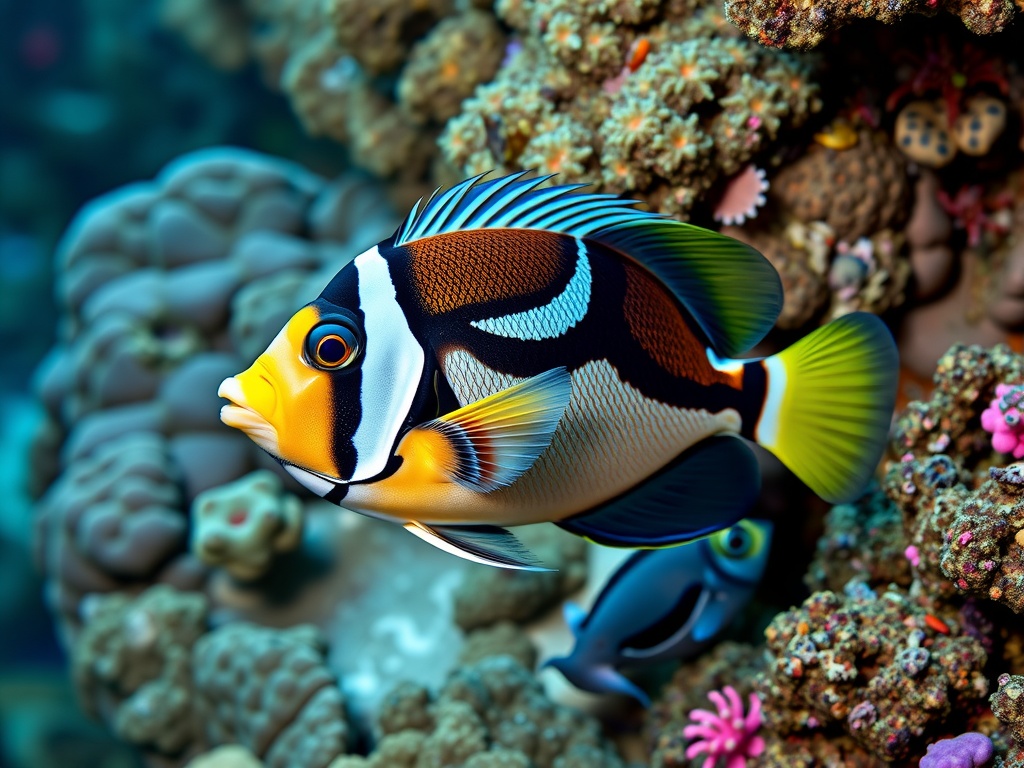
About the French Angelfish
The French angelfish is a striking marine fish recognized by its rounded, laterally compressed body and bold coloration of black scales edged in yellow, with a yellow-ringed eye and blue lips. Native to the western Atlantic Ocean, it is commonly found on coral reefs from Florida and the Bahamas to Brazil. Juveniles differ in appearance, sporting black bodies with bright yellow vertical bands. French angelfish are known for their strong pair bonds, often seen swimming in monogamous pairs throughout their territory. They play an important role on reefs by feeding on sponges, algae, and small invertebrates.
Fascinating facts
Distinctive Appearance
Adult French angelfish have dramatic yellow-edged scales and a bright yellow ring around each eye, making them stand out among reef fish.
Lifelong Pairs
These fish form strong monogamous pairs that defend their territory together and are rarely seen apart.
Dietary Specialists
French angelfish feed on a variety of items but are particularly fond of sponges, which make up a large part of their diet.
Detailed description
The French angelfish (Pomacanthus paru) is a large, laterally compressed marine angelfish reaching up to 41 cm (16 in) in length and weighing up to 1.6 kg (3.5 lbs). Its body is predominantly deep black with each scale edged in bright yellow, creating a speckled appearance, while the pectoral fins are yellow and the mouth is rimmed with blue. The face is marked by a distinctive yellow ring around the eye and blue highlights on the lips and chin. Juveniles are strikingly different, exhibiting a black body with three vivid yellow vertical bands, which fade as they mature. French angelfish possess a robust, continuous dorsal fin with 10 spines and 29–31 soft rays, and an anal fin with 3 spines and 22–24 soft rays. They are highly territorial and are almost always observed in monogamous pairs, patrolling and defending their home range. Their diet is omnivorous but specialized, focusing on sponges, tunicates, gorgonians, algae, and small invertebrates, with a digestive system adapted to process spongin and other tough materials. French angelfish are diurnal, seeking shelter in reef crevices at night. They play a key ecological role as both sponge predators and as cleaners in their juvenile stage, removing ectoparasites from larger fish. Their lifespan in the wild is estimated at 10–15 years, with some individuals living longer in captivity.
Did you know?
Despite their bold colors and size, French angelfish are sometimes kept in large marine aquariums, where they can become surprisingly tame and display unique personalities.
Research & sources
Wikipedia summary
Pomacanthus paru, also known by its common name the French angelfish, is a slow growing coral reef fish from the Caribbean. The species is of the family Pomacanthidae, which contains other species of marine angelfish. Its closest relative is the grey angelfish.
Behaviour & social structure
French angelfish exhibit strong pair bonding, with mated pairs maintaining and defending territories together year-round. Pairs communicate and reinforce bonds through synchronized swimming and mutual displays. They are diurnal, actively foraging during daylight hours and retreating to secure crevices at night. Juveniles act as cleaner fish, establishing cleaning stations where they remove parasites and dead tissue from visiting reef fish, a behavior that diminishes as they mature. Adults feed primarily on sponges, using their robust jaws and specialized teeth to tear off pieces, but they also consume algae, tunicates, hydroids, and small crustaceans. Feeding is typically methodical, with pairs moving together across their territory. Aggression is directed towards conspecific intruders and occasionally towards other angelfish species, especially the closely related grey angelfish (Pomacanthus arcuatus).
Reproduction & life cycle
French angelfish are oviparous and exhibit monogamous pair bonds that persist throughout the year. Spawning typically occurs at dusk, often during the warmer months, though reproduction can happen year-round in tropical waters. During courtship, pairs ascend in the water column in a synchronized spiral, releasing eggs and sperm simultaneously into the open water. Females can release several thousand buoyant, pelagic eggs per spawning event. Fertilized eggs hatch within 15–20 hours, producing planktonic larvae that drift with ocean currents for several weeks before settling onto the reef. There is no parental care after spawning; survival of offspring depends on dispersal and successful settlement. Sexual maturity is reached at approximately 2–3 years of age.
Adaptations & survival
French angelfish have evolved a laterally compressed body shape, allowing them to maneuver efficiently through complex coral structures. Their strong jaws and specialized tricuspid teeth enable them to feed on tough, chemically defended sponges and gorgonians, a niche few reef fish exploit. The vivid coloration of juveniles serves as a signal to other fish of their cleaning role, reducing predation risk. Adults’ cryptic coloration helps them blend into the reef environment. Their mucus-covered skin provides protection against parasites and pathogens. Socially, their monogamous pairing and territoriality optimize resource use and reproductive success in the crowded reef environment.
Cultural significance
French angelfish are popular in the marine aquarium trade due to their striking appearance and engaging behavior, though their large size and dietary needs make them challenging to keep. In Caribbean folklore and ecotourism, they are emblematic of healthy coral reefs and are frequently featured in underwater photography and diving literature. There are no significant traditional uses or mythological associations, but their presence is often used as an indicator of reef health in conservation programs.
Recent research
Recent research has focused on the ecological role of French angelfish as sponge predators and their influence on coral reef community structure. Studies have examined their cleaning behavior as juveniles and its impact on reef fish health. Genetic analyses have clarified their phylogenetic relationships within Pomacanthidae, confirming close ties to the grey angelfish (Pomacanthus arcuatus). Ongoing research includes the effects of climate change on their distribution and reproductive patterns, as well as the impacts of the aquarium trade on wild populations. Stable isotope analysis has been used to better understand their trophic ecology and dietary specialization.
Videos
Habitat
Coral reefs
Conservation
The French Angelfish is currently classified as Least Concern on the IUCN Red List.
Threats & challenges
Currently classified as Least Concern by the IUCN, French angelfish populations are considered stable. However, they face localized threats from habitat degradation, particularly coral reef loss due to climate change, ocean acidification, and destructive fishing practices. Overcollection for the marine aquarium trade can impact local populations, especially juveniles. Pollution, invasive species, and disease outbreaks also pose risks. Despite these challenges, their broad distribution and adaptability have helped buffer the species against severe declines, but ongoing monitoring is recommended.
Taxonomy
Scientific name
Pomacanthus paru
- Kingdom
- Animalia
- Phylum
- Chordata
- Class
- Actinopterygii
- Order
- Perciformes
- Family
- Pomacanthidae
- Genus
- Pomacanthus
- Species
- paru
Where to see a french angelfish
1 zoo and aquarium in 1 country are recorded as keeping this species.
Community notes
Share your observations about the French Angelfish.
No community notes yet. Be the first!
Discover more wildlife
More fascinating animals from the encyclopedia.