
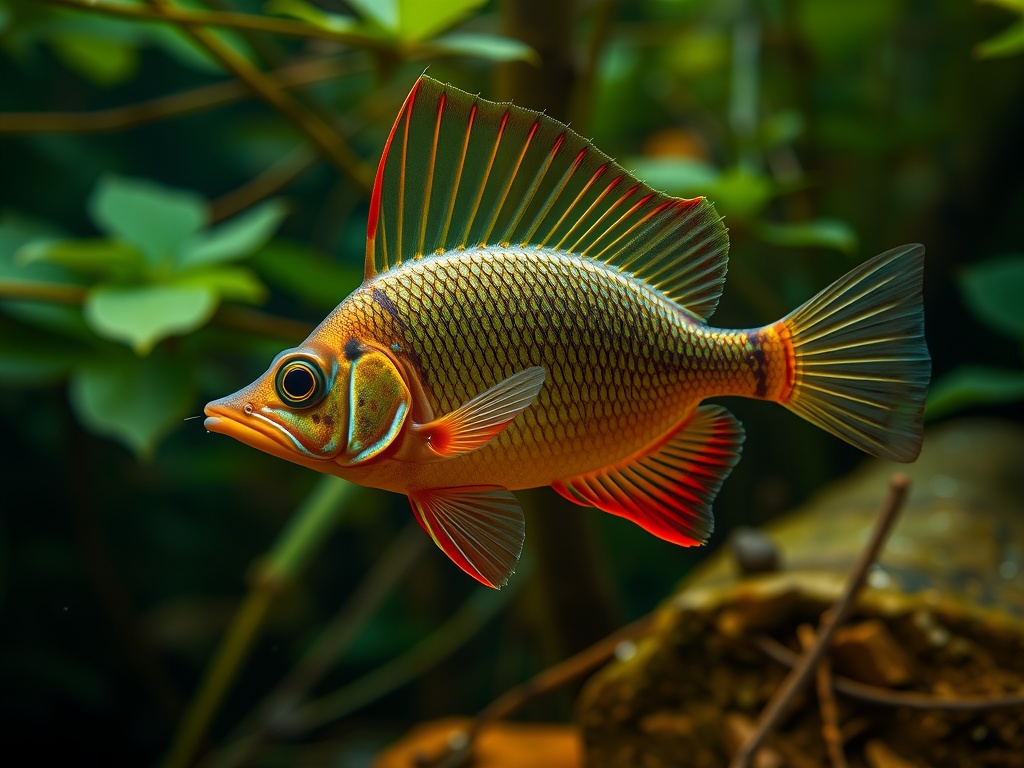
About the Freshwater angelfish
The freshwater angelfish is a striking cichlid native to the slow-moving rivers and flooded forests of the Amazon Basin in South America. Recognized for their tall, triangular bodies and elongated fins, they display a variety of color patterns, including silver, black, and marbled varieties. Popular in the aquarium trade for their beauty and graceful swimming, they are social fish that thrive in groups and exhibit complex behaviors. In the wild, freshwater angelfish often seek shelter among submerged roots and vegetation, making use of their laterally compressed bodies to navigate tight spaces. Due to captive breeding, they are widely available and not considered at risk in their native range.
Fascinating facts
Amazon Basin Native
Freshwater angelfish originate from the Amazon Basin, particularly in slow-moving tributaries and floodplains in South America.
Dedicated Parents
Both male and female angelfish participate in guarding and oxygenating their eggs, often cleaning the leaves or surfaces where they are laid.
Colorful Varieties
Through selective breeding, angelfish now come in many colors and patterns, including koi, marble, gold, and veil-tail varieties.
Detailed description
The freshwater angelfish (Pterophyllum scalare) is a medium-sized cichlid distinguished by its laterally compressed, disc-shaped body, which can reach up to 15 cm (6 in) in length and 20 cm (8 in) in height, including the elongated dorsal and anal fins. This unique body plan, coupled with long, trailing pelvic fins, allows the angelfish to maneuver with precision among dense aquatic vegetation and submerged roots in its native Amazonian habitats. Wild specimens typically display a silvery base color with four to six vertical black bars, providing effective camouflage among dappled light and shadows. In addition to their striking appearance, angelfish possess a terminal mouth with fine teeth adapted for picking at small invertebrates, plant matter, and detritus. Socially, they are known for forming loose shoals, but during breeding, they establish monogamous pairs and defend territories aggressively. Their advanced parental care includes both parents tending to eggs and fry, a trait common among cichlids. Angelfish communicate through subtle body language, fin displays, and even low-frequency sounds. Their laterally compressed bodies are not only an adaptation for hiding but also facilitate rapid vertical movements to escape predators or ambush prey. In captivity, selective breeding has produced a wide variety of color morphs and fin shapes, but wild-type forms remain prevalent in natural populations.
Did you know?
Despite their delicate appearance, freshwater angelfish can be territorial and display complex social hierarchies, especially during breeding.
Research & sources
Wikipedia summary
Pterophyllum is a small genus of freshwater fish from the family Cichlidae known to most aquarists as angelfish. All Pterophyllum species originate in the Amazon Basin, Orinoco Basin and various rivers in the Guiana Shield in tropical South America. The three species of Pterophyllum are unusually shaped for cichlids, being greatly laterally compressed, with round bodies and elongated triangular dorsal and anal fins. This body shape allows them to hide among roots and plants, often on a vertical surface. Naturally occurring angelfish are frequently striped transversely, colouration which provides additional camouflage. Angelfish are ambush predators and prey on small fish and macroinvertebrates. All Pterophyllum species form monogamous pairs. Eggs are generally laid on a submerged log or a flattened leaf but can also be laid on filter piping when kept in an aqaurium setting. As is the case for other cichlids, brood care is highly developed.
Behaviour & social structure
Freshwater angelfish are primarily diurnal, exhibiting peak activity during daylight hours when they forage for food and interact socially. As ambush predators, they employ stealth and patience, often remaining motionless among vegetation before darting out to capture small fish, insect larvae, or crustaceans. Their omnivorous diet also includes algae, plant debris, and detritus. In group settings, angelfish establish a loose social hierarchy, with dominant individuals asserting priority access to food and preferred shelter sites. During the breeding season, pairs become territorial and may display aggressive behaviors such as lateral displays, fin flaring, and chasing intruders. Outside of breeding, they are generally peaceful but may nip at the fins of slower-moving tankmates. Angelfish are known to recognize individual conspecifics and can exhibit cooperative behaviors, such as group defense against predators. Rest periods are typically spent hovering near vertical surfaces or among roots, minimizing energy expenditure and exposure to predators.
Reproduction & life cycle
Pterophyllum scalare exhibits complex reproductive behaviors characteristic of cichlids. Breeding pairs form strong monogamous bonds, often persisting across multiple spawning events. Courtship involves mutual displays, cleaning of a chosen spawning site (usually a broad leaf or submerged log), and synchronized swimming. Females lay between 100 and 1,000 adhesive eggs in neat rows, which are immediately fertilized by the male. Both parents guard the eggs, fanning them with their fins to ensure oxygenation and remove debris or fungus. Incubation lasts approximately 36 to 48 hours at optimal temperatures (26–28°C/79–82°F). Upon hatching, the larvae remain attached to the spawning site for another 5–7 days, absorbing their yolk sacs. Once free-swimming, the fry are herded and protected by both parents, who may continue to guard them for several weeks. In the wild, breeding can occur year-round but is often synchronized with seasonal flooding, which increases food availability and suitable habitat for offspring.
Adaptations & survival
The angelfish's laterally compressed, tall body is a key adaptation for navigating the dense, vertical structure of flooded forests and submerged root systems. Their cryptic coloration, including vertical bars and iridescent scales, provides camouflage from both predators and prey. The elongated dorsal, anal, and pelvic fins enhance maneuverability and allow for sudden changes in direction, crucial for ambush predation and escape. Sensory adaptations include well-developed lateral lines for detecting water movement and low-frequency vibrations, aiding in prey detection and social communication. Their omnivorous diet reflects a flexible feeding strategy, allowing them to exploit a wide range of food resources. Behavioral adaptations such as advanced parental care and territoriality increase offspring survival in environments with high predation pressure.
Cultural significance
Freshwater angelfish have become iconic in the global aquarium hobby, prized for their elegance, intelligence, and ease of breeding. They are frequently featured in aquarium literature, art, and media as symbols of grace and tranquility. In their native range, they do not hold significant roles in indigenous mythology or traditional uses, but their popularity has contributed to local economies through sustainable collection and aquaculture. The angelfish's distinctive form and behavior have inspired numerous scientific studies and educational programs, further cementing their status as ambassadors for freshwater biodiversity.
Recent research
Recent research on Pterophyllum scalare has focused on their social cognition, parental care strategies, and the genetic basis of color and fin variation. Studies have revealed that angelfish can distinguish between familiar and unfamiliar individuals, suggesting advanced social recognition abilities. Investigations into their reproductive biology have highlighted the importance of environmental cues, such as photoperiod and water chemistry, in triggering spawning. Genetic analyses have identified loci associated with popular color morphs, aiding selective breeding programs. Ongoing research addresses the impacts of habitat fragmentation and water pollution on wild populations, as well as the potential for angelfish to serve as bioindicators of ecosystem health.
Videos
Habitat
Slow-moving freshwater rivers and flooded forests


Conservation
The Freshwater angelfish is currently classified as Least Concern on the IUCN Red List.
Threats & challenges
While Pterophyllum scalare is currently listed as Least Concern by the IUCN, localized threats persist in parts of its range. Habitat degradation due to deforestation, agricultural runoff, and dam construction can alter water quality and reduce available breeding sites. Over-collection for the aquarium trade historically impacted some wild populations, though most angelfish in trade today are captive-bred. Invasive species and climate change, which can affect water temperature and hydrology, pose emerging challenges. Despite these threats, the species' wide distribution and adaptability have helped maintain stable populations overall. Conservation efforts focus on habitat protection and sustainable management of wild stocks.
Taxonomy
Scientific name
Pterophyllum scalare
- Kingdom
- Animalia
- Phylum
- Chordata
- Class
- Actinopterygii
- Order
- Cichliformes
- Family
- Cichlidae
- Genus
- Pterophyllum
- Species
- scalare
Where to see a freshwater angelfish
3 zoos and aquariums in 2 countries are recorded as keeping this species.
 Santa Barbara Zoological Gardens🇺🇸 Santa Barbara, United States
 Karlsruhe Zoo🇩🇪 Germany
 Tierpark und Fossilium Bochum🇩🇪 Bochum, Germany
Community notes
Share your observations about the Freshwater angelfish.
No community notes yet. Be the first!
Discover more wildlife
More fascinating animals from the encyclopedia.