
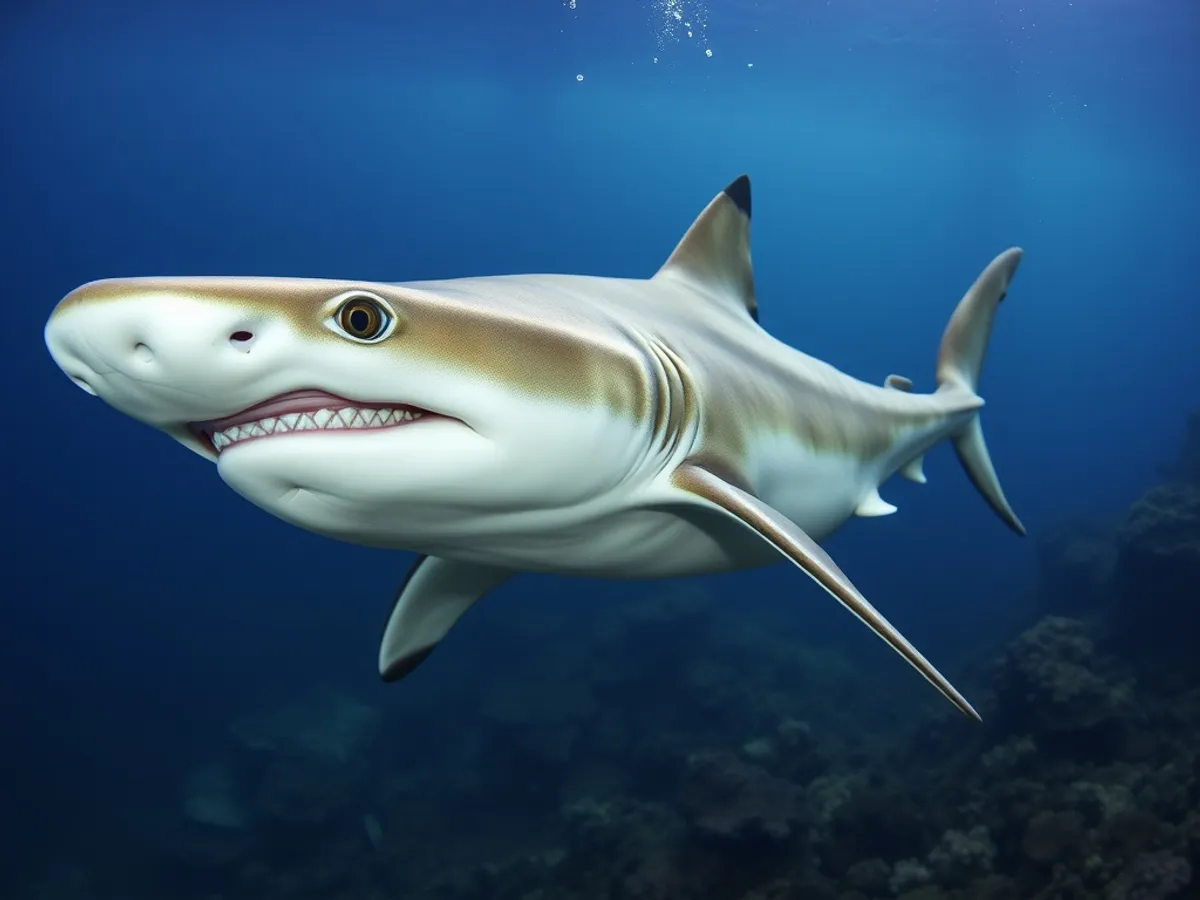
About the Frilled Shark
Chlamydoselachus anguineus looks less like a shark than like something reassembled from spare parts. Its body is long and eel-like, its dorsal fin is set almost at the tail, and it has six pairs of gill slits with extravagantly frilled margins — the first pair joined right across the throat like a collar — where most sharks have five plain ones. Its jaw is at the very front of the head rather than slung underneath, which is a primitive arrangement and means it can strike straight forward. Inside are roughly 300 teeth arranged in about 25 rows, each tooth a backward-curving trident. That shape is a one-way ratchet, and it is almost certainly built for squid: soft, muscular, slippery prey that would slide off a cutting tooth is impaled and held. Some researchers think the shark lunges like a snake, throwing the flexible body forward with the jaws open. It lives in the deep sea worldwide, usually far below 500 m, and it is so rarely seen alive that the handful of surface encounters have made international news. Its gestation may be the longest of any vertebrate: pups grow extremely slowly inside the mother with no placenta, and estimates run to around three and a half years.
Fascinating facts
Living Fossil
The frilled shark is often called a 'living fossil' because its lineage dates back over 80 million years with very little evolutionary change.
Squid Hunter
Its main prey are cephalopods, especially squid, which it captures with its rows of needle-like teeth and quick lunging motion.
Deep Dweller
Frilled sharks are found at extreme ocean depths, often between 200 and 1,500 meters, making them rarely seen by humans.
Detailed description
The frilled shark (Chlamydoselachus anguineus) is a deep-sea elasmobranch notable for its elongated, eel-like body, which can reach lengths of up to 2 meters, though most individuals are smaller. Its most distinctive feature is the presence of six pairs of long, frilly gill slits with the first pair extending across the throat, giving the species its common name. The body is cylindrical and flexible, covered in rough, dark brown to grayish skin, and tapers to a caudal fin with a reduced lower lobe. The head is flattened, with a blunt snout and large, terminal mouth lined with 25 rows of tricuspid, backward-curving teeth—totaling over 300—adapted for grasping slippery prey. The eyes are relatively large and lack nictitating membranes, an adaptation for low-light environments. Unlike most modern sharks, the frilled shark's skeleton and musculature are considered primitive, with amphistylic jaw suspension and a notochord that persists throughout life. The dorsal, pelvic, and anal fins are set far back on the body, contributing to its serpentine swimming motion. Internally, the liver is large and oil-rich, providing buoyancy in the deep-sea habitat. The species is considered a 'living fossil' due to its retention of many ancestral traits, offering a glimpse into early shark evolution.
Did you know?
The frilled shark has a gestation period that may last up to 3.5 years, one of the longest known in the animal kingdom.
Research & sources
Wikipedia summary
The frilled shark, also known as the lizard shark, is one of the two extant species of shark in the family Chlamydoselachidae. The frilled shark is considered a living fossil, because of its primitive, anguilliform (eel-like) physical traits, such as a dark-brown color, amphistyly, and a 2.0 m (6.6 ft)–long body, which has dorsal, pelvic, and anal fins located towards the tail. The common name, frilled shark, derives from the fringed appearance of the six pairs of gill slits at the shark's throat.
Behaviour & social structure
Frilled sharks are primarily solitary and are believed to be slow-moving, ambush predators. They exhibit anguilliform (eel-like) locomotion, undulating their bodies to propel themselves through the water. Their hunting strategy involves lurking near the seafloor or in the water column, using their dark coloration as camouflage in the low-light environment. When prey approaches, the frilled shark can lunge forward and open its highly distensible jaws to engulf prey whole. Diet analyses indicate a preference for cephalopods, particularly squid, but they also consume bony fishes and other small sharks. Their teeth are uniquely adapted to snag soft-bodied prey, preventing escape. There is little evidence of social behavior; individuals are rarely observed together, and there are no known aggregations or cooperative behaviors. Activity patterns are not well understood, but some evidence suggests vertical migrations may occur, possibly following prey or environmental gradients.
Reproduction & life cycle
Frilled sharks are ovoviviparous, meaning embryos develop inside eggs that remain within the mother's body until hatching. Females possess two functional ovaries and a pair of uteri. The gestation period is exceptionally long, estimated at 3.5 years (up to 42 months), which is among the longest known for any vertebrate. Litter sizes range from 2 to 15 pups, with an average of 6. Newborns measure 40–60 cm in length and are fully formed at birth, receiving no further parental care. There is no evidence of a defined breeding season; reproduction may occur year-round, likely due to the stable environmental conditions of the deep sea. Mating behavior has not been directly observed, but it is presumed to involve internal fertilization typical of elasmobranchs.
Adaptations & survival
The frilled shark exhibits several adaptations for deep-sea survival. Its elongated, flexible body allows for efficient anguilliform swimming and maneuverability in tight spaces. The large, oil-rich liver provides neutral buoyancy, compensating for the lack of a swim bladder. The backward-curved, tricuspid teeth are specialized for gripping soft, slippery prey such as squid. Reduced calcification of the skeleton and persistent notochord confer flexibility. The dark coloration offers camouflage in the deep-sea environment, and the large eyes enhance sensitivity to low light. The slow metabolic rate and long gestation period are typical of deep-sea species, reflecting adaptation to low food availability and stable conditions. The amphistylic jaw suspension, a primitive trait, allows for wide gape and rapid prey capture.
Cultural significance
The frilled shark has little direct significance in human culture due to its rarity and deep-sea habitat. However, its unusual appearance and 'living fossil' status have made it a subject of fascination in popular media, often depicted as a prehistoric or 'sea monster' figure. Occasional strandings or captures have inspired local legends and curiosity, particularly in Japan, where it is sometimes referred to as 'tsurushi same' (hanging shark). There are no known traditional uses or significant roles in folklore, but the species is increasingly recognized as an icon of deep-sea biodiversity and evolutionary history.
Recent research
Recent research on the frilled shark has focused on its reproductive biology, genetic diversity, and deep-sea adaptations. Molecular studies have clarified its phylogenetic position as one of the most basal extant sharks, providing insights into early elasmobranch evolution. Advances in deep-sea exploration technology, such as remotely operated vehicles (ROVs), have enabled rare in situ observations of behavior and habitat use. Studies of stomach contents and stable isotopes have improved understanding of its diet and ecological role. Ongoing research aims to assess population structure, connectivity between Atlantic and Pacific populations, and responses to environmental change. The species remains poorly understood due to the logistical challenges of deep-sea research.
Videos
Habitat
Deep ocean

Conservation
The Frilled Shark is currently classified as Near Threatened on the IUCN Red List.
Threats & challenges
Although the frilled shark is currently listed as 'Least Concern' by the IUCN, it faces several threats. Bycatch in deep-sea fisheries, particularly trawl and longline operations, is a significant source of mortality. The species' slow reproductive rate and long gestation make populations vulnerable to overexploitation. Habitat degradation from deep-sea mining and climate change-induced shifts in ocean chemistry and temperature may also pose future risks. There is limited data on population size and trends, but the species is considered naturally rare, with patchy distribution and low encounter rates. Conservation challenges include the lack of targeted management measures and the difficulty of studying deep-sea organisms.
Taxonomy
Scientific name
Chlamydoselachus anguineus
- Kingdom
- Animalia
- Phylum
- Chordata
- Class
- Chondrichthyes
- Order
- Hexanchiformes
- Family
- Chlamydoselachidae
- Genus
- Chlamydoselachus
- Species
- anguineus
Community notes
Share your observations about the Frilled Shark.
No community notes yet. Be the first!
Discover more wildlife
More fascinating animals from the encyclopedia.