
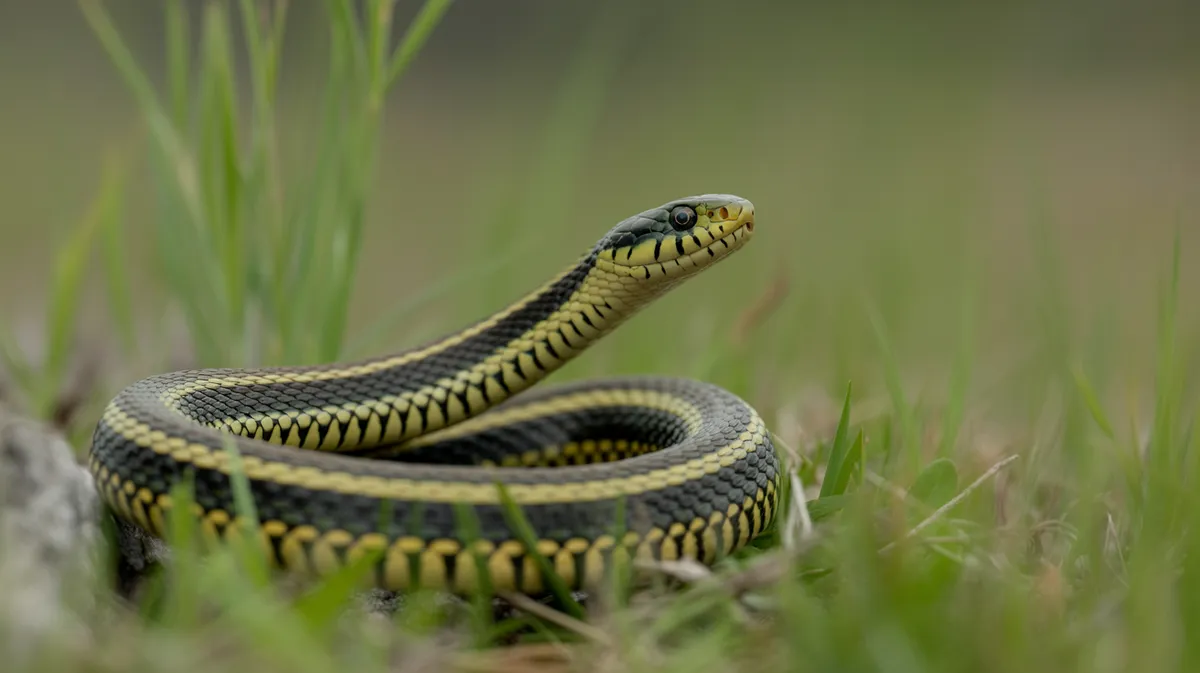
About the Garter Snake
The garter snake is a common, non-venomous snake widely distributed across North America. Recognizable by the distinctive stripes running lengthwise along its body, garter snakes display a variety of color patterns depending on their region. They are highly adaptable, thriving in woodlands, grasslands, marshes, and even suburban areas. Garter snakes are active during the day and are often seen basking in the sun or hunting for small prey. Despite their modest size, they play an important role in their ecosystems by controlling pest populations.
Fascinating facts
Striped Appearance
Garter snakes are easily identified by the prominent stripes running lengthwise down their bodies, which can be yellow, green, blue, or white depending on the subspecies.
Live Birth
Unlike most snakes, garter snakes give birth to live young, with litters ranging from 10 to 40 babies at a time.
Cold Climate Adaptation
Garter snakes can be found farther north than most other North American snakes because they are able to survive in cooler climates and hibernate communally for warmth.
Detailed description
The garter snake (Thamnophis sirtalis) is a slender, medium-sized colubrid, typically ranging from 46 to 137 cm (18–54 inches) in length, with females generally larger than males. Its body is characterized by three longitudinal stripes—most commonly yellow, green, or blue—running from head to tail, set against a background color that varies regionally from olive, brown, to black. The ventral surface is usually pale, and some populations exhibit checkered or spotted patterns between the stripes. Garter snakes possess keeled scales, giving them a rough texture, and a head only slightly wider than the neck. They have well-developed eyes with round pupils, indicative of their diurnal activity. These snakes are highly adaptable, occupying a wide range of habitats from moist meadows and marshes to dry woodlands and suburban gardens. They are primarily terrestrial but are proficient swimmers, often found near water bodies. Garter snakes are ectothermic and regulate their body temperature through basking. Their diet is diverse, including earthworms, amphibians, small fish, slugs, and occasionally small mammals and birds. Notably, garter snakes possess mildly venomous saliva, which is harmless to humans but aids in subduing prey. They play a crucial ecological role as both predator and prey within their ecosystems.
Did you know?
Despite being harmless to humans, some garter snakes can eat toxic newts and become mildly toxic themselves, deterring predators.
Research & sources
Wikipedia summary
Garter snake is the common name for small to medium-sized snakes belonging to the genus Thamnophis in the family Colubridae. They are native to North and Central America, ranging from central Canada in the north to Costa Rica in the south.
Behaviour & social structure
Garter snakes are primarily diurnal, becoming most active during warm daylight hours. They exhibit a combination of solitary and communal behaviors, often basking together in large numbers, particularly during the spring and autumn. When threatened, they may release a foul-smelling musk from their cloaca as a defense mechanism. Their hunting strategy relies on both visual and chemical cues, using their forked tongue and Jacobson's organ to detect prey. Garter snakes are opportunistic feeders, ambushing or actively searching for prey in leaf litter, shallow water, or grassy areas. They are known for their agility in both terrestrial and aquatic environments. During colder months, garter snakes enter brumation, aggregating in communal hibernacula—sometimes numbering in the thousands—to conserve heat and moisture. Social interactions are most pronounced during the breeding season, when males may form 'mating balls' around a single female.
Reproduction & life cycle
Garter snakes are ovoviviparous, meaning females give birth to live young rather than laying eggs. Mating typically occurs soon after emergence from brumation in early spring. Males locate females using pheromonal trails and may compete for access, resulting in the formation of large mating aggregations. After successful copulation, females undergo a gestation period of about 2–3 months. Litters can range from 10 to 80 neonates, depending on the female's size and health. Newborns are independent at birth, receiving no parental care, and immediately disperse to avoid predation. Sexual maturity is reached at 1–2 years for males and 2–3 years for females. Breeding frequency is generally annual, but may be biennial in colder climates.
Adaptations & survival
Garter snakes exhibit several key adaptations for survival. Their coloration and striping provide effective camouflage in grassy and marshy habitats, disrupting their outline and making them less visible to predators. The mildly toxic saliva, produced by Duvernoy's gland, subdues prey and deters some predators. Their resistance to certain amphibian toxins, such as tetrodotoxin from rough-skinned newts (Taricha granulosa), is a notable evolutionary adaptation, allowing them to exploit otherwise dangerous prey. Physiologically, they can tolerate a wide range of temperatures and moisture levels, contributing to their broad geographic distribution. Behavioral adaptations include communal hibernation for thermoregulation and predator avoidance, as well as the use of pheromones for mate location.
Cultural significance
Garter snakes have featured in North American folklore and indigenous traditions, often symbolizing renewal and transformation due to their annual shedding. They are frequently used in educational settings as model organisms for studying reptilian physiology, behavior, and genetics. In some cultures, garter snakes are considered beneficial for controlling pest populations in gardens and agricultural fields. Their docile nature and ease of care have also made them popular in the pet trade, though wild collection is discouraged to protect natural populations.
Recent research
Recent research has focused on the coevolutionary arms race between garter snakes and toxic newts, revealing genetic adaptations that confer resistance to tetrodotoxin. Studies on their pheromone communication have provided insights into reptilian chemical ecology and mate choice. Population genetics research has highlighted significant regional variation and hybridization among Thamnophis species. Ongoing monitoring of disease prevalence, such as snake fungal disease, is crucial for understanding emerging threats. Garter snakes also serve as indicator species for ecosystem health due to their sensitivity to environmental changes.
Sources
Handbook of Snakes of the United States and Canada
Albert Hazen Wright & Anna Allen Wright (1957)
scientificCoevolution of Newts and Snakes: An Examination of the Evolutionary Arms Race
Edmund D. Brodie III et al. (2002)
scientificVideos
Habitat
Wetlands, grasslands, forests, and near freshwater sources
 Various Continental Regions
Grassland
Open areas dominated by grasses rather than trees, supporting numerous herbivores and their predators.
 Global
Forest
Wooded areas with significant tree cover and diverse plant and animal communities.
 Global
Freshwater
Lakes, rivers, and wetlands with diverse aquatic ecosystems.
Conservation
The Garter Snake is currently classified as Least Concern on the IUCN Red List.
Threats & challenges
While garter snakes are currently classified as Least Concern by the IUCN, they face several localized threats. Habitat loss and fragmentation due to urbanization, agriculture, and wetland drainage reduce available shelter and prey. Road mortality is a significant issue, especially near hibernacula and breeding sites. Pollution, particularly pesticide and herbicide use, can impact both the snakes and their prey populations. Invasive species and disease (e.g., snake fungal disease) also pose emerging risks. Despite these challenges, their adaptability and generalist diet have allowed many populations to remain stable, though some subspecies with restricted ranges are more vulnerable.
Taxonomy
Scientific name
Thamnophis sirtalis
- Kingdom
- Animalia
- Phylum
- Chordata
- Class
- Reptilia
- Order
- Squamata
- Family
- Colubridae
- Genus
- Thamnophis
- Species
- sirtalis
Community notes
Share your observations about the Garter Snake.
No community notes yet. Be the first!
Discover more wildlife
More fascinating animals from the encyclopedia.