
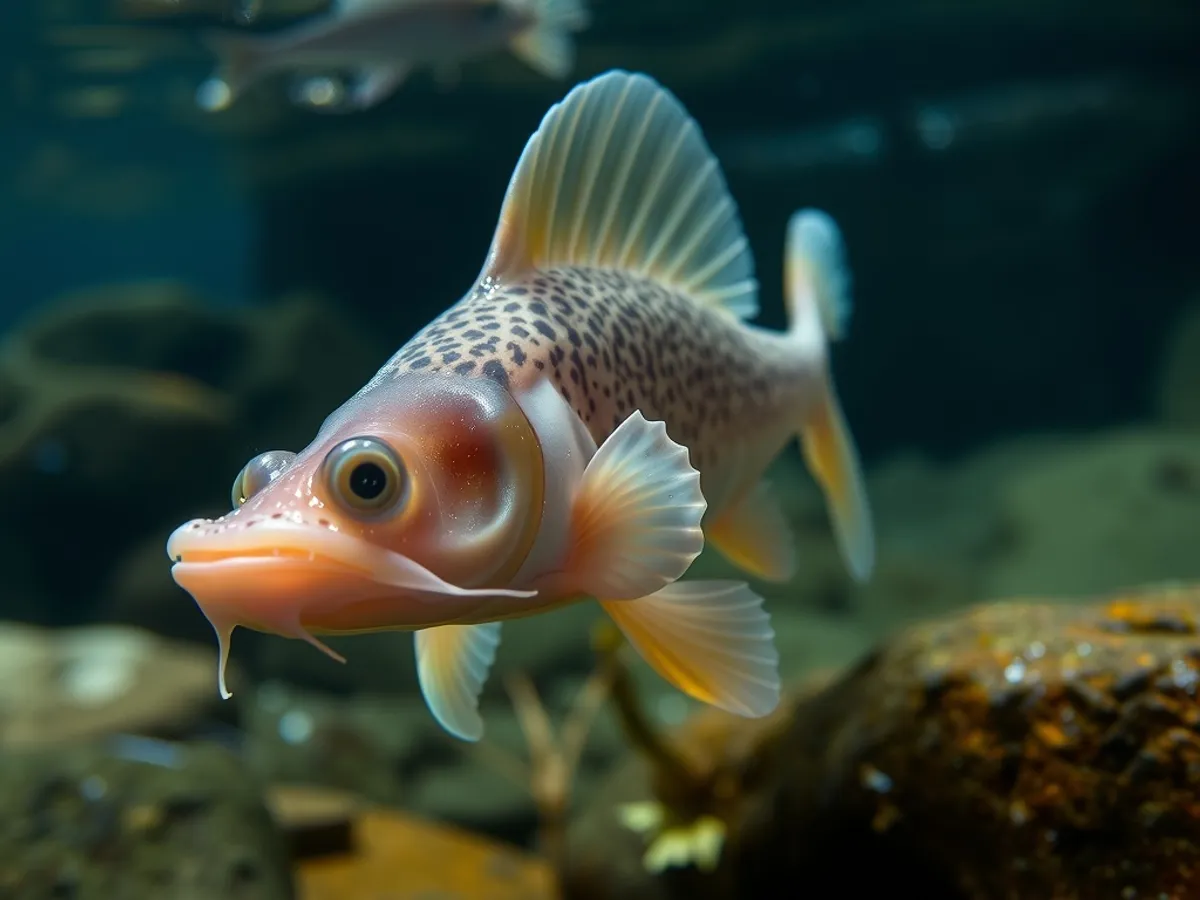
About the Ghost catfish
The ghost catfish, also known as the glass catfish, is a small freshwater fish famous for its almost completely transparent body, which allows its internal organs and spine to be visibly seen. Native to the river systems of Thailand, this species thrives in slow-moving, shaded waters with abundant vegetation. Ghost catfish are peaceful and social, typically schooling together for protection and comfort. Their unique appearance and gentle nature make them a popular choice among aquarium enthusiasts.
Fascinating facts
Transparent Body
The ghost catfish's body is almost entirely transparent, allowing you to see its bones and internal organs clearly.
Sensitive to Environment
They require clean, well-oxygenated water and are sensitive to changes in water quality, making them good indicators of environmental health.
Schooling Behavior
Ghost catfish are social creatures that prefer to live and move in schools, which helps them feel safe from predators.
Detailed description
Kryptopterus vitreolus, commonly known as the ghost catfish or glass catfish, is a small, laterally compressed freshwater catfish notable for its remarkable transparency. Adults typically reach 5–8 cm (2–3 inches) in length, with a slender, elongated body that lacks scales and is almost entirely see-through, except for a silvery patch near the head where the internal organs are concentrated. The dorsal fin is reduced to a tiny, almost invisible ray, while the long, filamentous anal fin extends along much of the ventral surface. The species possesses two long barbels that aid in navigation and prey detection. Ghost catfish are highly social, forming cohesive schools of 5–20 individuals in the wild, which helps reduce predation risk and stress. Their transparency serves as effective camouflage in their native slow-moving, shaded streams, where dappled light and submerged vegetation predominate. They are crepuscular, most active during dawn and dusk, and exhibit a gentle, non-aggressive temperament. In aquaria, they are sensitive to water quality and require stable, soft, slightly acidic conditions to thrive. Their unique anatomy and peaceful schooling behavior make them a subject of interest for both aquarists and researchers studying vertebrate transparency.
Did you know?
Despite their eerie appearance, ghost catfish are completely harmless and often used as bioindicators for water quality in their native habitats.
Research & sources
Wikipedia summary
Kryptopterus vitreolus, known commonly as the glass catfish, the glass cat, the ghost catfish or the phantom catfish, is a small species of translucent-bodied, social glass catfish in the family Siluridae. It is commonly seen in captivity and in the freshwater aquarium trade, although its official taxonomy is still debatable, and was only truly resolved in 2013. Glass catfish are endemic to Thailand, where they inhabit rivers and streams south of the Isthmus of Kra that drain into the Gulf of Thailand and river basins in the Cardamom Mountains. There are also unconfirmed reports from Penang, Malaysia.
Behaviour & social structure
Ghost catfish are obligate schoolers, displaying strong shoaling behavior for both social interaction and predator avoidance. In the wild, they inhabit midwater columns, rarely venturing to the surface or substrate except when startled. Their feeding activity peaks during low-light periods, reflecting their crepuscular nature. They are microcarnivores, preying primarily on small aquatic invertebrates such as insect larvae, zooplankton, and tiny crustaceans, which they detect using their sensitive barbels and lateral line system. In captivity, they readily accept live or frozen foods like daphnia, bloodworms, and brine shrimp. Social hierarchies are minimal, and aggression is rare; individuals communicate through subtle body movements and maintain tight group cohesion. When threatened, the school may scatter briefly before regrouping. Stress or isolation can lead to loss of coloration (turning milky white), reduced feeding, and increased susceptibility to disease.
Reproduction & life cycle
Reproductive behavior in Kryptopterus vitreolus is not fully documented in the wild, but captive breeding has provided some insights. Spawning is believed to be seasonal, likely triggered by changes in water temperature and increased rainfall, mimicking monsoonal cycles in their native range. Courtship involves males displaying increased activity and circling females. Females are oviparous, releasing adhesive eggs among submerged vegetation or fine-leaved plants. Fertilization is external, with males releasing sperm over the eggs. There is no parental care; eggs hatch within 2–3 days depending on temperature, and larvae are free-swimming shortly thereafter. Successful captive breeding is rare and typically requires precise water conditions, including soft, acidic water and a high-quality diet to induce spawning.
Adaptations & survival
The most striking adaptation of the ghost catfish is its near-complete transparency, achieved by the absence of body pigmentation and the arrangement of tissues to minimize light scattering. This adaptation provides camouflage from both predators and prey in clear, slow-moving waters. The reduction of the dorsal fin and the elongation of the anal fin improve maneuverability and stability in midwater habitats. Their long barbels are highly sensitive to tactile and chemical cues, compensating for their relatively poor eyesight in turbid or dimly lit environments. Schooling behavior further enhances survival by confusing predators and facilitating efficient foraging. Physiologically, they are adapted to soft, slightly acidic waters typical of Southeast Asian lowland streams.
Cultural significance
While not prominent in traditional folklore, the ghost catfish has become a symbol of aquatic beauty and fragility in the global aquarium hobby. Its ethereal appearance and peaceful nature have made it a favorite among aquarists, often featured in educational programs about fish anatomy and transparency. In Thailand, it is sometimes referred to in local markets, but it does not hold significant cultural or economic importance outside the ornamental fish trade.
Recent research
Recent taxonomic clarification in 2013 distinguished K. vitreolus from similar species, notably K. bicirrhis, resolving decades of confusion in the aquarium trade and scientific literature. Ongoing research focuses on the genetic basis of transparency, with implications for developmental biology and biomedical imaging. Studies have also examined their stress responses, schooling dynamics, and the ecological role of transparency in predator-prey interactions. Conservation genetics projects are monitoring wild populations to assess genetic diversity and potential impacts of habitat fragmentation.
Videos
Habitat
Freshwater rivers and streams

Conservation
The Ghost catfish is currently classified as Least Concern on the IUCN Red List.
Threats & challenges
Kryptopterus vitreolus is currently assessed as Least Concern by the IUCN, with stable populations in its native range. However, localized threats include habitat degradation from agricultural runoff, deforestation, and water pollution, which can alter the delicate water chemistry required for their survival. Overcollection for the aquarium trade has historically been a concern, but most specimens are now captive-bred. Climate change and hydrological alterations may pose future risks by affecting breeding cycles and habitat availability. Conservation efforts focus on habitat protection and promoting sustainable aquarium trade practices.
Taxonomy
Scientific name
Kryptopterus vitreolus
- Kingdom
- Animalia
- Phylum
- Chordata
- Class
- Actinopterygii
- Order
- Siluriformes
- Family
- Siluridae
- Genus
- Kryptopterus
- Species
- vitreolus
Community notes
Share your observations about the Ghost catfish.
No community notes yet. Be the first!
Discover more wildlife
More fascinating animals from the encyclopedia.