
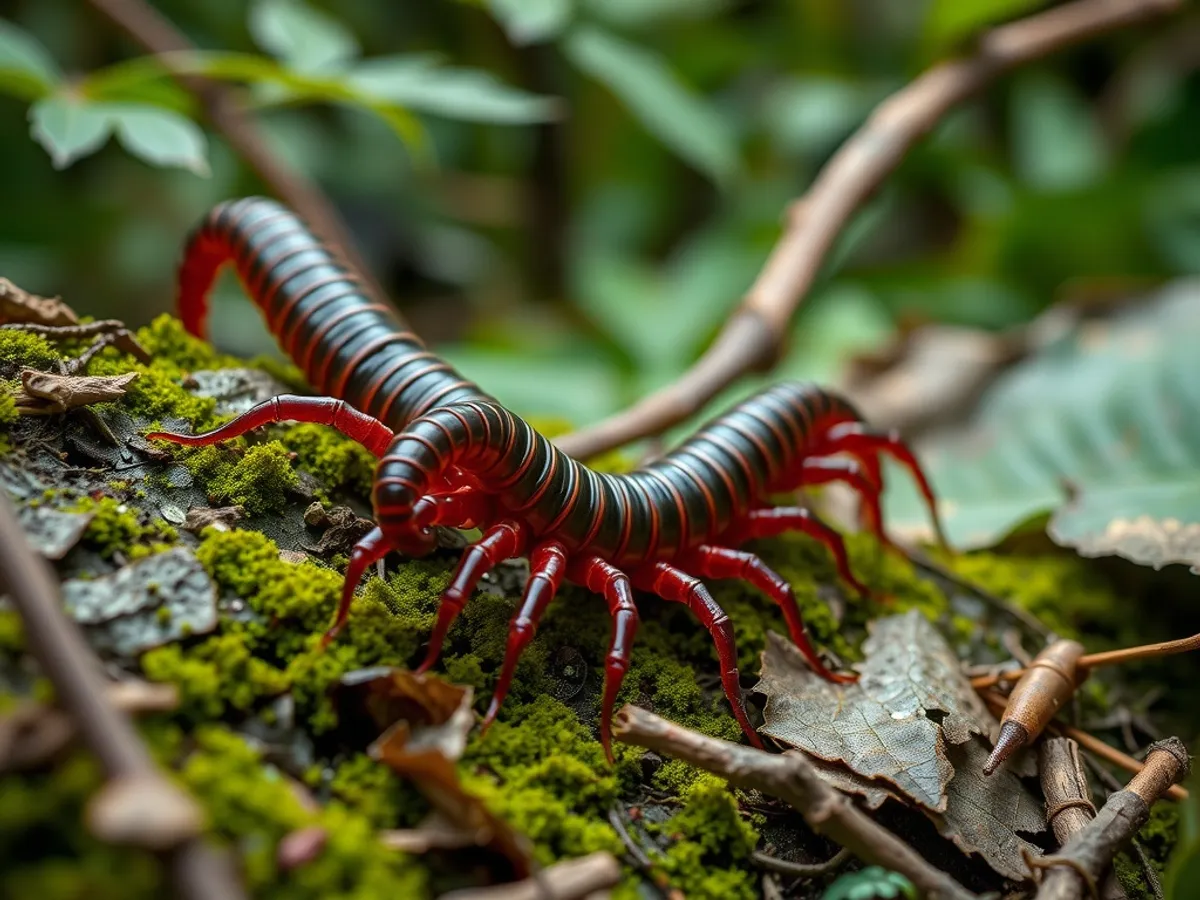
About the Giant Centipede
The Giant Centipede is one of the largest centipede species in the world, renowned for its impressive size and formidable predatory skills. Native to the tropical and subtropical forests of northern South America, this invertebrate can reach lengths of up to 30 centimeters (12 inches). Its elongated, segmented body is equipped with powerful, venomous forcipules that it uses to hunt various prey, including insects, spiders, small mammals, amphibians, and even birds. The Giant Centipede is a nocturnal hunter, relying on its speed and agility to overwhelm much larger animals.
Fascinating facts
Venomous Predator
Giant Centipedes inject venom through modified front legs called forcipules, paralyzing their prey almost instantly.
Nocturnal Hunter
They are primarily active at night, using stealth and speed to ambush a wide variety of animals.
Arboreal Abilities
These centipedes are excellent climbers, often navigating tree trunks, rocky crevices, and even cave ceilings in search of prey.
Detailed description
Scolopendra gigantea, commonly known as the Amazonian giant centipede, is the largest known centipede species, with adults typically measuring 23–30 cm (9–12 inches) in length, though rare specimens may exceed 33 cm (13 inches). Its body is composed of 21–23 distinct, flattened segments, each bearing a single pair of robust, yellowish to reddish legs, with the final pair often elongated and used for defense or sensory purposes. The exoskeleton is tough, glossy, and usually dark reddish-brown, providing both protection and camouflage among leaf litter and decaying wood. The head features a pair of long, sensitive antennae and powerful forcipules—modified front legs that inject venom into prey. S. gigantea is a highly agile and aggressive nocturnal predator, capable of subduing a wide range of vertebrate and invertebrate prey, including insects, tarantulas, small lizards, frogs, rodents, and even small birds. It exhibits solitary behavior, with individuals occupying overlapping territories but rarely interacting outside of mating. The species is oviparous, with females laying clutches of 15–60 eggs in moist, concealed locations and providing maternal care by coiling around the eggs to protect them from desiccation and predation. S. gigantea possesses remarkable climbing abilities, enabling it to hunt both on the forest floor and in low vegetation or caves. Its venom contains a complex cocktail of toxins, including serotonin, histamine, and cytolytic peptides, which rapidly immobilize prey and deter predators. Lifespan in the wild is estimated at 5–7 years, with growth achieved through periodic molting.
Did you know?
The Giant Centipede has been observed preying on bats by climbing cave walls and attacking them while they roost.
Research & sources
Wikipedia summary
Giant centipede may refer to a wide range of large centipedes, notably:Cormocephalus rubriceps, a large centipede native to Australia and New Zealand Ethmostigmus rubripes, a large centipede found in Australia, New Guinea, Solomon Islands, Indonesia, Southeast Asia and China Any centipede of the genus Scolopendra, which contains over 70 known species, all of which can reach a length of at least 10 cm, with many species exceeding 20 cm Scolopendra gigantea, the largest species of centipede in the world, found in tropical South America
Behaviour & social structure
Scolopendra gigantea is primarily nocturnal, emerging from its daytime refuges under logs, rocks, or within crevices to hunt at night. It is an opportunistic ambush predator, relying on stealth and rapid strikes to capture prey. The centipede uses its antennae to detect vibrations and chemical cues, then quickly subdues prey with its venomous forcipules. Feeding is solitary, and cannibalism can occur if individuals encounter each other, especially during periods of food scarcity. Defensive behaviors include rearing up, displaying the terminal legs, and secreting irritant substances. S. gigantea is highly territorial and will aggressively defend its shelter. It does not form social groups, and interactions are limited to brief, sometimes violent, encounters during the mating season.
Reproduction & life cycle
Reproduction in S. gigantea typically occurs during the wet season, when humidity is high. Males deposit a spermatophore on the substrate, which the female collects with her genital opening after a brief courtship involving antennal tapping and body contact. Females lay 15–60 eggs in a concealed, humid microhabitat and exhibit notable parental care, coiling around the eggs and later the hatchlings for several weeks to protect them from predators, fungi, and desiccation. The eggs hatch after 1–2 months, depending on environmental conditions. Juveniles resemble miniature adults and undergo multiple molts before reaching maturity, which may take 2–3 years. Parental care ceases once the young are sufficiently developed to disperse.
Adaptations & survival
Scolopendra gigantea exhibits several key adaptations for survival in its tropical environment. Its elongated, flexible body allows it to navigate complex substrates, while its powerful, venomous forcipules enable it to subdue prey much larger than itself. The centipede's exoskeleton provides protection against desiccation and predation. Its terminal legs mimic antennae, confusing predators and aiding in defense. The species' ability to climb vertical surfaces and swim short distances increases its hunting range. Nocturnality reduces competition and predation risk. Venom composition is highly evolved, containing neurotoxins and cytolytic agents that rapidly incapacitate prey and deter vertebrate predators.
Cultural significance
Scolopendra gigantea features prominently in local folklore and indigenous traditions throughout its range. In some Amazonian cultures, it is regarded with fear and respect due to its size and potent venom, often symbolizing danger or resilience. Traditional medicine in certain regions has used centipede-derived preparations for treating pain and inflammation, though scientific evidence for efficacy is limited. The species is sometimes kept as an exotic pet, admired for its impressive appearance and predatory prowess, but also regarded as dangerous and requiring specialized care.
Recent research
Recent studies have focused on the biochemical composition of S. gigantea venom, revealing novel peptides with potential pharmaceutical applications, including antimicrobial and analgesic properties. Ecological research has examined its role as a top invertebrate predator in neotropical ecosystems, influencing prey populations and contributing to nutrient cycling. Ongoing genetic studies aim to clarify phylogenetic relationships within the Scolopendra genus and assess population structure across its range. Behavioral research has documented maternal care and cannibalism, providing insights into the evolution of parental investment in centipedes.
Videos
Habitat
Tropical rainforest


Conservation
The Giant Centipede is currently classified as Least Concern on the IUCN Red List.
Threats & challenges
Currently, S. gigantea is listed as Least Concern, with stable populations across its range in northern South America, including Venezuela, Colombia, Trinidad, and parts of the Amazon basin. However, habitat destruction due to deforestation, agricultural expansion, and urbanization poses localized threats. Collection for the exotic pet trade may also impact some populations. The species faces predation from birds, mammals, and larger reptiles, but its venom and defensive behaviors provide effective deterrence. Climate change, particularly shifts in humidity and temperature, could affect its reproductive success and distribution in the future.
Taxonomy
Scientific name
Scolopendra gigantea
- Kingdom
- Animalia
- Phylum
- Arthropoda
- Class
- Chilopoda
- Order
- Scolopendromorpha
- Family
- Scolopendridae
- Genus
- Scolopendra
- Species
- gigantea
Community notes
Share your observations about the Giant Centipede.
No community notes yet. Be the first!
Discover more wildlife
More fascinating animals from the encyclopedia.