
About the Giant Eland
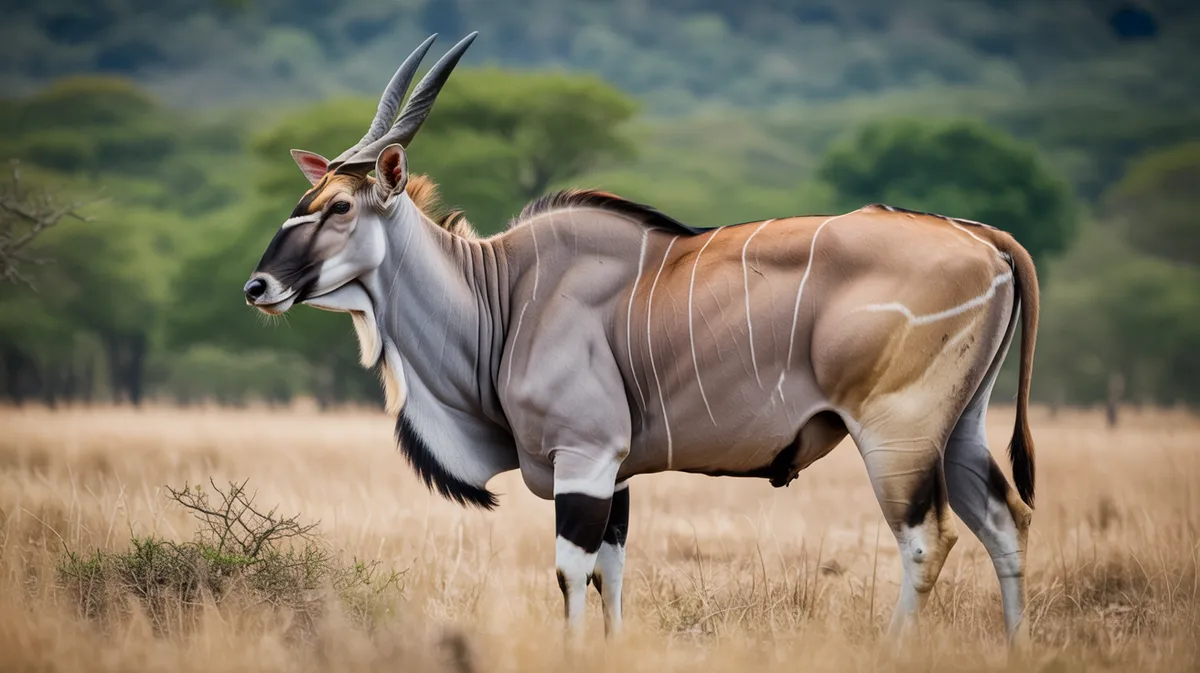
The Giant Eland is the largest species of antelope, renowned for its impressive spiral horns and striking stature. Native to the savannas and woodlands of Central and West Africa, this majestic animal is highly adaptable, utilizing its speed and agility to avoid predators. Males can weigh over a metric ton and both sexes sport long, elegant horns that can reach up to 1.2 meters in length. Socially, giant elands form loose herds and are known for their elusive and shy behavior, making them difficult to observe in the wild.
Fascinating facts
Largest Antelope
The giant eland holds the title of the largest antelope species, with some males standing up to 1.8 meters at the shoulder.
Selective Browser
Their diet consists mainly of leaves, grasses, and fruits, and they often feed at dawn and dusk to avoid the heat.
Elusive and Alert
Giant elands are extremely wary and have keen senses, making them one of the most challenging African antelopes to approach in the wild.
Detailed description
The giant eland (Taurotragus derbianus) is the largest living antelope, with males typically weighing between 600 and 1000 kg, and exceptional individuals exceeding 1,200 kg. Females are notably smaller, averaging 400–600 kg. Their robust bodies are supported by long, slender legs adapted for speed and endurance, and their coats are a reddish-brown to chestnut color, marked by 8–15 narrow white vertical stripes along the torso. Both sexes possess tightly spiraled horns, with males' horns reaching up to 123 cm and females' up to 66 cm. The dewlap is prominent, especially in males, and is thought to aid in thermoregulation. Giant elands are highly alert and elusive, with acute senses of hearing and smell. They are primarily crepuscular, being most active at dawn and dusk, and are capable of remarkable bursts of speed (up to 70 km/h) and high jumps (over 1.5 meters). Socially, they form loose, nomadic herds of 15–25 individuals, though larger aggregations may occur seasonally. Herds are typically composed of females and their young, while adult males are often solitary or form bachelor groups. The species is known for its extensive home ranges, sometimes exceeding 500 km², and its ability to traverse varied habitats, from open woodlands to gallery forests. Their elusive nature and preference for dense cover make them difficult to observe in the wild.
Did you know?
Despite their massive size, giant elands are surprisingly agile and can outrun most predators over short distances.
Research & sources
Wikipedia summary
The giant eland, also known as the Lord Derby's eland or greater eland, is an open-forest and savanna antelope. A species of the family Bovidae and genus Taurotragus, it was described in 1847 by John Edward Gray. The giant eland is the largest species of antelope, with a body length ranging from 220–290 cm (7.2–9.5 ft). There are two subspecies: T. d. derbianus and T. d. gigas.
Behaviour & social structure
Giant elands are predominantly browsers, feeding on leaves, shoots, fruits, and seeds from a wide variety of trees and shrubs, though they will also graze on grasses when available. Their diet shifts seasonally, with increased browsing during the dry season. They are highly mobile, traveling long distances in search of food and water, and are capable of surviving for extended periods without direct water intake, deriving moisture from their diet. Social interactions are generally peaceful, with minimal aggression except during the breeding season when males compete for access to females through displays and occasional sparring. Vocalizations are rare, but they communicate through low-frequency rumbles, snorts, and visual signals such as head tossing and body posturing. Daily routines involve periods of foraging interspersed with rest in shaded areas during the hottest parts of the day. Giant elands are wary of predators such as lions, hyenas, and African wild dogs, relying on their speed and agility to escape threats.
Reproduction & life cycle
Giant elands exhibit a polygynous mating system, with dominant males seeking to mate with multiple females during the breeding season, which typically coincides with the end of the dry season (December to April, varying by region). Courtship involves males following and guarding estrous females, accompanied by displays such as neck stretching and horn presentation. After successful mating, the gestation period lasts approximately 9 months (270–280 days), culminating in the birth of a single calf, usually at the onset of the rainy season when resources are abundant. Calves are precocial, able to stand and follow their mothers within hours of birth. Mothers hide their young in dense vegetation for the first few weeks, visiting them periodically for nursing. Weaning occurs at 4–6 months, but calves may remain with their mothers for up to a year. Sexual maturity is reached at 2–3 years for females and 4–5 years for males.
Adaptations & survival
The giant eland's large body size and long legs confer advantages in traversing vast distances and escaping predators. Their spiral horns are used for defense and intraspecific competition. The prominent dewlap aids in heat dissipation, a crucial adaptation for life in hot climates. Their coat coloration and striping provide camouflage in dappled woodland environments. Behavioral adaptations include nomadic movement patterns to exploit patchy food resources and the ability to browse a wide range of plant species, reducing competition with other herbivores. Their acute senses and skittish nature enhance predator avoidance. Physiologically, they can conserve water and tolerate high temperatures, allowing survival in arid and semi-arid regions.
Cultural significance
Giant elands have long featured in the folklore and traditional beliefs of West and Central African peoples, often symbolizing strength, endurance, and grace. Their horns and hides have been used in ceremonial attire and as status symbols. In some cultures, eland meat is considered a delicacy, and traditional hunting played a role in community rituals. The species is also an important flagship for conservation efforts, serving as a symbol for the preservation of African savanna and woodland ecosystems.
Recent research
Recent research has focused on the genetic differentiation between the two subspecies, with molecular studies confirming significant divergence. Satellite telemetry has provided new insights into their extensive ranging behavior and habitat use, informing conservation planning. Studies on diet and digestive physiology have highlighted their adaptability to seasonal changes in food availability. Conservation programs, such as the Derby Eland Project in Senegal, are pioneering community-based management and anti-poaching strategies. Ongoing research is also investigating the impacts of climate change and habitat fragmentation on population viability.
Videos
Habitat
Open forests, savannas, and woodlands
Conservation
The Giant Eland is currently classified as Vulnerable on the IUCN Red List.
Threats & challenges
The giant eland faces significant threats from habitat loss due to agricultural expansion, deforestation, and human settlement. Poaching for meat and horns, as well as unregulated trophy hunting, has led to severe population declines, particularly in West and Central Africa. The species is classified as Vulnerable by the IUCN, with the western subspecies (T. d. derbianus) considered Critically Endangered and surviving only in a few protected reserves. Fragmentation of populations and loss of genetic diversity are additional concerns. Disease transmission from livestock and competition for resources further exacerbate their decline. Conservation challenges include inadequate law enforcement, civil unrest in range countries, and limited funding for protected area management.
Taxonomy
Scientific name
Taurotragus derbianus
- Kingdom
- Animalia
- Phylum
- Chordata
- Class
- Mammalia
- Order
- Artiodactyla
- Family
- Bovidae
- Genus
- Taurotragus
- Species
- derbianus
Where to see a giant eland
2 zoos and aquariums in 1 country are recorded as keeping this species.

Community notes
Share your observations about the Giant Eland.
No community notes yet. Be the first!
Discover more wildlife
More fascinating animals from the encyclopedia.