
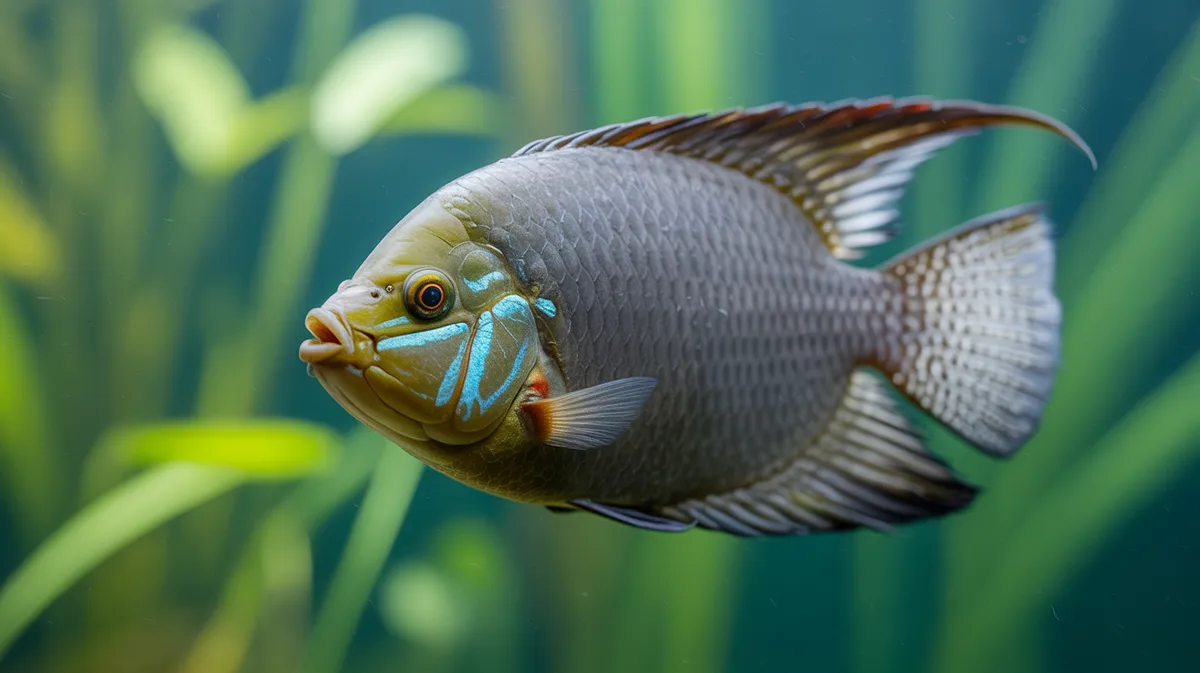
About the Giant Gourami
The giant gourami is a large freshwater fish native to Southeast Asia, renowned for its impressive size and distinctive, thick-lipped face. Its body is laterally compressed and can take on shades of silver, gray, or pale pink, often with darker stripes in juveniles. Adapted to stagnant and slow-moving waters, this species is capable of breathing air thanks to a labyrinth organ, allowing it to survive in oxygen-poor environments. Giant gouramis are popular both as food fish in their native range and as ornamental species in large aquariums due to their hardy nature and gentle temperament.
Fascinating facts
Air Breather
The giant gourami possesses a specialized labyrinth organ that allows it to breathe atmospheric air, enabling it to survive in low-oxygen waters.
Voracious Eater
This species is omnivorous, feeding on a wide variety of plant material, fruits, and occasionally small animals or insects.
Adaptable Habitat
Giant gouramis can thrive in diverse freshwater habitats, from slow-moving rivers and lakes to urban ponds and swamps.
Detailed description
The giant gourami (Osphronemus goramy) is a robust, deep-bodied freshwater fish that can reach lengths of up to 70 cm (27.5 in) and weights exceeding 8 kg (17.6 lbs), though most individuals are smaller in the wild. Its body is laterally compressed with a prominent, thick-lipped mouth and a rounded forehead, especially pronounced in mature males. The dorsal and anal fins are elongated and soft-rayed, extending toward the caudal fin, while the pelvic fins are threadlike and sensitive, aiding in environmental exploration. Juveniles display vertical dark bands that fade with age, transitioning to a uniform pale silver, gray, or pinkish hue in adults. The skin is covered with large, cycloid scales, and the species exhibits sexual dimorphism: males develop a pronounced nuchal hump and longer fin extensions. The giant gourami possesses a labyrinth organ, a specialized respiratory structure enabling it to breathe atmospheric air, allowing survival in hypoxic or stagnant waters. Its eyes are relatively large, providing good vision in turbid environments. This species is known for its longevity, often living 20 years or more in captivity. Its slow, deliberate swimming style and ability to tolerate a wide range of water conditions contribute to its popularity as both a food and ornamental fish.
Did you know?
Despite their size, giant gouramis can be surprisingly gentle and are often kept as companion animals in large aquariums.
Research & sources
Wikipedia summary
The giant gourami is a species of large gourami native to freshwater habitats in Southeast Asia. It has also been introduced elsewhere. The species is commercially important as a food fish and is also farmed. It can be found in the aquarium trade, as well. The species has been used for weed control on highly invasive aquatic plants like Salvinia molesta, as the giant gourami can be a voracious herbivore.
Behaviour & social structure
Giant gouramis are generally diurnal, exhibiting peak activity during daylight hours. They are omnivorous, feeding on a wide variety of plant material, algae, aquatic weeds, fruits, and occasionally small invertebrates or fish. In the wild, they are known to graze on submerged vegetation and can be highly effective in controlling invasive aquatic plants such as Salvinia molesta. Feeding is accomplished by nipping or uprooting plants with their strong jaws. Socially, giant gouramis are relatively peaceful but can become territorial, especially during breeding or in confined spaces. In natural settings, they may form loose aggregations but are often solitary or found in pairs. In captivity, they can coexist with other large, non-aggressive fish but may display dominance behaviors. They are known for their intelligence, recognizing caretakers and even learning simple behaviors. Resting behavior includes hovering near the surface to gulp air or sheltering among submerged roots and vegetation.
Reproduction & life cycle
Giant gouramis are oviparous and exhibit elaborate nest-building behavior. During the breeding season, which typically coincides with the onset of the rainy season in their native range, males construct large, floating bubble nests using plant debris and secreted mucus. Courtship involves the male displaying to the female and guiding her to the nest. After spawning, the female releases several thousand eggs, which the male fertilizes externally. The male then guards and tends the nest, maintaining its structure and protecting the eggs from predators. Incubation lasts 24–36 hours, after which the larvae hatch and remain in the nest for several days, absorbing their yolk sacs. The male continues to guard the fry until they are free-swimming and able to fend for themselves. Sexual maturity is typically reached at 2–3 years of age.
Adaptations & survival
Key adaptations of the giant gourami include the labyrinth organ, which allows efficient aerial respiration in oxygen-depleted waters—a significant evolutionary advantage in stagnant or seasonally variable habitats. Their omnivorous diet and robust digestive system enable them to exploit a wide range of food sources, including tough aquatic vegetation. The species' large size and thick scales provide protection against many predators. Behavioral adaptations include nest-building and parental care, which enhance offspring survival. Their tolerance for a broad range of water temperatures (20–30°C) and pH values (6.0–8.0) facilitates survival in diverse environments, including artificial and degraded habitats.
Cultural significance
The giant gourami holds significant cultural and economic value in Southeast Asia. It is a staple food fish, prized for its firm, mild-flavored flesh and is commonly featured in traditional dishes. In Indonesia, it is known as 'ikan gurame' and is often served at ceremonial events and feasts. The species is also popular in ornamental fishkeeping, symbolizing prosperity and longevity in some cultures. In addition, its use in biological control of invasive aquatic plants highlights its ecological importance. Folklore and local proverbs sometimes reference the gourami's resilience and adaptability.
Recent research
Recent research has focused on optimizing aquaculture practices, including selective breeding for faster growth and disease resistance. Studies on the species' digestive physiology have informed the development of plant-based feeds, reducing reliance on fishmeal. Genetic analyses have clarified phylogenetic relationships within Osphronemidae and identified potential cryptic species. Ecological research has examined the impact of introduced populations on native ecosystems, particularly in Africa and Australia. The species' role in weed control has been evaluated in the context of integrated pest management. Ongoing studies are assessing the effects of climate change on distribution and reproductive timing.
Videos
Habitat
Freshwater rivers, swamps, and lakes

Conservation
The Giant Gourami is currently classified as Least Concern on the IUCN Red List.
Threats & challenges
While the giant gourami is currently listed as Least Concern by the IUCN, localized threats exist. Overfishing for food and the aquarium trade, habitat degradation due to pollution, damming, and wetland conversion can impact wild populations. Invasive populations outside their native range may disrupt local ecosystems. Disease outbreaks, particularly in aquaculture settings, pose additional challenges. However, their adaptability and widespread use in aquaculture have helped maintain stable population numbers overall. Conservation efforts focus on sustainable management and monitoring of both wild and farmed stocks.
Taxonomy
Scientific name
Osphronemus goramy
- Kingdom
- Animalia
- Phylum
- Chordata
- Class
- Actinopterygii
- Order
- Anabantiformes
- Family
- Osphronemidae
- Genus
- Osphronemus
- Species
- goramy
Where to see a giant gourami
1 zoo and aquarium in 1 country are recorded as keeping this species.
Community notes
Share your observations about the Giant Gourami.
No community notes yet. Be the first!
Discover more wildlife
More fascinating animals from the encyclopedia.