
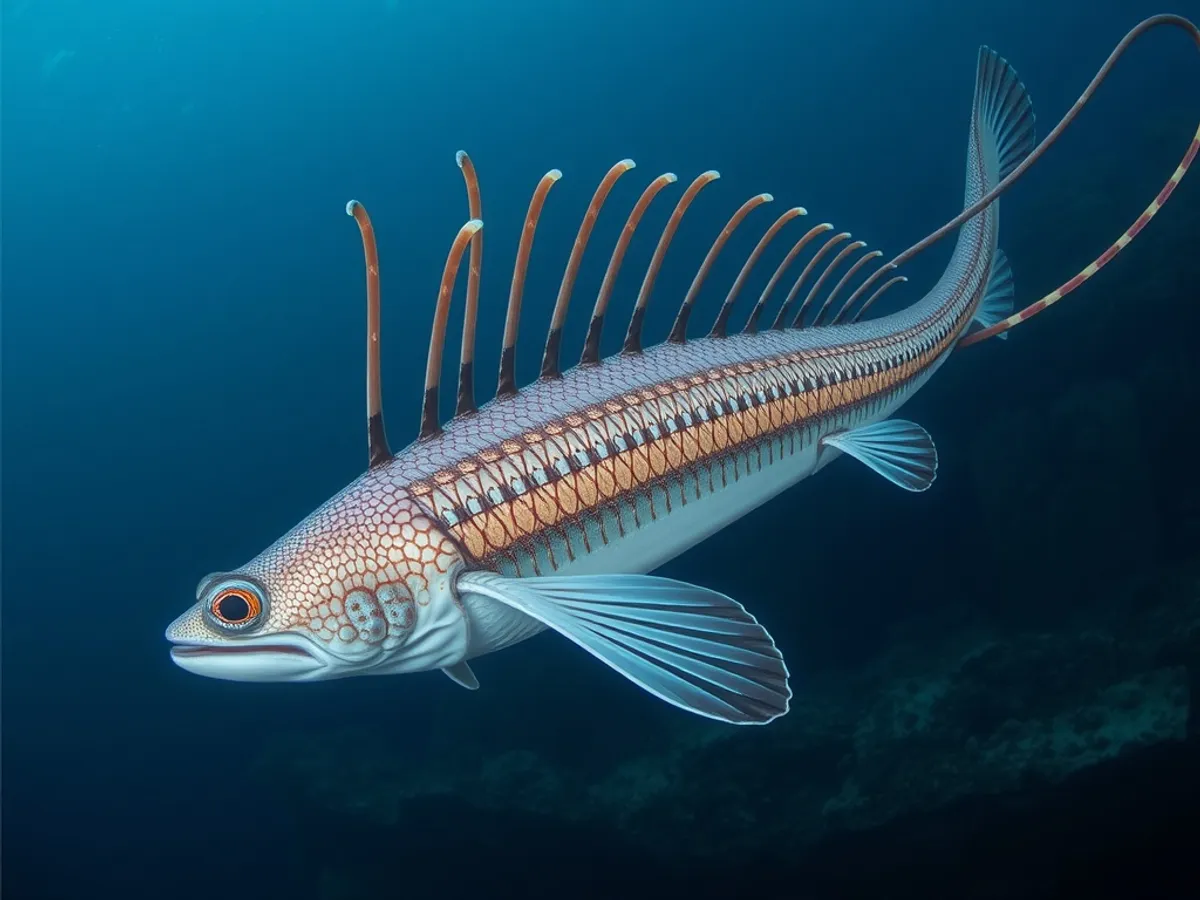
About the Giant oarfish
Regalecus glesne is the longest bony fish alive, with reliable specimens over 8 m and credible reports of considerably more, and a body compressed into a silvery ribbon a few centimetres thick. It has no scales; it is coated instead in guanine, which is what gives it the metallic sheen. It has no swim bladder. It has no real teeth. It is not the terrifying sea monster its appearance implies — the oarfish drifts in the open ocean straining krill and small crustaceans through gill rakers, using a protrusible mouth that shoots forward to engulf them. The few times a healthy one has been filmed alive, it was hanging vertically in the water, head up, holding station by rippling the long crimson dorsal fin that runs the whole length of its body while the body itself stayed rigid — a swimming mode utterly unlike the eel-like thrashing usually imagined. Almost every oarfish a person ever sees is a sick or dying one washed into the shallows, which is precisely why they have generated so much folklore, from the sea serpents of European sailors to the Japanese ryugu no tsukai, the messenger from the sea god's palace, said to strand before an earthquake. That last belief has been tested against the records and does not hold up.
Fascinating facts
World's Longest Bony Fish
The giant oarfish holds the record for the longest bony fish, with verified individuals reaching up to 11 meters (36 feet) in length.
Deep-Sea Dweller
This elusive species typically lives at depths ranging from 200 to 1,000 meters (656 to 3,280 feet) below the ocean surface.
Sea Serpent Origins
Sightings of giant oarfish swimming near the surface are thought to have inspired ancient tales of massive sea serpents.
Detailed description
The giant oarfish (Regalecus glesne) is the largest known bony fish, with verified specimens reaching up to 8 meters (26 feet) and unconfirmed reports of individuals exceeding 11 meters (36 feet) in length. Its body is greatly elongated, laterally compressed, and ribbon-like, covered in silvery, scaleless skin with a metallic sheen. The dorsal fin runs the entire length of the body, beginning just above the eyes and composed of up to 400 soft rays, the first few of which are greatly extended and form a distinctive crimson crest. The pelvic fins are reduced to long, trailing filaments, while the pectoral fins are small and set low on the body. The head is relatively small with a protrusible mouth adapted for suction feeding. Oarfish lack swim bladders, relying on their gelatinous tissues and low-density bones for neutral buoyancy. Their large eyes are adapted for low-light conditions, reflecting their deep-sea habitat. The internal anatomy is specialized for a pelagic lifestyle, with a reduced skeleton and a high water content (up to 75% of body mass). Rarely observed alive, oarfish are typically encountered near the surface when sick, dying, or after storms, which has contributed to their legendary status.
Did you know?
The giant oarfish is believed to be the origin of many legendary sea serpent sightings reported by sailors.
Research & sources
Wikipedia summary
The giant oarfish is a species of oarfish of the family Regalecidae. It is an oceanodromous species with a worldwide distribution, excluding polar regions. Other common names include Pacific oarfish, king of herrings, ribbonfish, and streamer fish.
Behaviour & social structure
Giant oarfish are solitary and elusive, spending most of their lives in mesopelagic to bathypelagic zones, typically at depths of 200–1,000 meters (660–3,280 feet), though they may ascend to shallower waters. Their locomotion is unique: they swim by undulating their long dorsal fin in a sinuous, ribbon-like motion, while the body remains relatively straight, allowing for precise vertical movement. Feeding primarily occurs at depth, where they consume zooplankton, small crustaceans, squid, and occasionally small fish, using rapid suction generated by their protrusible jaws. There is no evidence of active hunting; instead, they are believed to be opportunistic feeders, drifting with ocean currents and capturing prey that comes within reach. Social interactions are minimal, with no evidence of schooling or cooperative behavior. Oarfish are thought to be mostly nocturnal, ascending to shallower depths at night to feed, though this is based on limited observations.
Reproduction & life cycle
Reproductive biology of the giant oarfish is poorly understood due to the rarity of live observations. They are believed to be broadcast spawners, releasing large numbers of buoyant eggs (up to 6 mm in diameter) into the water column, where external fertilization occurs. Spawning likely takes place in the open ocean, possibly seasonally, but precise timing and locations are unknown. Larvae are pelagic, transparent, and morphologically distinct from adults, with elongated dorsal fin rays and a more upright swimming posture. There is no evidence of parental care; eggs and larvae are left to develop independently. Sexual maturity is estimated to occur at lengths of 3–5 meters, but this is based on limited specimen data.
Adaptations & survival
Giant oarfish exhibit several adaptations for deep-sea life. Their elongated, ribbon-like body minimizes energy expenditure and allows them to maneuver vertically through the water column. The absence of scales and the presence of a gelatinous, water-rich tissue reduce density, aiding buoyancy in the absence of a swim bladder. Their large, sensitive eyes are adapted for detecting faint light and bioluminescence at depth. The extended dorsal fin rays and trailing pelvic filaments may serve as sensory organs, detecting vibrations or changes in water pressure. Their protrusible jaws and rapid suction feeding mechanism are effective for capturing small, elusive prey in the open ocean. The silvery, reflective skin provides camouflage in the dimly lit mesopelagic zone.
Cultural significance
The giant oarfish has played a prominent role in maritime folklore and mythology, often cited as the origin of 'sea serpent' legends due to its enormous size and undulating movement. In Japanese culture, it is known as 'Ryugu no tsukai' (Messenger from the Sea God's Palace) and is considered an omen of earthquakes or tsunamis, a belief reinforced by strandings preceding seismic events. Oarfish have appeared in art, literature, and popular media as mysterious and awe-inspiring creatures. There is no evidence of traditional use as food or medicine, likely due to their rarity and gelatinous flesh.
Recent research
Recent advances in deep-sea submersible technology and remotely operated vehicles (ROVs) have enabled rare in situ observations of giant oarfish, providing new insights into their swimming behavior and habitat preferences. Genetic studies have begun to clarify their phylogenetic relationships within Lampriformes. Ongoing research focuses on larval development, population genetics, and the ecological role of oarfish in pelagic food webs. Notably, a 2010 ROV video off the Gulf of Mexico captured the first live footage of a healthy oarfish swimming in its natural habitat. Stable isotope analysis is being used to better understand their diet and trophic position.
Videos
Habitat
Deep ocean

Conservation
The Giant oarfish is currently classified as Least Concern on the IUCN Red List.
Threats & challenges
Currently, the giant oarfish faces few direct threats due to its deep-sea habitat and low commercial value. Bycatch in deep-sea trawling operations and entanglement in fishing gear are occasional risks. Climate change and ocean deoxygenation may impact their prey availability and distribution, though specific effects are unknown. Because oarfish are rarely encountered and difficult to study, population trends remain unclear, but there is no evidence of significant decline. The IUCN Red List classifies the species as Least Concern. Accidental strandings and surface appearances are often linked to natural causes such as injury, disease, or oceanographic events.
Taxonomy
Scientific name
Regalecus glesne
- Kingdom
- Animalia
- Phylum
- Chordata
- Class
- Actinopterygii
- Order
- Lampriformes
- Family
- Regalecidae
- Genus
- Regalecus
- Species
- glesne
Community notes
Share your observations about the Giant oarfish.
No community notes yet. Be the first!
Discover more wildlife
More fascinating animals from the encyclopedia.