
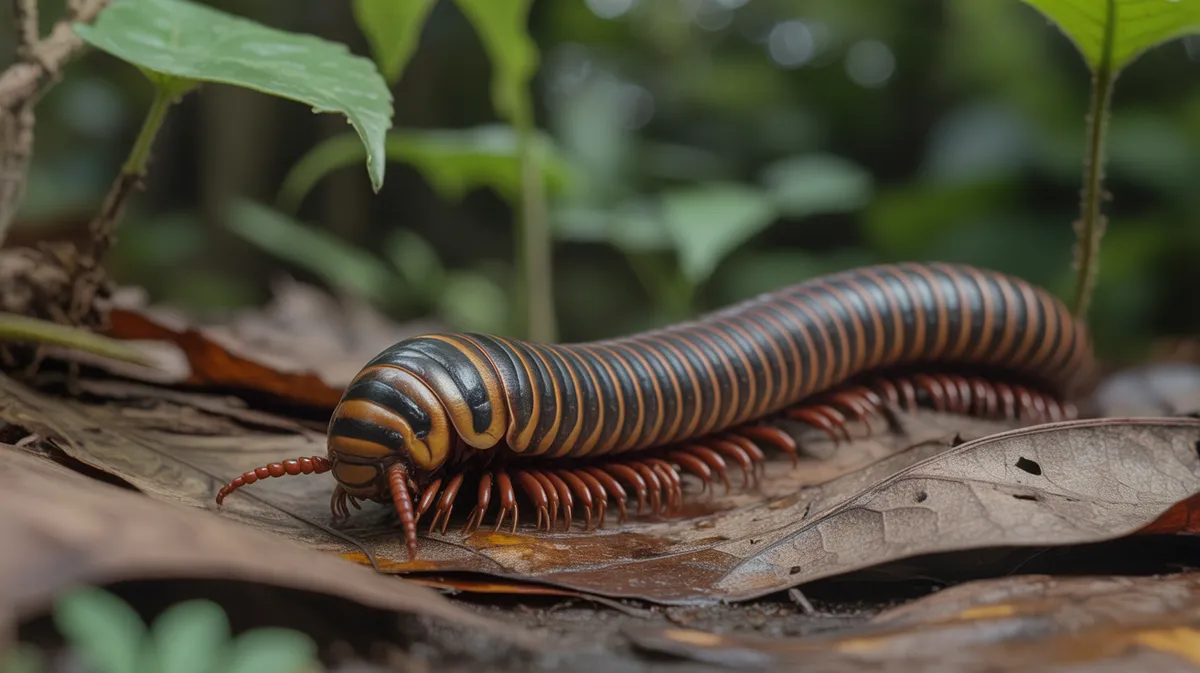
About the Giant pill millipede
The giant pill millipede is a striking invertebrate native to the forests of Madagascar and southern Africa. Known for their ability to roll into a tight ball as a defensive mechanism, these millipedes can reach sizes much larger than most other millipede species. Their segmented, glossy exoskeleton provides protection against predators and environmental hazards. Despite their size, giant pill millipedes are harmless detritivores, playing a crucial role in breaking down organic matter on the forest floor.
Fascinating facts
Ball Defense
When threatened, the giant pill millipede rolls into a tight sphere, protecting its vulnerable underside from predators.
Forest Recycler
These millipedes feed on decaying plant material, playing an important ecological role in nutrient cycling.
Not an Insect
Despite their appearance, giant pill millipedes are not insects but are classified as myriapods, more closely related to centipedes.
Detailed description
The giant pill millipede (Sphaerotherium giganteum) is among the largest of the pill millipedes, with adults reaching diameters of up to 6.5 cm (2.5 inches) when fully rolled into a ball. Its body is composed of 13–15 robust, glossy, and heavily calcified tergites (dorsal plates), which overlap to form a nearly perfect sphere when the animal is threatened—a defense known as volvation. The exoskeleton is typically dark brown to black, sometimes with subtle iridescence, and is highly resistant to desiccation and predation. The head is small and tucked beneath the anterior segments, equipped with short antennae and simple ocelli for detecting light. S. giganteum possesses two pairs of legs per body segment, with a total of 30–40 pairs in adults, adapted for burrowing and navigating leaf litter. Internally, the digestive tract is specialized for breaking down tough, lignin-rich plant detritus, aided by symbiotic gut microbes. Respiration occurs via spiracles connected to an internal tracheal system. These millipedes are primarily nocturnal, emerging at dusk to feed and retreating to moist microhabitats during the day. Their slow, deliberate movements and cryptic coloration help them avoid detection by predators such as birds, small mammals, and reptiles.
Did you know?
Unlike most millipedes, giant pill millipedes have the remarkable ability to close themselves into a completely sealed ball, making them almost impenetrable to most predators.
Research & sources
Wikipedia summary
Sphaerotheriida is an order of millipedes in the infraclass Pentazonia, sometimes known as giant pill millipedes. They inhabit Southern Africa, Madagascar, South and Southeast Asia, Australia and New Zealand. Like the Northern Hemisphere pill millipedes of the order Glomerida, these millipedes can roll into a ball when disturbed. When they are rolled-up, most sphaerotheriidans reach a maximum size of a cherry or golf ball, but some species from Madagascar can even reach the size of an orange. When rolled-up, predators are unable to unravel giant pill millipedes since the margins of their second and last dorsal plates fit perfectly into one another, creating a sealed ball. A few giant pill millipede species are able to produce sound, the only millipedes known to do this. This order of millipedes is also unique in that some African species are used for medicinal purposes.
Behaviour & social structure
Giant pill millipedes are solitary detritivores, spending much of their time concealed beneath leaf litter, decaying logs, or stones. They exhibit thigmotactic behavior, preferring close contact with surfaces, which reduces water loss and predation risk. Feeding occurs mostly at night, when humidity is higher, and consists of consuming decomposing plant matter, fungi, and occasionally small invertebrates. S. giganteum is capable of producing faint stridulatory sounds by rubbing specialized body parts, a rare trait among millipedes, likely serving as a deterrent to predators or as a means of intraspecific communication. When threatened, they rapidly curl into a tight ball, sealing themselves with interlocking tergite margins, making them nearly impossible to pry open. Social interactions are minimal outside of the breeding season, though aggregations may occur in particularly favorable microhabitats.
Reproduction & life cycle
Breeding in Sphaerotherium giganteum typically coincides with the onset of the rainy season, when environmental moisture supports egg development. Males locate females using pheromone cues and engage in brief courtship behaviors, including antennal tapping and body alignment. Copulation involves the transfer of spermatophores via modified legs (gonopods) on the male's seventh segment. Females lay clutches of 20–50 eggs in shallow, self-constructed chambers within moist soil or leaf litter. The eggs are coated with a protective secretion to prevent desiccation. Incubation lasts 4–6 weeks, after which the juveniles emerge as miniature versions of adults, with fewer segments and legs. There is no parental care post-oviposition. Juveniles undergo successive molts, adding segments and legs with each instar, reaching maturity in approximately 2–3 years.
Adaptations & survival
S. giganteum's most distinctive adaptation is its ability to perform volvation, rolling into a sealed, armored sphere that protects its vulnerable ventral surface and deters predators. The interlocking tergites and calcified exoskeleton provide exceptional mechanical defense. Its nocturnal and fossorial habits minimize water loss and exposure to diurnal predators. The presence of symbiotic gut bacteria enables efficient digestion of lignocellulosic plant material, allowing exploitation of nutrient-poor detritus. Stridulation, while rare in millipedes, may serve as an anti-predator adaptation or facilitate mate recognition. Their low metabolic rate and tolerance for hypoxic microhabitats further enhance survival in fluctuating forest floor environments.
Cultural significance
In parts of southern Africa, giant pill millipedes have been used in traditional medicine, believed to possess properties beneficial for treating various ailments, though scientific validation is lacking. Their unique ability to roll into a ball has made them subjects of local folklore and curiosity, sometimes symbolizing protection or resilience. In some regions, they are collected and sold as novelty pets, though this practice is discouraged due to conservation concerns. Educational programs occasionally highlight their ecological role in nutrient cycling and soil health.
Recent research
Recent research has focused on the phylogenetics and biogeography of Sphaerotheriida, revealing ancient Gondwanan origins and high levels of endemism, particularly in Madagascar. Studies using molecular markers have clarified relationships within the group and highlighted cryptic species diversity. Investigations into their gut microbiome have uncovered novel lignocellulose-degrading bacteria, with potential applications in biotechnology. Behavioral studies have documented the rare stridulatory ability and its possible functions. Ongoing conservation research aims to assess population trends and the impacts of habitat fragmentation, with several species proposed as bioindicators of forest ecosystem health.
Videos
Habitat
Moist forest floor, particularly in leaf litter of rainforests and woodlands


Conservation
The Giant pill millipede is currently classified as Near Threatened on the IUCN Red List.
Threats & challenges
Giant pill millipedes face several conservation challenges, including habitat loss due to deforestation, agricultural expansion, and urbanization. Their dependence on moist, undisturbed leaf litter makes them particularly sensitive to microclimatic changes and soil compaction. Collection for the pet trade and traditional medicine poses localized threats, especially in Madagascar and southern Africa. Pesticide use and invasive species further impact populations. While some populations remain stable in protected areas, others are declining, warranting a Near Threatened status. Climate change, with its potential to alter rainfall patterns and humidity, may further threaten their specialized habitats.
Taxonomy
Scientific name
Sphaerotherium giganteum
- Kingdom
- Animalia
- Phylum
- Arthropoda
- Class
- Diplopoda
- Order
- Sphaerotheriida
- Family
- Sphaerotheriidae
- Genus
- Sphaerotherium
- Species
- giganteum
Community notes
Share your observations about the Giant pill millipede.
No community notes yet. Be the first!
Discover more wildlife
More fascinating animals from the encyclopedia.