
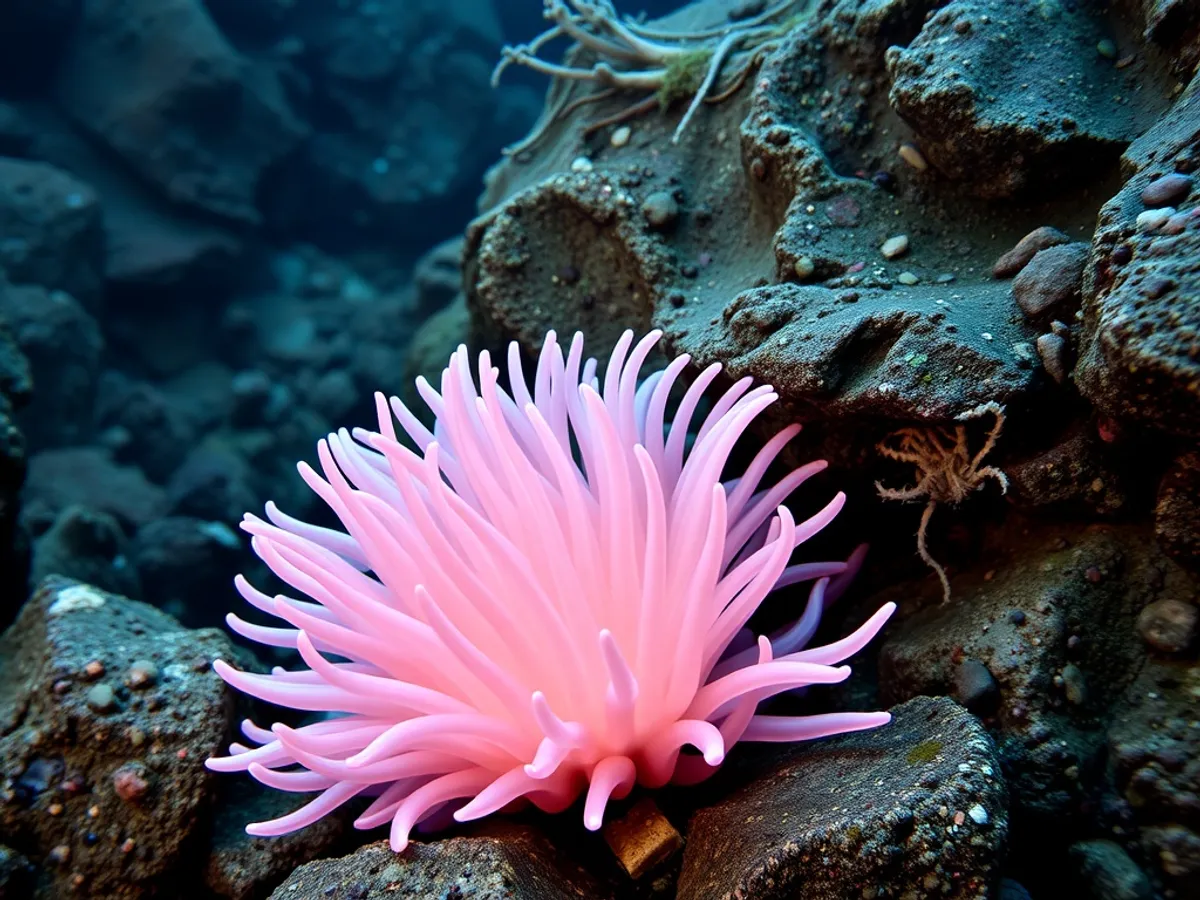
About the Giant pink sea anemone
The giant pink sea anemone is a striking marine invertebrate known for its large, vibrant pink to reddish body and tentacles. This species is commonly found attached to rocks and pilings in the intertidal and subtidal zones of the Pacific coast of North America. It uses its hundreds of stinging tentacles to capture small fish, crustaceans, and planktonic animals for food. Remarkably resilient, it can tolerate a range of tidal conditions and is often observed in tide pools exposed during low tide.
Fascinating facts
Tide Pool Resident
Giant pink sea anemones are commonly found in Pacific Northwest tide pools, where they may be exposed to air and sunlight during low tide.
Carnivorous Appetite
They feed on small fish, shrimp, and other tiny sea creatures, stunning prey with their venomous tentacles.
Clonal Reproduction
This species can reproduce asexually by budding off genetically identical clones, sometimes forming small clusters of related anemones.
Detailed description
The giant pink sea anemone (Epiactis prolifera) is a conspicuous anthozoan cnidarian, typically measuring 5–10 cm in diameter, though individuals can occasionally reach up to 15 cm across when fully expanded. Its column is robust and smooth, often a vivid pink, magenta, or reddish hue, with a crown of up to 200 slender, tapering tentacles arranged in concentric circles. The tentacles are armed with specialized stinging cells called nematocysts, used for both prey capture and defense. The oral disc is centrally located and can be tinged with lighter or darker shades. Unlike many anemones, E. prolifera often displays a basal pedal disc that allows it to adhere tenaciously to rocky substrates, even in areas of strong wave action. This species is notable for its brooding behavior: juveniles are frequently visible clustered around the base of the adult, protected by the parent’s body. Its tissues contain symbiotic algae (zooxanthellae) in some populations, contributing to its coloration and possibly supplementing its nutrition. E. prolifera is solitary, rarely forming dense aggregations, and is highly tolerant of fluctuating salinity, temperature, and exposure, allowing it to thrive in both exposed and sheltered intertidal pools. Its lifespan is not well-documented but is believed to extend several years in stable conditions.
Did you know?
Despite being stationary, giant pink sea anemones can slowly move across surfaces using their muscular foot.
Research & sources
Behaviour & social structure
Epiactis prolifera is primarily sessile, remaining attached to hard substrates such as rocks, pilings, or shells. It displays limited locomotion, occasionally gliding slowly on its pedal disc to reposition itself in response to environmental changes or competition. Feeding occurs when prey—typically small crustaceans, copepods, amphipods, polychaete worms, or larval fish—come into contact with its tentacles, which instantly fire nematocysts to immobilize and capture the prey. The tentacles then transfer food to the central mouth. E. prolifera is mostly solitary and does not exhibit social behaviors, though juveniles may cluster around the parent during early development. It is primarily active during high tide or when submerged, retracting its tentacles and closing up during low tide to prevent desiccation. Defensive behaviors include rapid contraction of the tentacles and column when disturbed. It can also expel water to reduce its size and minimize exposure.
Reproduction & life cycle
The reproductive biology of Epiactis prolifera is remarkable for its internal brooding strategy. This species is a protandrous hermaphrodite, initially functioning as a male and later developing female reproductive organs. Fertilization is internal; sperm are released into the water and taken up by neighboring anemones, where eggs are fertilized within the gastrovascular cavity. The embryos develop into planula larvae and are brooded internally or within the parent’s tentacular crown. After several weeks, the larvae emerge as miniature anemones and remain clustered around the parent’s base for additional protection and nourishment, often for several months. This brooding behavior increases juvenile survival rates in the harsh intertidal environment. Breeding can occur year-round but peaks in spring and summer when water temperatures rise and food is abundant.
Adaptations & survival
Epiactis prolifera possesses several adaptations for survival in the dynamic intertidal zone. Its thick, mucous-covered column minimizes water loss during exposure to air, and its ability to retract deeply into crevices or close tightly helps resist desiccation and predation. The nematocysts in its tentacles are highly effective for both prey capture and defense against predators such as sea stars and nudibranchs. The brooding reproductive strategy is a significant evolutionary adaptation, ensuring higher offspring survival in environments where planktonic larvae might be swept away or predated. Some populations harbor symbiotic zooxanthellae, which may provide supplemental nutrition via photosynthesis, especially in sunlit tide pools. Its tolerance to wide salinity and temperature ranges allows it to inhabit both exposed and sheltered coastal habitats.
Cultural significance
Epiactis prolifera has limited direct cultural significance but is an important component of Pacific Northwest tide pool ecosystems, often featured in educational programs and public aquaria to illustrate intertidal biodiversity and reproductive strategies. Its striking appearance and brooding behavior make it a subject of interest in marine biology outreach and citizen science initiatives. There are no known traditional uses or mythological associations specific to this species.
Recent research
Recent research on Epiactis prolifera has focused on its reproductive ecology, particularly the genetic and environmental factors influencing brooding and hermaphroditism. Studies have examined the adaptive value of internal brooding in variable intertidal habitats and the potential for local adaptation to microhabitat conditions. Molecular analyses are ongoing to clarify phylogenetic relationships within the genus Epiactis and to investigate population connectivity along the Pacific coast. The role of symbiotic algae in some populations is also being explored, with implications for understanding resilience to environmental stressors. Additionally, E. prolifera serves as a model organism for studying the impacts of climate change on intertidal invertebrates.
Sources
Reproductive Strategies of Intertidal Sea Anemones: Viviparity in Epiactis prolifera
Hand, C. & Uhlinger, K. (1992)
scientificCnidarian Life History and Population Structure in the Northeast Pacific
Sebens, K.P. (1981)
scientificReproductive biology and population genetics of the brooding sea anemone Epiactis prolifera
Hand, C. & Uhlinger, K.R. (1992)
scientificVideos
Habitat
Rocky intertidal and subtidal zones

Conservation
The Giant pink sea anemone is currently classified as Least Concern on the IUCN Red List.
Threats & challenges
Currently, Epiactis prolifera faces few direct threats and is considered stable throughout its range. However, localized challenges include habitat disturbance from coastal development, pollution (especially oil spills and runoff), and increased recreational activity in tide pool habitats. Ocean acidification and rising sea temperatures due to climate change may pose future risks by altering intertidal community structure and prey availability. Despite these potential threats, the species' broad ecological tolerance and reproductive strategy contribute to its resilience. There is no evidence of significant population decline, and it is not targeted by fisheries or the aquarium trade.
Taxonomy
Scientific name
Epiactis prolifera
- Kingdom
- Animalia
- Phylum
- Cnidaria
- Class
- Anthozoa
- Order
- Actiniaria
- Family
- Actiniidae
- Genus
- Epiactis
- Species
- prolifera
Community notes
Share your observations about the Giant pink sea anemone.
No community notes yet. Be the first!
Discover more wildlife
More fascinating animals from the encyclopedia.