
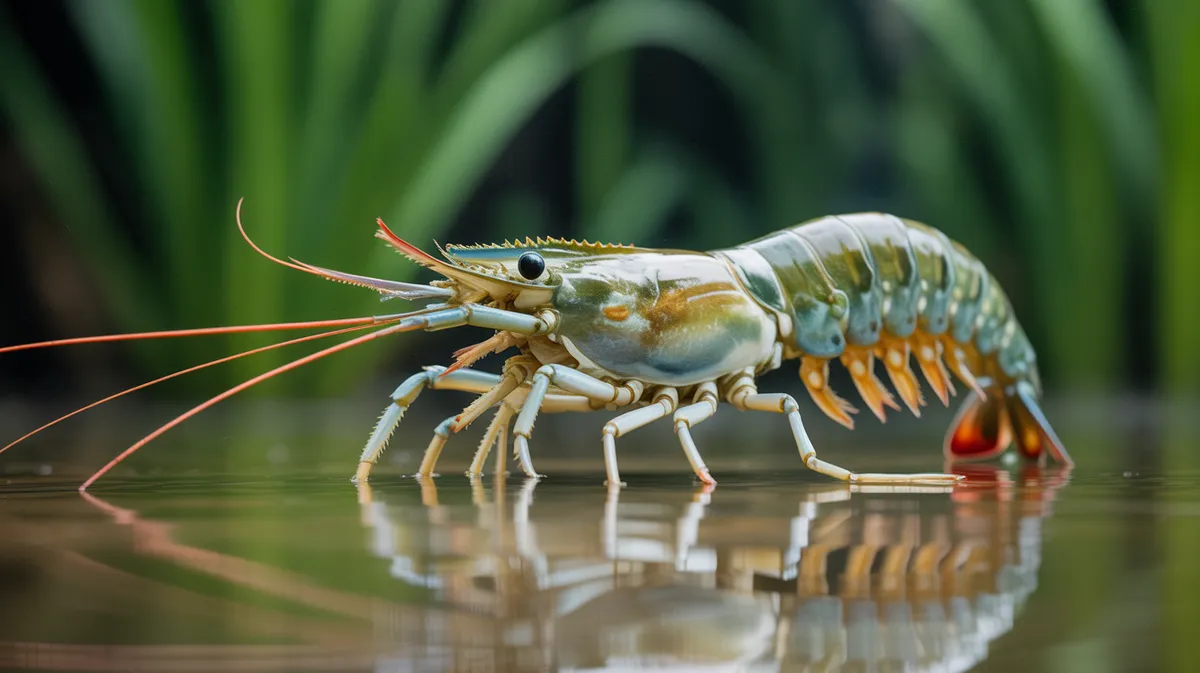
About the Giant river prawn
The giant river prawn is one of the largest freshwater prawns in the world, boasting long, blue-tinted claws and a sleek, elongated body. Native to South and Southeast Asia, this species thrives in tropical and subtropical rivers, lakes, and estuaries. It is a highly valued aquaculture species, known for its rapid growth and adaptability to a variety of freshwater and slightly brackish environments. The giant river prawn plays a significant role in regional cuisines and economies, especially in countries like Thailand, India, and Malaysia.
Fascinating facts
Impressive Size
Giant river prawns can grow up to 32 cm (over 12 inches) in length, making them one of the largest freshwater prawns in the world.
Life Cycle Migration
While adults live in freshwater, their eggs and larvae require brackish water, prompting females to migrate downstream to estuaries to spawn.
Aquaculture Star
This species is widely farmed for food due to its fast growth, adaptability, and high market demand in many Asian countries.
Detailed description
The giant river prawn (Macrobrachium rosenbergii) is a large, robust decapod crustacean, with adult males reaching total lengths of up to 32 cm and females typically smaller, around 25 cm. Its body is elongated and laterally compressed, covered by a smooth, translucent exoskeleton that ranges from greenish-brown to blue, with adult males exhibiting strikingly long, blue-tinted chelipeds (claws) that can exceed the length of the body. The species is sexually dimorphic, with males developing three morphotypes—small 'smalls', orange-clawed 'orange claws', and dominant blue-clawed 'blue claws'—each with distinct roles and behaviors. The rostrum is long, serrated, and slightly upward-curved, aiding in defense and foraging. Macrobrachium rosenbergii is primarily nocturnal, sheltering under submerged structures during the day and emerging at dusk to forage. It is omnivorous, feeding on detritus, algae, small invertebrates, and plant matter. The species is highly adaptable, tolerating a range of water temperatures (18–34°C) and salinities, but requires brackish water for larval development. Social hierarchies are established among males, with dominant individuals monopolizing access to females and prime territories. The species exhibits rapid growth rates, making it a cornerstone of freshwater aquaculture. Its life cycle includes a planktonic larval phase in brackish water, followed by a benthic juvenile and adult phase in freshwater habitats.
Did you know?
Despite their name and freshwater habitat as adults, the larvae of giant river prawns require brackish water to develop properly.
Research & sources
Wikipedia summary
Macrobrachium rosenbergii, also known as the giant river prawn or giant freshwater prawn, is a commercially important species of palaemonid freshwater prawn. It is found throughout the tropical and subtropical areas of the Indo-Pacific region, from India to Southeast Asia and Northern Australia. The giant freshwater prawn has also been introduced to parts of Africa, Thailand, China, Japan, New Zealand, the Americas, and the Caribbean. It is one of the biggest freshwater prawns in the world, and is widely cultivated in several countries for food. While M. rosenbergii is considered a freshwater species, the larval stage of the animal depends on brackish water. Once the individual shrimp has grown beyond the planktonic stage and becomes a juvenile, it lives entirely in fresh water.
Behaviour & social structure
Giant river prawns are primarily crepuscular and nocturnal, becoming most active during twilight and nighttime hours. They are opportunistic omnivores, scavenging for organic debris, algae, aquatic plants, and small aquatic animals such as insect larvae, worms, and mollusks. Feeding is accomplished using their chelae to grasp and manipulate food. Social interactions are complex, especially among males, where dominance hierarchies are established through displays and combat, particularly among the three male morphotypes. Blue-clawed males are the largest and most dominant, often aggressively defending territories and access to females. Subordinate males (orange-clawed and small males) may adopt sneaking tactics to access mates or resources. Prawns are generally solitary outside of breeding or feeding aggregations, and they use tactile and chemical cues for communication. During the day, they seek refuge under rocks, submerged logs, or dense aquatic vegetation to avoid predation.
Reproduction & life cycle
Reproduction in Macrobrachium rosenbergii is seasonal in the wild, often coinciding with the onset of the rainy season, but can occur year-round in controlled aquaculture environments. Courtship involves complex tactile and chemical signaling, with dominant blue-clawed males typically monopolizing receptive females. Females molt just prior to mating, and copulation occurs immediately after molting when the exoskeleton is soft. Fertilized eggs are carried on the female's pleopods for 18–23 days, depending on water temperature. Each clutch can contain 10,000–80,000 eggs. After hatching, larvae are released into brackish water, where they undergo 11 larval stages over 20–35 days before metamorphosing into post-larvae capable of migrating into freshwater. There is no parental care after larval release. Juveniles grow rapidly, reaching sexual maturity in 6–8 months under optimal conditions.
Adaptations & survival
Macrobrachium rosenbergii exhibits several notable adaptations. Its long, serrated rostrum and powerful chelipeds are used for defense, intraspecific competition, and food manipulation. The species' ability to tolerate a wide range of salinities (euryhalinity) is crucial for its life cycle, allowing larvae to develop in brackish water while adults inhabit freshwater. Morphological plasticity among males (distinct morphotypes) represents an evolutionary strategy for maximizing reproductive success under varying social conditions. The prawn's exoskeleton provides protection from predators and desiccation, while periodic molting facilitates growth and regeneration of lost limbs. Its omnivorous diet and scavenging behavior allow it to exploit diverse food resources, contributing to its ecological success and suitability for aquaculture.
Cultural significance
The giant river prawn holds significant economic and culinary value across South and Southeast Asia, featuring prominently in regional cuisines such as Thai 'goong mae nam', Indian 'chingri', and Malaysian 'udang galah'. It is a symbol of prosperity and abundance in some cultures, often served during festive occasions. Traditional fishing and farming of this species support livelihoods in rural communities. In addition to its food value, the prawn is sometimes depicted in local art and folklore, symbolizing resilience and adaptability. Its introduction to new regions for aquaculture has also influenced local economies and food systems globally.
Recent research
Recent research has focused on improving aquaculture techniques, including selective breeding for disease resistance and faster growth, optimizing larval rearing protocols, and understanding the molecular basis of sex differentiation and morphotype development. Studies on the prawn's microbiome and immune system are advancing knowledge of disease management. Environmental DNA (eDNA) methods are being developed for monitoring wild and farmed populations. Genomic resources for Macrobrachium rosenbergii have expanded, facilitating research into population genetics and adaptation. Ongoing ecological studies are assessing the impacts of introduced populations on native biodiversity in non-native regions.
Videos
Habitat
Freshwater rivers and estuaries

Conservation
The Giant river prawn is currently classified as Least Concern on the IUCN Red List.
Threats & challenges
While Macrobrachium rosenbergii is currently listed as Least Concern by the IUCN, wild populations face localized threats such as habitat degradation, pollution, overfishing, and competition with invasive species. Aquaculture practices, if poorly managed, can contribute to genetic bottlenecks, disease outbreaks (notably white tail disease caused by Macrobrachium rosenbergii nodavirus), and environmental impacts from effluent discharge. Climate change poses additional risks through alterations in water temperature and salinity regimes. Despite these challenges, the species' high fecundity and adaptability have supported stable or increasing populations in many regions, especially where aquaculture is well regulated.
Taxonomy
Scientific name
Macrobrachium rosenbergii
- Kingdom
- Animalia
- Phylum
- Arthropoda
- Class
- Malacostraca
- Order
- Decapoda
- Family
- Palaemonidae
- Genus
- Macrobrachium
- Species
- rosenbergii
Community notes
Share your observations about the Giant river prawn.
No community notes yet. Be the first!
Discover more wildlife
More fascinating animals from the encyclopedia.