
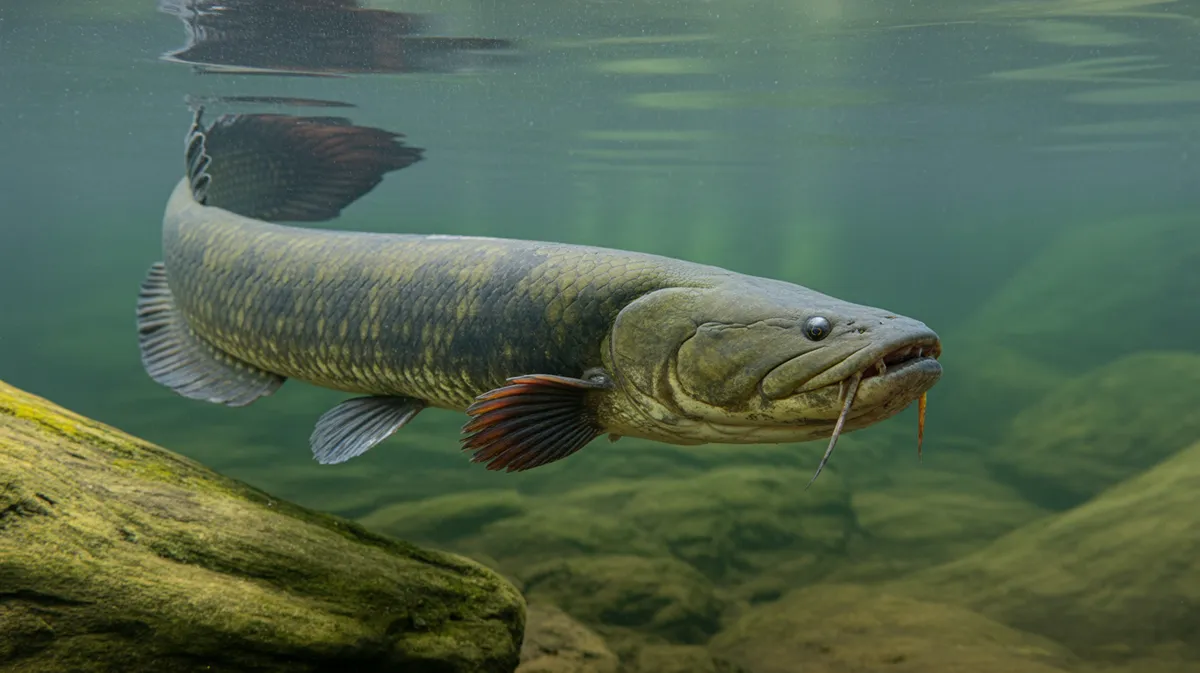
About the Giant snakehead
The giant snakehead is a large, predatory freshwater fish native to Southeast Asia. Known for its elongated body, sharp teeth, and distinctive snake-like head, this species can grow up to 1.5 meters in length. It is an aggressive apex predator in its ecosystem, capable of preying on fish, amphibians, and even small birds. The giant snakehead is highly adaptable, able to survive in low-oxygen waters by breathing air, and is notorious for its parental care, with adults fiercely guarding their young.
Fascinating facts
Air-breathing Ability
Giant snakeheads possess a specialized respiratory system that allows them to breathe air, enabling them to survive in oxygen-poor waters and even on land for short periods.
Land Locomotion
This fish can travel over land between water sources by undulating its body in a serpentine fashion, which helps it colonize new habitats.
Fierce Parental Care
Adult giant snakeheads are highly protective of their young, aggressively defending their fry from potential threats.
Detailed description
The giant snakehead (Channa micropeltes) is a formidable freshwater predator, distinguished by its elongated, cylindrical body and large, flattened head reminiscent of a snake, from which it derives its common name. Adults typically reach lengths of 1 to 1.3 meters, with some individuals documented at up to 1.5 meters, and can weigh as much as 20 kilograms. The species exhibits striking coloration: juveniles display vivid red and orange lateral stripes, which fade as they mature into a darker, bluish-black dorsum with a white ventral surface. Its mouth is large and terminal, equipped with sharp, recurved teeth adapted for seizing and holding slippery prey. The dorsal and anal fins are long and continuous, aiding in rapid acceleration and maneuverability in complex aquatic habitats. Giant snakeheads possess a labyrinth organ, allowing them to breathe atmospheric air and survive in hypoxic (low-oxygen) environments, a trait that enables them to inhabit stagnant or seasonally variable waters. Their eyes are well-developed, supporting both diurnal and nocturnal hunting. As apex predators, they exert significant influence on local fish communities, often reducing populations of smaller fish species. Adults are highly territorial, especially during breeding, and display pronounced aggression towards intruders. Notably, they are capable of limited terrestrial locomotion, using undulating body movements to move overland between water bodies during wet conditions.
Did you know?
Giant snakeheads have been observed moving over land between water bodies by wriggling their bodies in a snake-like motion.
Research & sources
Wikipedia summary
Channa micropeltes, giant snakehead, giant mudfish or toman harimau, is among the largest species in the family Channidae, capable of growing to 1.3 m (4.3 ft) in length and a weight of 20 kg (44 lb). It is native to the fresh waters of Southeast Asia, but has also been introduced elsewhere and is considered invasive in Taiwan. Other names include shol machh in Bengali, red snakehead, redline snakehead, and ikan toman.
Behaviour & social structure
Giant snakeheads are solitary and highly territorial, especially as adults. They establish and defend territories using visual displays and physical aggression, particularly during the breeding season. Their hunting strategy is primarily ambush-based: they remain motionless among submerged vegetation or debris, then lunge rapidly at prey, which includes fish, amphibians, crustaceans, and occasionally small mammals or birds. They are opportunistic feeders and may exhibit cannibalistic tendencies, especially in crowded or resource-scarce conditions. Activity patterns are crepuscular to nocturnal, with peak feeding at dawn and dusk, though they may hunt during the day in turbid waters. Juveniles often form loose schools for protection, but this sociality dissipates as they mature. Adults communicate with conspecifics through a combination of visual signals and low-frequency sounds produced by grinding their pharyngeal teeth.
Reproduction & life cycle
Breeding typically coincides with the onset of the rainy season, when rising water levels create optimal spawning habitats. Giant snakeheads are oviparous, with external fertilization. Pairs form monogamous bonds during the breeding period and engage in elaborate courtship behaviors, including circling and synchronized swimming. Females lay several thousand adhesive eggs in shallow, vegetated areas. Both parents exhibit exceptional parental care: they guard the eggs, fan them to ensure oxygenation, and later protect the free-swimming fry for several weeks. Adults are known to aggressively defend their brood against potential predators, including much larger animals and even humans. The fry initially feed on plankton and small invertebrates, gradually shifting to piscivory as they grow. Sexual maturity is typically reached at 2–3 years of age.
Adaptations & survival
Key adaptations include the labyrinth organ, which facilitates aerial respiration and allows survival in oxygen-poor or stagnant waters. Their robust, muscular bodies and long, continuous fins enable sudden bursts of speed and agile maneuvering in dense aquatic vegetation. The sharp, recurved teeth and large gape are specialized for grasping and consuming large, active prey. Their coloration provides camouflage among submerged roots and plants. The ability to traverse short distances over land during wet conditions enables them to colonize new habitats and escape unfavorable environments. Parental care is highly developed, increasing offspring survival rates in predation-rich environments.
Cultural significance
The giant snakehead holds significant cultural and economic value across Southeast Asia. It is a prized food fish, featured in numerous traditional dishes, and is farmed extensively in countries like Thailand, Malaysia, and Indonesia. In folklore, it is sometimes associated with strength, resilience, and territoriality. The species is also popular among sport anglers due to its size and fighting ability. In some regions, it has been used in traditional medicine, believed to promote wound healing and recovery. However, its aggressive nature and potential to disrupt local ecosystems have led to legal restrictions on its import and possession in several countries outside its native range.
Recent research
Recent research has focused on the invasive potential of Channa micropeltes, particularly its ecological impacts in non-native habitats. Studies have documented rapid population growth and significant predation pressure on native fish communities in invaded areas. Genetic analyses have revealed considerable intraspecific variation, suggesting multiple introduction events and possible hybridization with other Channa species. Physiological studies have examined the labyrinth organ's efficiency and the species' remarkable tolerance to hypoxia and environmental stress. Ongoing research is investigating the species' role in ecosystem dynamics, potential for aquaculture improvement, and mechanisms underlying its aggressive parental care and territoriality.
Videos
Habitat
Freshwater rivers, lakes, and swamps


Conservation
The Giant snakehead is currently classified as Least Concern on the IUCN Red List.
Threats & challenges
While currently classified as Least Concern by the IUCN, giant snakeheads face localized threats from overfishing, habitat degradation, and pollution, particularly in heavily populated regions of Southeast Asia. Their popularity as a food fish and in the ornamental trade has led to population declines in some areas. Invasive populations, such as those established in Taiwan and parts of Indonesia outside their native range, pose ecological risks by outcompeting native species and disrupting local food webs. Climate change and water management practices (e.g., damming, drainage) may alter their habitats and impact reproductive success. Despite these challenges, their adaptability and high reproductive output have allowed them to persist in a wide range of environments.
Taxonomy
Scientific name
Channa micropeltes
- Kingdom
- Animalia
- Phylum
- Chordata
- Class
- Actinopterygii
- Order
- Perciformes
- Family
- Channidae
- Genus
- Channa
- Species
- micropeltes
Community notes
Share your observations about the Giant snakehead.
No community notes yet. Be the first!
Discover more wildlife
More fascinating animals from the encyclopedia.