
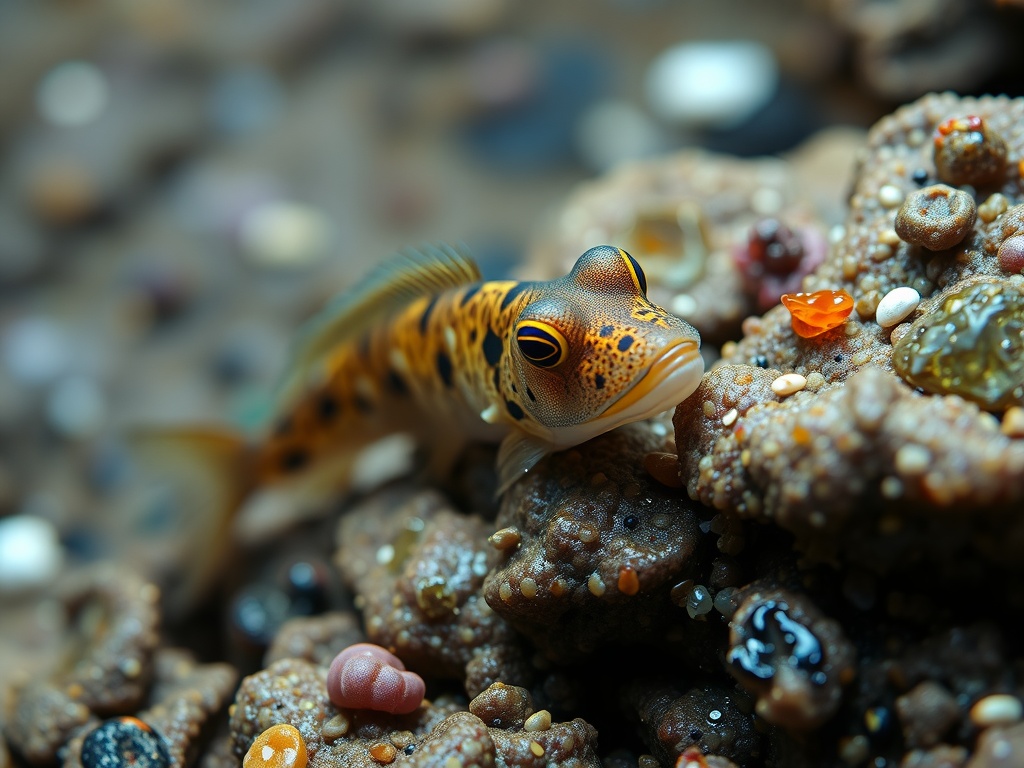
About the Gobiesox Clingfish
The Gobiesox Clingfish is a small, benthic fish known for its remarkable ability to adhere to rocks and other submerged surfaces using a specialized suction disc formed from its pelvic fins. This species is typically found in rocky intertidal zones along the Pacific coasts of North America. Its flattened, elongated body and cryptic coloration help it blend in with its surroundings, providing both camouflage from predators and a strategic advantage for feeding. The Gobiesox Clingfish primarily feeds on small invertebrates it finds among the rocks and tide pools. Despite its small size, it is a resilient species well-adapted to the dynamic, wave-swept environments where it lives.
Fascinating facts
Super Suction Power
The pelvic fins of the Gobiesox Clingfish are modified into a powerful suction disc, allowing it to stick firmly to rocks even in strong waves.
Intertidal Expert
Gobiesox Clingfish are highly adapted to the intertidal zone, enduring fluctuating temperatures, salinity, and exposure to air during low tides.
Tiny Predator
These clingfish feed on small invertebrates such as amphipods, isopods, and tiny crustaceans they find hiding among rocks.
Detailed description
The Gobiesox Clingfish (Gobiesox maeandricus), also known as the Northern Clingfish, is a small, dorsoventrally flattened fish typically reaching lengths of 5–8 cm, though some individuals can grow up to 10 cm. Its most distinctive anatomical feature is the large adhesive disc located on its ventral surface, formed by modified pelvic and pectoral fins, which allows it to attach firmly to smooth, wet, and even slippery substrates in high-energy intertidal zones. The skin is scaleless and covered in a thick mucus layer, providing both protection from abrasion and desiccation. Its coloration is highly variable, ranging from mottled browns, greens, and reds, often matching the surrounding rocks and algae, which aids in camouflage. The head is broad with a blunt snout and large, upward-facing eyes adapted for scanning the environment above and around. Gobiesox maeandricus is a benthic species, spending most of its life clinging to rocks, kelp holdfasts, or under ledges. It is primarily solitary, with individuals maintaining small territories. The species is well-adapted to withstand the physical stresses of the intertidal zone, including rapid changes in temperature, salinity, and oxygen availability. Its robust body and strong suction disc allow it to resist dislodgement by powerful waves and currents, making it one of the most resilient fishes in its habitat.
Did you know?
The clingfish's adhesive disc has inspired research into new bio-inspired glues and attachment devices for underwater use.
Research & sources
Behaviour & social structure
Gobiesox Clingfish are predominantly nocturnal or crepuscular, becoming most active during low tide or in shaded areas. They spend much of the day hidden under rocks or within crevices to avoid predation and desiccation. Foraging occurs primarily at night, when they emerge to hunt for small invertebrates such as amphipods, polychaete worms, small crustaceans, and mollusks. Their feeding strategy involves carefully searching the undersides of rocks and algae for prey, using their sensitive barbels and chemosensory abilities. They are solitary and territorial, with individuals defending prime attachment sites from conspecifics. Social interactions are limited, mainly occurring during the breeding season. Clingfish exhibit site fidelity, often returning to the same shelter after foraging excursions. Their ability to rapidly attach and detach from surfaces allows them to evade predators and move efficiently across complex terrain.
Reproduction & life cycle
Reproduction in Gobiesox maeandricus is oviparous, with spawning typically occurring in late spring to early summer, although timing may vary with latitude and local conditions. During courtship, males display to females by performing undulating movements and leading them to suitable nesting sites, usually the undersides of rocks or within crevices. Females lay adhesive eggs in clusters, which are then fertilized externally by the male. Clutch sizes can range from 100 to 300 eggs, depending on female size and condition. Males exhibit parental care by guarding the eggs, fanning them with their fins to ensure proper oxygenation and removing debris or potential fungal growth. Incubation lasts approximately 2–3 weeks, after which the larvae hatch and are planktonic for a brief period before settling to the benthos as juveniles. There is little to no parental care post-hatching.
Adaptations & survival
Gobiesox Clingfish possess several remarkable adaptations for intertidal life. The adhesive disc, lined with microscopic papillae, generates strong suction even on smooth, wet surfaces, allowing the fish to withstand wave action and avoid being swept away. Their scaleless, mucus-covered skin reduces friction and prevents desiccation during low tide exposure. Cryptic coloration and the ability to alter pigmentation provide effective camouflage against predators. Physiologically, they can tolerate wide fluctuations in temperature, salinity, and oxygen, enabling survival in tide pools subject to rapid environmental changes. Their flattened body shape allows them to squeeze into narrow crevices for shelter. Sensory adaptations include well-developed chemoreceptors and barbels for detecting prey in low-visibility conditions.
Cultural significance
Gobiesox Clingfish have limited direct cultural significance to humans. They are occasionally noted in tide pool guides and educational programs as examples of extreme adaptation to intertidal life, and their unique suction disc has inspired biomimetic research in engineering and robotics. They do not feature prominently in indigenous mythology or traditional fisheries, likely due to their small size and cryptic habits. Their presence in healthy tide pool ecosystems is sometimes used as an indicator of environmental quality.
Recent research
Recent research has focused on the biomechanics of the clingfish suction disc, revealing that its adhesive strength rivals or exceeds that of many artificial suction devices, even on rough or irregular surfaces. Studies have also examined the microstructure of the disc's papillae, providing insights for the development of bio-inspired adhesives. Ongoing ecological research investigates the species' role in intertidal food webs, their responses to environmental stressors, and their genetic diversity across their range from Alaska to California. There is growing interest in how climate change may affect their distribution and reproductive timing. In 2014, a study published in the Proceedings of the National Academy of Sciences highlighted the clingfish's disc as a model for next-generation medical and industrial adhesives.
Videos
Habitat
Rocky intertidal zones

Conservation
The Gobiesox Clingfish is currently classified as Least Concern on the IUCN Red List.
Threats & challenges
Currently, Gobiesox maeandricus faces few significant threats and is classified as Least Concern by the IUCN. However, localized challenges include habitat disturbance from coastal development, pollution, and trampling by humans in popular tide pool areas. Climate change poses a potential long-term threat through sea level rise, increased storm frequency, and ocean acidification, which may alter intertidal habitats and prey availability. Despite these pressures, populations remain stable across most of their range. No targeted fisheries exist for this species, and bycatch is minimal. Continued monitoring is recommended to detect any future population declines, especially in areas with high human activity.
Taxonomy
Scientific name
Gobiesox maeandricus
- Kingdom
- Animalia
- Phylum
- Chordata
- Class
- Actinopterygii
- Order
- Gobiesociformes
- Family
- Gobiesocidae
- Genus
- Gobiesox
- Species
- maeandricus
Community notes
Share your observations about the Gobiesox Clingfish.
No community notes yet. Be the first!
Discover more wildlife
More fascinating animals from the encyclopedia.