
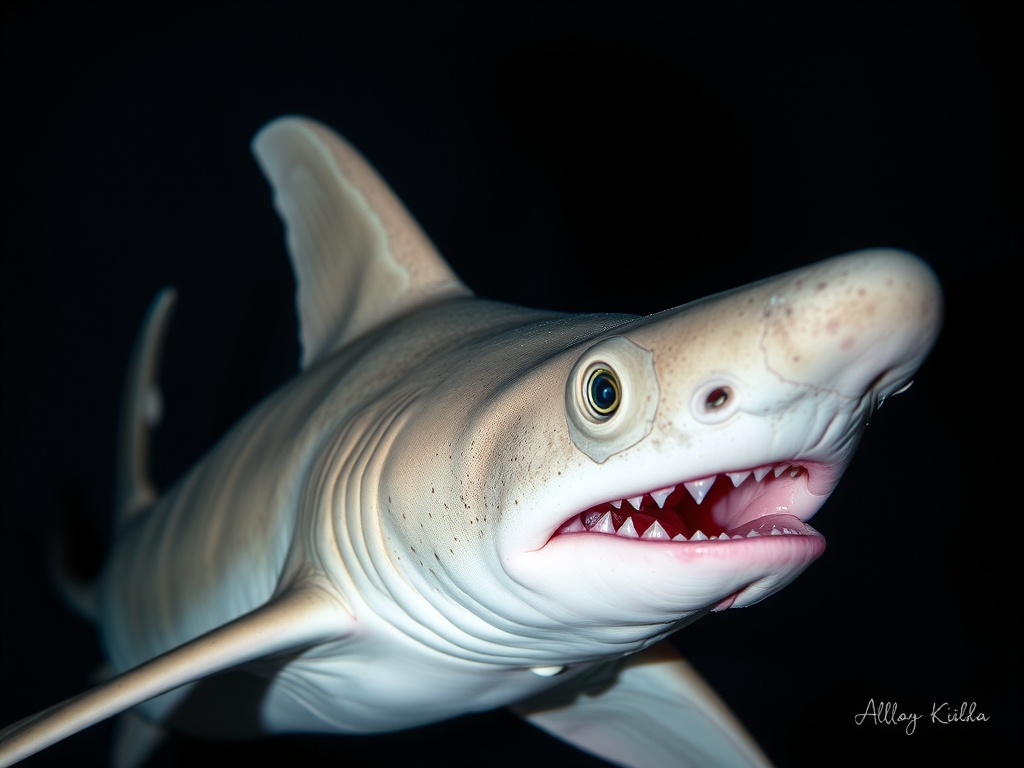
About the Goblin Shark
The goblin shark is a deep-sea relic, the last member of a family that goes back over a hundred million years, and it hunts with a mechanism that looks like a special effect. Its jaws are not fixed to the underside of the skull in the usual way but slung on elastic ligaments, and when it strikes they fire forward out of the head — a slingshot, catapulting the whole jaw apparatus toward the prey at speeds among the fastest recorded for any fish, then snapping back. That matters because it is a poor swimmer, flabby and slow, drifting through cold water hundreds of metres down where a chase is not an option; it must be able to take prey from a standing start. The long flattened blade of its snout is packed with electroreceptors that detect the faint electrical fields of animals it cannot see. Its pink colour is not pigment: the skin is semi-translucent, and what shows through is the blood in the vessels beneath. Almost everything known about it comes from accidental captures.
Fascinating facts
Extraordinary Jaws
Goblin sharks can extend their jaws forward up to 8.6–9.4% of their body length in order to catch prey, in a unique slingshot motion.
Deep-Sea Dweller
They are rarely seen by humans and typically inhabit depths greater than 200 meters, often in submarine canyons and on continental slopes.
Ancient Lineage
The goblin shark belongs to the family Mitsukurinidae, which has existed for around 125 million years, making it one of the most ancient shark families.
Detailed description
The goblin shark (Mitsukurina owstoni) is a strikingly unique deep-sea elasmobranch, instantly recognizable by its elongated, flattened rostrum and highly protrusible jaws. Adults typically measure between 3 and 4 meters in length, though rare specimens have been reported up to 6 meters. Its skin is semi-translucent and pinkish-gray, a coloration resulting from visible blood vessels beneath a thin dermal layer rather than pigmentation. The goblin shark's jaws can extend forward dramatically—up to 8.6–9.4% of its total body length—allowing it to snatch prey with remarkable speed. Its teeth are long, slender, and nail-like, optimized for gripping soft-bodied prey such as deep-sea fish, cephalopods, and crustaceans. The body is soft and flabby, with small, rounded fins and a weakly developed caudal peduncle, adaptations that suit its slow-moving, energy-conserving lifestyle in the deep sea. The eyes are small and lack a nictitating membrane, reflecting a reliance on electroreception over vision. Internal anatomy reveals a large liver rich in low-density lipids, aiding buoyancy in the high-pressure, low-light environment. Goblin sharks are solitary and elusive, rarely encountered by humans, and are considered a living fossil, representing a lineage that has changed little since the Early Cretaceous.
Did you know?
Goblin sharks are sometimes called 'living fossils' because their lineage has changed very little since the Cretaceous period.
Research & sources
Wikipedia summary
The goblin shark is a rare species of deep-sea shark. Sometimes called a "living fossil", it is the only extant representative of the family Mitsukurinidae, a lineage some 125 million years old. This pink-skinned animal has a distinctive profile with an elongated, flat snout, and highly protrusible jaws containing prominent nail-like teeth. It is usually between 3 and 4 m long when mature, though it can grow considerably larger such as one captured in 2000 that is thought to have measured 6 m (20 ft). Goblin sharks are benthopelagic creatures that inhabit upper continental slopes, submarine canyons, and seamounts throughout the world at depths greater than 100 m (330 ft), with adults found deeper than juveniles. Some researchers believed that these sharks could also dive to depths of up to 1,300 m (4,270 ft), for short periods of time. However, footage captured in 2024 suggests that their range could be deeper than previously thought, with a confirmed sighting of an adult swimming at 2,000 m (6,560 ft).
Behaviour & social structure
Goblin sharks are primarily solitary, benthopelagic predators, spending most of their lives near the seafloor on continental slopes, submarine canyons, and seamounts. They exhibit slow, lethargic swimming, likely using ambush tactics rather than active pursuit to capture prey. Their most remarkable behavior is the rapid projection of their jaws, which can be thrust forward at speeds up to 3.1 meters per second, a mechanism powered by specialized ligaments and muscles. This adaptation allows them to capture elusive or fast-moving prey in the darkness of the deep sea. Stomach content analyses indicate a diet of teleost fishes (such as rattails), cephalopods, and decapod crustaceans. Little is known about their daily routines, but they are presumed to be opportunistic feeders, foraging individually and possibly using their elongated snout to detect prey via electroreception. There is no evidence of social grouping or coordinated hunting.
Reproduction & life cycle
Goblin sharks are ovoviviparous, meaning embryos develop inside eggs that remain within the mother's body until hatching. Females give birth to live young, but litter size is poorly documented; available data suggest litters of 4–10 pups. Newborns are estimated to be around 82–100 cm in length. There is no known parental care post-birth, and juveniles are believed to inhabit shallower depths than adults. Mating behavior has never been observed, and reproductive cycles, gestation periods, and breeding seasons remain largely unknown due to the species' deep-sea habitat and rarity. Sexual maturity is estimated to occur at lengths of 2.6–3.8 meters for males and 3.6–4.5 meters for females.
Adaptations & survival
The goblin shark exhibits several key adaptations for deep-sea survival. Its elongated rostrum is densely packed with ampullae of Lorenzini, specialized electroreceptors that detect the weak bioelectric fields of prey in the darkness. The highly protrusible jaws, unique among sharks, allow for rapid extension to snatch prey at a distance. The soft, flabby body and reduced musculature indicate a low-energy lifestyle, suitable for the sparse food resources of the deep sea. The large, oil-rich liver provides buoyancy, compensating for the lack of a swim bladder. Reduced pigmentation and small eyes are typical of deep-sea species, reflecting a reliance on non-visual senses. The goblin shark's slow metabolism and infrequent feeding are further adaptations to the deep ocean's low productivity.
Cultural significance
The goblin shark's bizarre appearance has made it a subject of fascination and occasional fear in popular culture, often featured in documentaries and media as an example of deep-sea 'monsters.' In Japan, it is known as 'tenguzame,' referencing the mythical Tengu with a long nose. Despite its striking looks, it has little direct significance in folklore or traditional uses, and is not considered valuable for food due to its poor flesh quality. Its role in scientific research and public aquaria is limited by the difficulty of keeping deep-sea species alive in captivity.
Recent research
Recent research has focused on the goblin shark's unique jaw mechanics, with high-speed videography revealing the fastest jaw protrusion among sharks. Genetic studies confirm its ancient lineage and clarify its evolutionary relationships within Lamniformes. In 2024, deep-sea ROV footage documented an adult goblin shark at a depth of 2,000 meters, extending the known depth range and suggesting greater ecological plasticity than previously thought. Ongoing studies aim to better understand its distribution, life history, and population genetics, but progress is hampered by the species' rarity and deep-sea habitat. Advances in deep-sea exploration technology are expected to yield more insights in the coming years.
Sources
Sharks, rays and skates (Chondrichthyes, Elasmobranchii) from the Upper Marine Molasse (middle Burdigalian, early Miocene) of the Simssee area (Bavaria, Germany), with comments on palaeogeographic and ecological patterns
Villafaña, J.A. et al. (2020)
scientificVideos
Habitat
Deep ocean

Conservation
The Goblin Shark is currently classified as Least Concern on the IUCN Red List.
Threats & challenges
Currently, the goblin shark faces minimal direct threats from human activity due to its deep-sea habitat, which is largely inaccessible to commercial fisheries. However, incidental bycatch in deep-sea trawling and longline fisheries does occur, particularly off Japan, Taiwan, and Portugal. The species is not targeted commercially and is generally discarded when caught. Its population trends are unknown, but its wide distribution and apparent rarity suggest it is not immediately at risk. Potential future threats include deep-sea mining, habitat disturbance, and increased fishing pressure as technology advances. The IUCN lists the goblin shark as Least Concern, but emphasizes the need for continued monitoring due to its low reproductive rate and vulnerability to overexploitation.
Taxonomy
Scientific name
Mitsukurina owstoni
- Kingdom
- Animalia
- Phylum
- Chordata
- Class
- Chondrichthyes
- Order
- Lamniformes
- Family
- Mitsukurinidae
- Genus
- Mitsukurina
- Species
- owstoni
Community notes
Share your observations about the Goblin Shark.
No community notes yet. Be the first!
Discover more wildlife
More fascinating animals from the encyclopedia.