
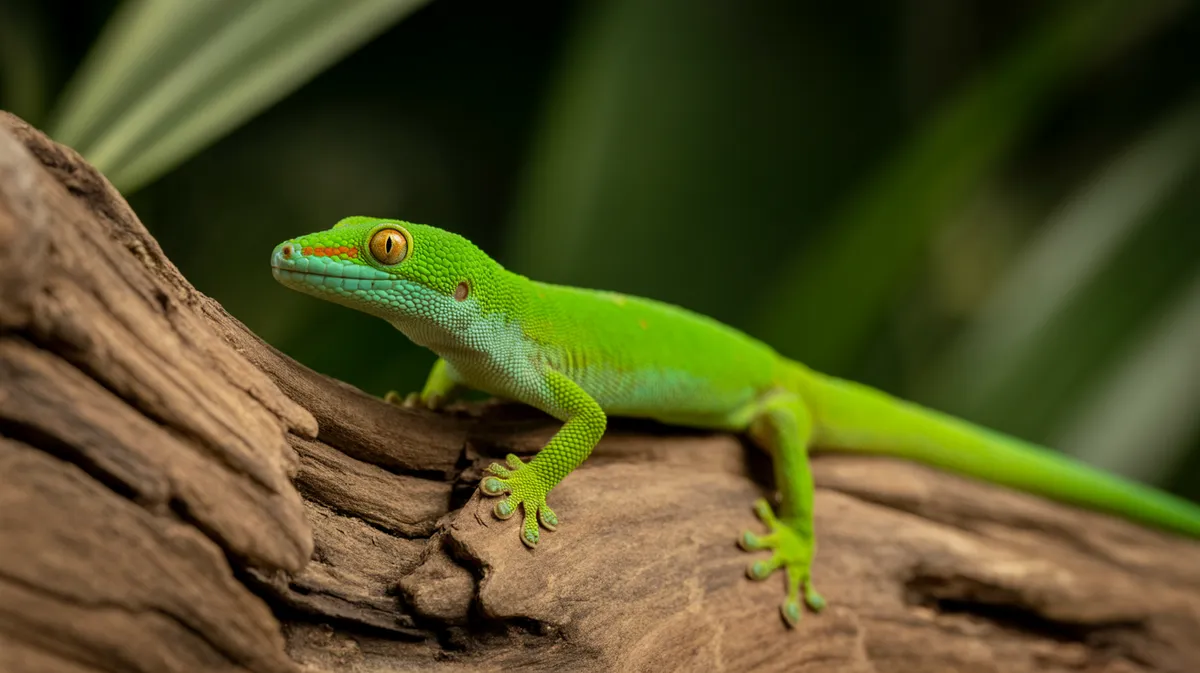
About the Gold Dust Day Gecko
The Gold Dust Day Gecko is a small, vividly colored lizard native to northern Madagascar but widely introduced to Hawaii and other islands. It is easily recognized by its bright green body, golden yellow speckles (resembling gold dust), and striking red markings on its back and head. This diurnal gecko is arboreal, spending much of its life on trees, shrubs, and even in human habitats. Highly adaptable, it is often seen licking nectar, hunting insects, and basking in the tropical sun.
Fascinating facts
Daytime Activity
Unlike most geckos, Gold Dust Day Geckos are diurnal, meaning they are active during the day rather than at night.
Unique Coloration
Their bright green color with gold flecks and red markings makes them one of the most recognizable geckos in the world.
Nectar Lovers
They often feed on nectar and pollen in addition to insects, sometimes acting as accidental pollinators for tropical flowers.
Detailed description
The Gold Dust Day Gecko (Phelsuma laticauda) is a small, vividly colored lizard, typically reaching a total length of 12–13 cm (4.7–5.1 in), with a slender, laterally compressed body and a somewhat flattened head. Its most distinctive features are the bright, emerald-green dorsal coloration, scattered with fine golden-yellow speckles ('gold dust'), and prominent red markings above the eyes and on the lower back. The ventral surface is pale, often whitish or yellowish. Its toes are equipped with specialized adhesive lamellae, enabling remarkable climbing ability on smooth surfaces, including glass and leaves. The species exhibits large, lidless eyes with vertical pupils, providing excellent vision for diurnal activity. Gold Dust Day Geckos are highly active during the day, spending most of their time on tree trunks, leaves, or even building walls in urban environments. They are primarily arboreal but are also known to exploit anthropogenic habitats, showing a high degree of ecological flexibility. Their skin is delicate and can be easily damaged, which is a consideration in both wild and captive settings. Sexual dimorphism is subtle, with males generally being slightly larger and possessing preanal pores.
Did you know?
Unlike most geckos, Gold Dust Day Geckos cannot blink and instead lick their eyes to keep them clean and moist.
Research & sources
Wikipedia summary
The gold dust day gecko is a diurnal species of gecko. It lives in northern Madagascar, the Comoro Islands, and the Mascarene Islands; it has also been introduced to Hawaii and other Pacific islands. It is primarily an arboreal species which can be found in tropical forests and may also associate with human dwellings. The gold dust day gecko feeds on insects and nectar.
Behaviour & social structure
Gold Dust Day Geckos are diurnal and display pronounced territoriality, especially among males, who may engage in threat displays and occasional combat to defend prime basking or feeding sites. They are omnivorous, foraging actively for insects, spiders, and other small arthropods, as well as consuming nectar, pollen, soft fruits, and occasionally flower petals. Their feeding behavior includes rapid tongue flicks to lap up nectar or catch prey. Social interactions are complex; while generally solitary, pairs may form loose associations during the breeding season. Communication involves body postures, head-bobbing, and visual signaling, as well as chemical cues. They bask in sunlight to regulate body temperature, often retreating to shaded areas during the hottest part of the day. At night, they seek shelter in crevices or under bark.
Reproduction & life cycle
Breeding occurs primarily during the warmer, wetter months, with females capable of producing multiple clutches per season. Courtship involves males displaying vibrant coloration and performing head-bobs and tail-waving. After successful mating, females lay one or two soft-shelled eggs, typically hidden in secure locations such as leaf axils, under bark, or in crevices. The eggs are not guarded, and incubation lasts approximately 40–60 days at temperatures of 26–28°C (79–82°F). Hatchlings are fully independent, measuring about 3–4 cm (1.2–1.6 in) at birth. There is no parental care post-oviposition, and juveniles must fend for themselves immediately. Sexual maturity is reached at around 9–12 months under optimal conditions.
Adaptations & survival
Phelsuma laticauda possesses several adaptations for an arboreal lifestyle, including expanded toe pads with microscopic setae that generate van der Waals forces, allowing adhesion to smooth and vertical surfaces. Their bright coloration provides camouflage among foliage and flowers, while also serving as a visual signal in social and reproductive contexts. The species' ability to exploit both animal and plant food sources (omnivory) enhances survival in variable environments. Their diurnal activity pattern aligns with the availability of both insect prey and floral resources. Rapid tail autotomy (self-amputation) serves as an effective anti-predator mechanism, with the tail regenerating over time. Behavioral plasticity, such as tolerance of human-modified habitats, has facilitated their successful introduction to new regions.
Cultural significance
In Madagascar and the islands where they are native, Gold Dust Day Geckos are often regarded with curiosity and sometimes superstition, as geckos in general are associated with good luck or omens in Malagasy folklore. In Hawaii, where they have become established, they are popular in the pet trade and are sometimes featured in local art and tourism materials due to their striking appearance. There are no significant traditional uses, but their presence in gardens is often welcomed for their role in controlling insect pests.
Recent research
Recent research has focused on the ecological impacts of Phelsuma laticauda in introduced habitats, particularly in Hawaii, where they interact with native and non-native species. Studies have examined their role as pollinators for certain ornamental and native plants, as well as their competitive interactions with other gecko species. Genetic studies are ongoing to clarify the relationships between different Phelsuma populations and to monitor potential hybridization events. Advances in understanding their adhesive toe pad microstructure have contributed to biomimetic research, inspiring the development of synthetic adhesives. Conservation genetics and population monitoring are also active areas of study, especially in the context of habitat fragmentation.
Videos
Habitat
Tropical forest and urban gardens

Conservation
The Gold Dust Day Gecko is currently classified as Least Concern on the IUCN Red List.
Threats & challenges
In their native range, Gold Dust Day Geckos face threats from habitat loss due to deforestation and agricultural expansion. Introduced predators such as cats, rats, and some bird species also pose risks, particularly on islands. In introduced areas like Hawaii, they may compete with native geckos and other Phelsuma species, potentially impacting local biodiversity. However, their populations are generally stable, and the species is classified as 'Least Concern' by the IUCN. Overcollection for the pet trade is a localized concern, but captive breeding programs have reduced wild harvesting. Climate change and further habitat alteration remain potential long-term threats.
Taxonomy
Scientific name
Phelsuma laticauda
- Kingdom
- Animalia
- Phylum
- Chordata
- Class
- Reptilia
- Order
- Squamata
- Family
- Gekkonidae
- Genus
- Phelsuma
- Species
- laticauda
Community notes
Share your observations about the Gold Dust Day Gecko.
No community notes yet. Be the first!
Discover more wildlife
More fascinating animals from the encyclopedia.