
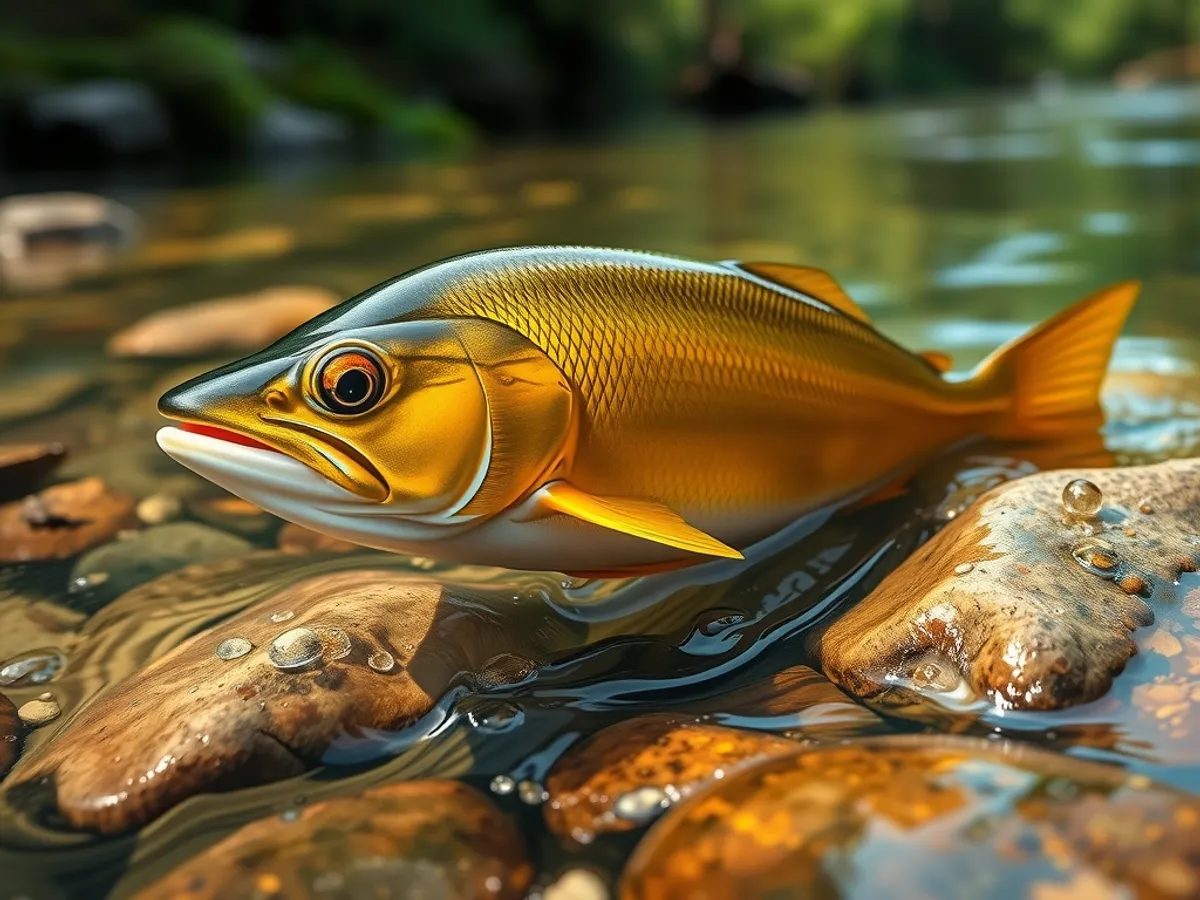
About the Golden dorado
The golden dorado is a large, predatory freshwater fish native to central and east-central South America. Renowned for its striking golden-yellow coloration and powerful, muscular body, this species is highly sought after by anglers for its strength and acrobatic leaps. Golden dorados inhabit fast-moving rivers and streams, where they feed aggressively on smaller fish and occasionally on crustaceans. Their impressive size, speed, and predatory behavior have earned them the nickname 'river tiger.'
Fascinating facts
Sport Fishing Star
Golden dorados are considered one of the most prized freshwater game fish in South America due to their strength and fighting ability.
Voracious Predator
This species uses its keen eyesight and speed to hunt, often ambushing schools of smaller fish with sudden bursts of energy.
River Dweller
Golden dorados thrive in fast-flowing rivers like the Paraná, Paraguay, and Uruguay, preferring clear, oxygen-rich waters.
Detailed description
The golden dorado (Salminus brasiliensis) is a robust, large-bodied freshwater fish distinguished by its brilliant metallic gold coloration, with olive-green shading on the back and bright orange or reddish fins. Adults commonly reach lengths of 60–75 cm, with some individuals exceeding 1 meter and weighing up to 25 kg, making them among the largest predatory characiforms in South America. The head is massive and conical, with a powerful, protruding lower jaw armed with sharp, conical teeth adapted for grasping slippery prey. The body is laterally compressed and muscular, built for explosive bursts of speed and acrobatic leaps. Golden dorados are apex predators in their habitats, exhibiting aggressive hunting strategies and high levels of activity. Their lateral line is highly developed, allowing them to detect subtle vibrations in turbulent river environments. They are primarily solitary but may form loose aggregations during feeding or spawning. The species exhibits complex migratory behavior, often traveling long distances upstream to reach spawning grounds. Sexual dimorphism is present, with females typically growing larger than males. The golden dorado's lifespan can exceed 15 years in the wild, with growth rates influenced by food availability and environmental conditions.
Did you know?
Despite their name, golden dorados are not related to the marine mahi-mahi, which is also sometimes called 'dorado.'
Research & sources
Wikipedia summary
Salminus brasiliensis, also known as the golden dorado, dorado, river tiger, dourado, or jaw characin is a large, predatory characiform freshwater fish found in central and east-central South America. Despite having Salminus in its name, the dorado is not related to any species of salmon, nor to the saltwater fish also called dorado. It is very popular among recreational anglers and supports large commercial fisheries.
Behaviour & social structure
Golden dorados are diurnal, with peak activity during early morning and late afternoon. They are highly territorial and exhibit solitary hunting, ambushing prey such as characins, catfish, and other small to medium-sized fish. Their predatory tactics include rapid chases, sudden lunges, and coordinated attacks in turbulent waters. Juveniles may form small schools for protection, but adults are mostly solitary except during spawning migrations. Golden dorados are known for their remarkable leaping ability, often breaching the water's surface to catch prey or evade threats. They maintain defined home ranges and use visual and lateral line cues to locate prey. Social interactions are generally limited to aggressive displays or competition for food and mates.
Reproduction & life cycle
Reproduction in golden dorado is closely tied to seasonal hydrological cycles, particularly the onset of the rainy season (typically October to March). Spawning occurs in flooded river margins and tributaries, where increased water flow and temperature trigger upstream migrations. Females are highly fecund, producing up to 2 million adhesive eggs per spawning event. Fertilization is external, with males releasing milt over the eggs. There is no parental care; eggs and larvae are left to develop independently. Larvae drift downstream to nursery areas with slower currents and abundant cover. Sexual maturity is reached at 3–4 years of age, with females maturing slightly later than males. Spawning aggregations can be large and are critical for population recruitment.
Adaptations & survival
Golden dorados possess several adaptations for life as apex river predators. Their streamlined, muscular bodies and deeply forked tails enable rapid acceleration and sustained swimming in fast currents. The large, upturned mouth and robust jaw musculature allow them to seize and subdue large, struggling prey. Sharp, recurved teeth prevent escape of captured fish. Their coloration provides camouflage in sun-dappled, sediment-rich waters, while the lateral line system enhances prey detection in turbid environments. Behavioral adaptations include seasonal migrations to exploit spawning and feeding opportunities, and the ability to leap obstacles during upstream movements.
Cultural significance
The golden dorado holds iconic status among South American anglers, revered for its fighting spirit and acrobatic displays. It is a central figure in regional sportfishing tourism, especially in Argentina, Paraguay, and Brazil, contributing significantly to local economies. In indigenous folklore, the dorado is sometimes regarded as a guardian of rivers or a symbol of strength and vitality. Its golden coloration has inspired myths and associations with wealth, paralleling the legendary city of El Dorado. Traditional uses include subsistence fishing, though its flesh is less prized than its sporting qualities.
Recent research
Recent research has focused on the dorado's migratory ecology, using radio telemetry and genetic studies to map population structure and movement patterns. Studies have revealed that some populations undertake migrations exceeding 1,000 km, highlighting the importance of river connectivity. Ongoing investigations are assessing the impacts of hydropower development on spawning success and larval drift. Conservation genetics is being used to identify distinct management units and inform restocking efforts. There is also growing interest in the dorado's role as a keystone predator and its influence on fish community dynamics in Neotropical rivers.
Sources
Videos
Habitat
Freshwater rivers and streams

Conservation
The Golden dorado is currently classified as Near Threatened on the IUCN Red List.
Threats & challenges
Although currently listed as Least Concern by the IUCN, golden dorado populations face significant regional pressures. Overfishing, both for sport and commercial purposes, has led to local declines, particularly where catch-and-release practices are not enforced. Habitat degradation from dam construction, water pollution, and deforestation disrupts migratory routes and spawning habitats. Invasive species and competition with introduced fish further threaten recruitment. Climate change poses additional risks by altering flood regimes and water temperatures. Conservation challenges include enforcing fishing regulations, protecting critical habitats, and maintaining river connectivity.
Taxonomy
Scientific name
Salminus brasiliensis
- Kingdom
- Animalia
- Phylum
- Chordata
- Class
- Actinopterygii
- Order
- Characiformes
- Family
- Characidae
- Genus
- Salminus
- Species
- brasiliensis
Community notes
Share your observations about the Golden dorado.
No community notes yet. Be the first!
Discover more wildlife
More fascinating animals from the encyclopedia.