
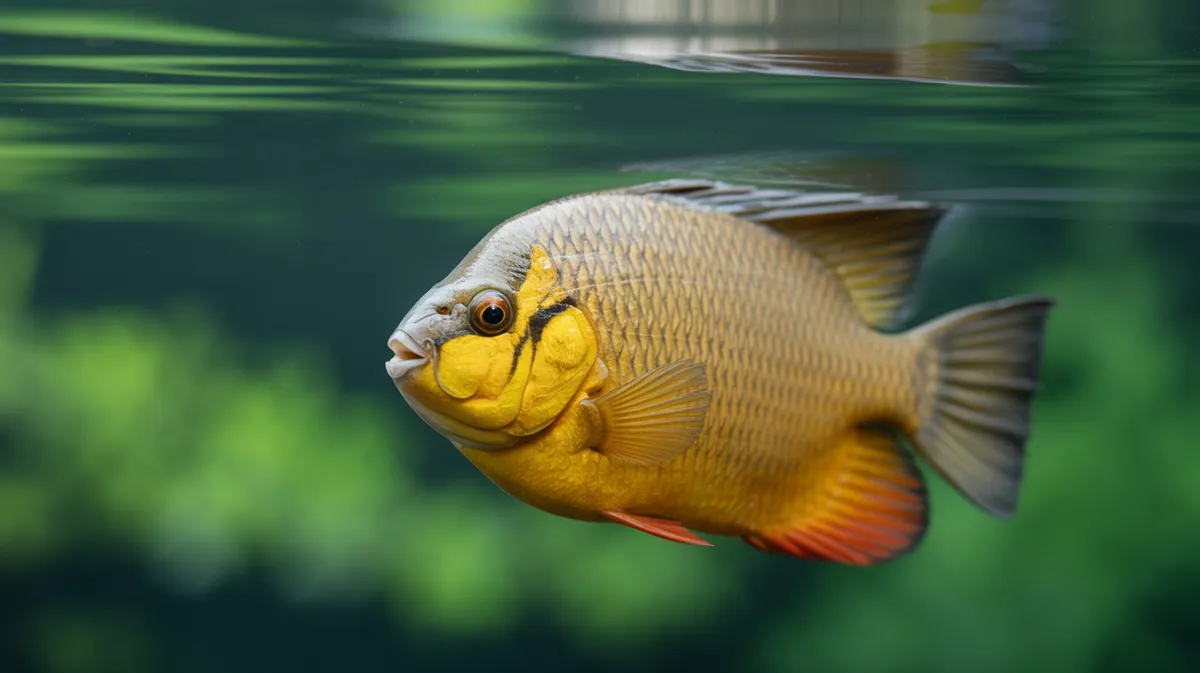
About the Golden Severum
The Golden Severum is a popular freshwater cichlid known for its vibrant golden-yellow coloration, which is the result of selective breeding from the wild Green Severum. Native to the slow-moving rivers and flooded forests of the Amazon Basin in South America, this fish is prized by aquarists for its peaceful temperament and striking appearance. Golden Severums are medium-sized, oval-shaped fish that display subtle iridescence and may develop orange or red highlights as they mature. They are social animals that thrive in well-structured aquariums with ample hiding spaces and moderate water flow.
Fascinating facts
Colorful Aquarium Favorite
The Golden Severum's bright coloration is a selectively bred trait, making it a staple in the aquarium trade worldwide.
Omnivorous Appetite
Golden Severums eat a varied diet that includes plant matter, insects, and small invertebrates, both in the wild and in captivity.
Dedicated Parents
Severum pairs form monogamous bonds and exhibit strong parental care by guarding and fanning their eggs and fry.
Detailed description
The Golden Severum (Heros efasciatus) is a medium-sized cichlid, typically reaching 15–20 cm (6–8 inches) in length, with a laterally compressed, oval-shaped body and rounded fins. Its distinctive golden-yellow coloration is a result of selective breeding, as wild-type Heros efasciatus display greenish or olive hues with faint vertical bars. The Golden Severum exhibits iridescent scales, and mature individuals often develop red or orange highlights around the gill plates, dorsal fin, and belly. Anatomically, it possesses a robust jaw structure and pharyngeal teeth, adaptations for processing a varied omnivorous diet. The species is known for its relatively peaceful temperament compared to other cichlids, though territoriality can emerge during breeding. In the wild, Heros efasciatus inhabits slow-moving tributaries, oxbow lakes, and seasonally flooded forests of the Amazon Basin, where water is typically soft, acidic, and warm (24–28°C/75–82°F). The species demonstrates complex social behaviors, including pair bonding and cooperative brood care. Its laterally compressed body and large pectoral fins facilitate precise maneuvering among submerged roots and vegetation. Golden Severums are diurnal, with activity peaking during daylight hours. Their adaptability to a range of water conditions and social nature have contributed to their popularity in the aquarium trade.
Did you know?
Despite their peaceful nature, Golden Severums can become territorial during spawning and will carefully clean a flat surface before laying their eggs.
Research & sources
Behaviour & social structure
Golden Severums are generally peaceful, especially when compared to more aggressive cichlid species, but can display territoriality during breeding or when establishing dominance hierarchies. They are social and often form loose groups in the wild, though pairs may become more isolated during spawning. In captivity, they interact with conspecifics and compatible tankmates through visual displays, gentle chasing, and fin flaring. Their feeding behavior is opportunistic; they forage for plant matter, insects, crustaceans, and detritus, often sifting through substrate or picking at surfaces. Severums exhibit exploratory behaviors, investigating new objects or changes in their environment. They are known to rearrange tank decor or uproot plants, reflecting their natural instinct to modify their habitat. Daily routines include periods of active foraging, social interaction, and resting in sheltered areas.
Reproduction & life cycle
Golden Severums are biparental substrate spawners, forming monogamous pairs during the breeding season. Courtship involves mutual displays, cleaning of a flat surface (such as a rock or broad leaf), and synchronized swimming. The female typically lays 100–1,000 adhesive eggs in neat rows, which are immediately fertilized by the male. Both parents guard the eggs, fanning them with their fins to ensure oxygenation and remove debris or fungus. Incubation lasts 3–5 days at optimal temperatures (26–28°C/79–82°F), after which the larvae hatch and are moved to shallow pits excavated by the parents. Fry become free-swimming after another 5–7 days and are closely guarded and herded by the adults for several weeks. Parental care is highly developed, with both sexes participating in defense and maintenance of the brood. In the wild, spawning is often triggered by seasonal flooding and associated changes in water chemistry.
Adaptations & survival
Golden Severums possess several adaptations for survival in dynamic floodplain environments. Their laterally compressed bodies and large, rounded fins allow for agile navigation among dense aquatic vegetation and submerged roots. The species' omnivorous dentition, including pharyngeal teeth, enables efficient processing of both plant and animal matter. Behavioral plasticity allows them to exploit a wide range of food sources and habitats. Their coloration, while more vivid in captive-bred forms, provides camouflage among sun-dappled aquatic plants in the wild. Parental care behaviors, including egg guarding and fry herding, significantly increase offspring survival rates. Additionally, their tolerance for variable water conditions—such as fluctuations in pH and dissolved oxygen—reflects evolutionary specialization for the seasonally changing Amazonian floodplain.
Cultural significance
While Heros efasciatus does not have a prominent role in indigenous Amazonian folklore or traditional uses, the Golden Severum morph has become highly significant in the global aquarium hobby. Its peaceful nature, striking coloration, and adaptability have made it a favorite among aquarists worldwide. The species is often featured in educational programs and public aquaria, helping to raise awareness about Amazonian biodiversity and freshwater conservation. In some cultures, the golden coloration is associated with prosperity and good fortune, further enhancing its appeal.
Recent research
Recent studies on Heros efasciatus have focused on its reproductive endocrinology, parental care behaviors, and responses to environmental stressors such as hypoxia and pollution. Genetic research has clarified the relationships between Heros species and the origins of various color morphs, including the Golden Severum. Ongoing work is examining the impacts of habitat fragmentation on population genetics and the potential for adaptation to changing floodplain dynamics. Behavioral studies in captivity have provided insights into cichlid social cognition and learning abilities, with Severums demonstrating complex problem-solving and memory. There is also interest in their role as bioindicators for water quality in the Amazon Basin.
Videos
Habitat
Freshwater rivers and flooded forests


Conservation
The Golden Severum is currently classified as Least Concern on the IUCN Red List.
Threats & challenges
In their native range, Heros efasciatus populations are currently stable and not considered threatened, but localized pressures exist. Habitat alteration due to deforestation, dam construction, and water pollution can impact local populations by reducing spawning sites and altering water chemistry. Overfishing for the aquarium trade is not a significant threat due to the prevalence of captive breeding. Climate change, with its potential to alter flood regimes and water temperatures, poses a long-term risk to Amazonian aquatic ecosystems. Invasive species and competition with introduced fish may also present localized challenges. Overall, the species is assessed as Least Concern by the IUCN, but ongoing habitat monitoring is recommended.
Taxonomy
Scientific name
Heros efasciatus
- Kingdom
- Animalia
- Phylum
- Chordata
- Class
- Actinopterygii
- Order
- Cichliformes
- Family
- Cichlidae
- Genus
- Heros
- Species
- efasciatus
Community notes
Share your observations about the Golden Severum.
No community notes yet. Be the first!
Discover more wildlife
More fascinating animals from the encyclopedia.