
About the Golden Trout
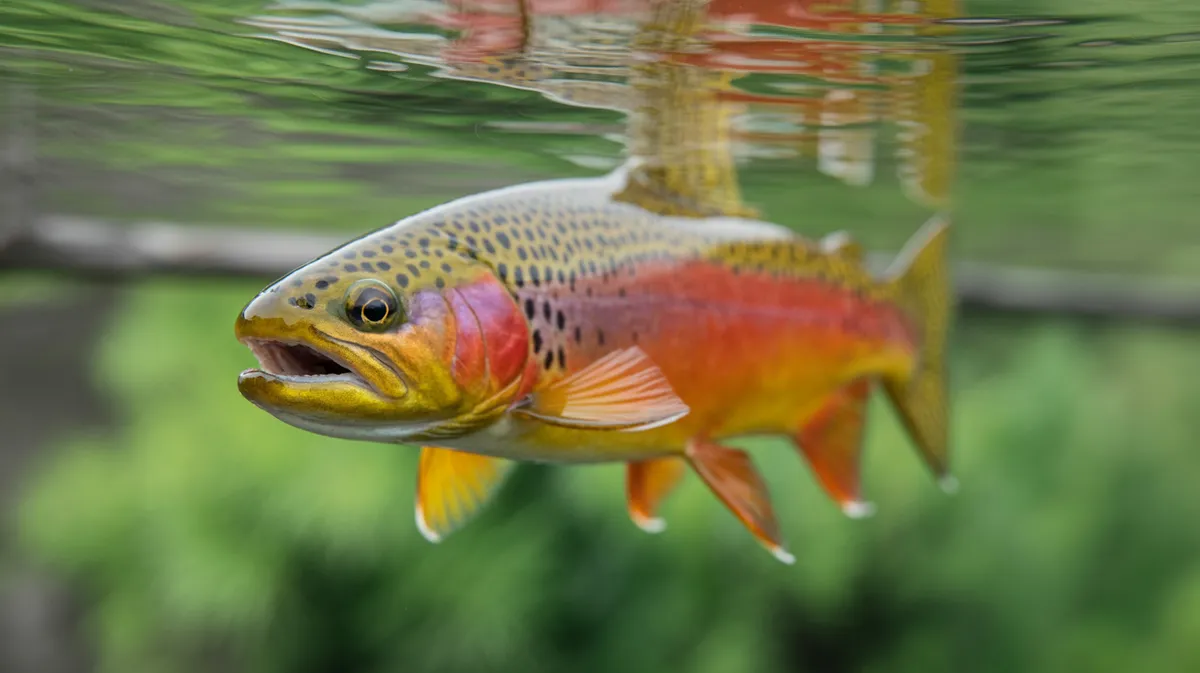
The Golden Trout is a brilliantly colored freshwater fish native to the cold, clear mountain streams and lakes of California's Sierra Nevada. Easily recognized by its bright golden-yellow body, red horizontal band, and distinctive black spots, this trout is considered one of the most beautiful trout species in the world. It is a subspecies of the rainbow trout and is highly prized by anglers for its elusive nature and striking appearance. Golden Trout inhabit high-altitude waters, often above 6,000 feet, and have adapted to the unique conditions of alpine environments.
Fascinating facts
Striking Colors
Golden Trout display vibrant hues of gold, red, and olive, making them one of the most colorful trout species in North America.
High Elevation Resident
They are adapted to live in cold, clear waters of alpine lakes and streams, often found at elevations exceeding 9,000 feet.
Conservation Challenges
Pure Golden Trout populations are threatened by hybridization with introduced trout species and by habitat degradation.
Detailed description
The California golden trout (Oncorhynchus mykiss aguabonita) is a small, vibrantly colored salmonid, typically reaching 15–28 cm (6–11 in) in length, though individuals up to 30 cm (12 in) have been recorded in optimal conditions. Its body is characterized by a brilliant golden-yellow hue, with a vivid red-orange lateral stripe running from the gill cover to the tail, and distinctive parr marks (oval spots) along the lateral line, especially prominent in juveniles. The dorsal, caudal, and anal fins are edged with white to yellowish coloration. Golden trout possess a streamlined body adapted for swift mountain streams, with a slightly forked tail and well-developed pectoral fins for maneuverability. Their scales are small and delicate, and the mouth is terminal with fine, conical teeth suited for an omnivorous diet. This subspecies is highly adapted to cold, oligotrophic (nutrient-poor) waters at elevations typically above 2,100 meters (6,900 feet). Golden trout are generally solitary or form loose aggregations, especially during spawning. Their lifespan in the wild is typically 5–7 years, with sexual maturity reached at 2–3 years. The species is renowned for its sensitivity to environmental changes, making it an important indicator of alpine aquatic ecosystem health.
Did you know?
Golden Trout have been introduced to other states and countries, but pure populations remain rare and are threatened by hybridization and habitat loss.
Research & sources
Wikipedia summary
The California golden trout (Oncorhynchus aguabonita or Oncorhynchus mykiss aguabonita) is a species of trout native to California. The golden trout is normally found in the Golden Trout Creek, Volcano Creek, and the South Fork Kern River. The Golden trout has been the official freshwater state fish of California since 1947.
Behaviour & social structure
Golden trout are primarily diurnal, exhibiting peak activity during daylight hours, especially in the morning and late afternoon. They are opportunistic feeders, consuming a varied diet of aquatic and terrestrial insects (such as mayflies, caddisflies, and ants), small crustaceans, zooplankton, and occasionally algae or detritus. Feeding behavior is often surface-oriented, with trout rising to intercept drifting insects. Social interactions are generally limited outside the breeding season, with individuals maintaining small territories, particularly in stream habitats. During periods of low food availability, golden trout may exhibit increased foraging range and even cannibalistic tendencies, especially among juveniles. Predation risk from introduced species (e.g., brown trout, brook trout) has altered their natural behavior, leading to increased wariness and use of cover. In winter, activity decreases significantly as metabolic rates drop in response to cold water temperatures.
Reproduction & life cycle
Golden trout spawn in late spring to early summer (typically June–July), triggered by rising water temperatures (6–10°C/43–50°F) and increased stream flow from snowmelt. Spawning occurs in shallow, gravel-bottomed riffles of streams, where females excavate nests (redds) using their tails. Females lay between 200 and 1,000 eggs, depending on size and age, which are then fertilized externally by males. Incubation lasts 3–4 weeks, influenced by water temperature. There is no parental care after spawning; eggs and fry are vulnerable to predation and environmental fluctuations. Juveniles remain in shallow, protected areas until they grow large enough to disperse. Sexual maturity is typically reached at 2–3 years, and adults may spawn annually if conditions permit.
Adaptations & survival
Golden trout exhibit several adaptations for survival in high-elevation, cold-water environments. Their metabolic rates are optimized for low temperatures, allowing efficient energy use in nutrient-poor habitats. The bright coloration may serve as camouflage among sunlit, rocky streambeds and aquatic vegetation, as well as a signal during breeding. Their streamlined bodies and strong fins enable them to navigate swift currents and avoid predators. Physiologically, they tolerate low dissolved oxygen levels and wide temperature fluctuations, though they are sensitive to siltation and chemical pollutants. Behavioral adaptations include opportunistic feeding and the ability to exploit brief seasonal food abundance. Their reproductive timing is closely linked to snowmelt cycles, ensuring optimal conditions for offspring survival.
Cultural significance
The golden trout holds significant cultural and symbolic value in California, designated as the official state freshwater fish since 1947. It is celebrated for its beauty and rarity, often referred to as the 'jewel of the Sierra.' The species has inspired conservation movements and is a sought-after catch among fly anglers, who regard it as a pinnacle achievement due to its remote habitat and elusive nature. The golden trout also features in local folklore and is emblematic of the pristine wilderness of the Sierra Nevada. Its image is used in educational materials, conservation campaigns, and state emblems.
Recent research
Recent research has focused on the genetic integrity of golden trout populations, using molecular markers to assess hybridization with introduced rainbow trout. Studies have also examined the effects of climate change on stream hydrology and trout distribution, as well as the efficacy of habitat restoration and non-native fish removal projects. Ongoing monitoring by state and federal agencies aims to track population trends and inform adaptive management. Notably, a 2020 study highlighted the importance of genetic refugia in preserving pure golden trout lineages, and experimental reintroduction efforts are underway in historically occupied watersheds.
Videos
Habitat
Cold mountain streams and alpine lakes


Conservation
The Golden Trout is currently classified as Near Threatened on the IUCN Red List.
Threats & challenges
Golden trout face a range of threats, including habitat degradation from livestock grazing, water diversion, and recreational impacts that alter stream structure and water quality. Hybridization and competition with introduced trout species (rainbow, brown, and brook trout) have resulted in genetic dilution and reduced population viability. Climate change poses additional risks by altering snowpack, stream flow, and water temperature regimes, potentially reducing suitable habitat. Overfishing and illegal stocking further exacerbate population declines. Current estimates suggest that genetically pure populations occupy less than 10% of their historical range, and the species is classified as Critically Imperiled by NatureServe. Conservation efforts focus on habitat restoration, removal of non-native species, and genetic monitoring.
Taxonomy
Scientific name
Oncorhynchus mykiss aguabonita
- Kingdom
- Animalia
- Phylum
- Chordata
- Class
- Actinopterygii
- Order
- Salmoniformes
- Family
- Salmonidae
- Genus
- Oncorhynchus
- Species
- aguabonita
Community notes
Share your observations about the Golden Trout.
No community notes yet. Be the first!
Discover more wildlife
More fascinating animals from the encyclopedia.