
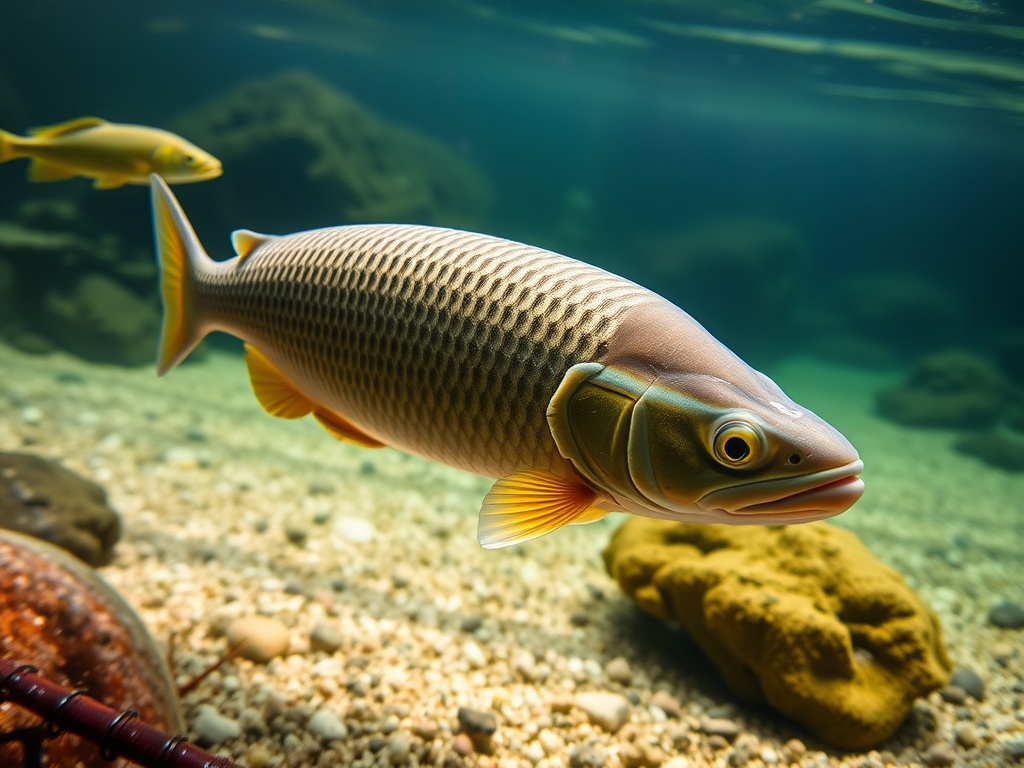
About the Grass carp
The grass carp is a large freshwater fish native to East Asia, recognized for its elongated, torpedo-shaped body and silvery-gray scales. It primarily inhabits slow-moving rivers, lakes, and ponds, and is highly valued for its ability to control aquatic vegetation. Grass carp have been widely introduced around the world for biological weed control, but can sometimes disrupt local ecosystems. They are fast-growing and can reach impressive sizes, making them popular in aquaculture and sport fishing.
Fascinating facts
Vegetation Eaters
Grass carp are used worldwide to manage aquatic weeds, as they feed voraciously on a wide range of submerged plants.
Rapid Growth
They are among the fastest-growing freshwater fish, often reaching marketable size in just one to two years.
Global Introduction
Originally from Asia, grass carp have been introduced to more than 50 countries for weed control and aquaculture.
Detailed description
The grass carp (Ctenopharyngodon idella) is a robust, large-bodied freshwater fish characterized by its elongated, cylindrical form and broad, blunt head. Adults typically reach lengths of 60–100 cm, but individuals exceeding 150 cm and weighing over 45 kg have been recorded, especially in optimal conditions. The body is covered with large, cycloid scales that are silvery to olive-gray dorsally, fading to a whitish belly. Grass carp possess a terminal mouth lacking barbels, with pharyngeal teeth adapted for grinding plant material. Their eyes are positioned laterally, providing a wide field of vision. The dorsal fin is short and set far back on the body, while the caudal fin is deeply forked, aiding in swift, sustained swimming. Grass carp are primarily diurnal, often seen cruising in schools near the water surface or midwater, especially in vegetated habitats. They are highly migratory in their native range, undertaking long upstream journeys to spawn. Juveniles display rapid growth rates, often reaching 1 kg within their first year under favorable conditions. Their digestive tract is notably long, reflecting their herbivorous diet and adaptation to processing fibrous plant material.
Did you know?
Grass carp are one of the largest members of the minnow family (Cyprinidae) and can grow over 1.5 meters (5 feet) long.
Research & sources
Wikipedia summary
The grass carp is a species of large herbivorous freshwater fish in the family Cyprinidae, native to the Pacific Far East, with a native range stretching from northern Vietnam to the Amur River on the Sino-Russian border. This Asian carp is the only species of the genus Ctenopharyngodon.
Behaviour & social structure
Grass carp are predominantly herbivorous, feeding on a wide variety of aquatic macrophytes, including submerged, floating, and emergent vegetation. They exhibit selective feeding, often preferring softer, more palatable plants but will consume tougher species when preferred food is scarce. Feeding activity peaks during daylight hours, with individuals grazing continuously, sometimes consuming up to 40% of their body weight in plant matter daily. Socially, grass carp are gregarious, forming loose aggregations, particularly during feeding and migration. They exhibit strong schooling behavior as juveniles, which may reduce predation risk. Adults may become more solitary or form smaller groups. Grass carp are generally non-territorial and display minimal aggressive interactions, except during spawning migrations when competition for optimal spawning sites may occur. They are highly responsive to environmental cues, such as water temperature and flow, which influence their activity patterns and migration timing.
Reproduction & life cycle
Grass carp are broadcast spawners, with reproduction typically triggered by rising water temperatures (18–30°C) and increased river flow during the spring and early summer. Spawning occurs in large, fast-flowing rivers, where females release between 500,000 and 1.5 million semi-buoyant eggs per season, depending on body size. Fertilization is external, and eggs drift downstream, requiring turbulent, well-oxygenated water to remain suspended and develop successfully. Embryonic development is rapid, with hatching occurring within 24–48 hours. Larvae are pelagic and continue to drift for several days before settling in calmer, vegetated backwaters. Grass carp exhibit no parental care; survival of eggs and larvae is highly dependent on river conditions and predation rates. In non-native environments, successful natural reproduction is rare unless suitable riverine conditions are present, so most populations are maintained through artificial propagation and stocking.
Adaptations & survival
Grass carp have evolved several adaptations for their herbivorous lifestyle and migratory behavior. Their pharyngeal teeth are specialized for shredding and grinding tough plant material, while their elongated digestive tract maximizes nutrient extraction from fibrous diets. The streamlined, torpedo-shaped body and powerful caudal fin facilitate long-distance swimming and migration against strong currents. Physiologically, grass carp exhibit rapid growth rates and high food conversion efficiency, enabling them to reach large sizes quickly. Their eggs are semi-buoyant, an adaptation for dispersal in flowing water, ensuring wide distribution of offspring. Grass carp also display a high degree of environmental tolerance, thriving in a range of water temperatures (0–38°C), oxygen levels, and water qualities, which has contributed to their success as an introduced species.
Cultural significance
Grass carp have significant economic and cultural importance, particularly in China, where they have been cultivated for over a thousand years as one of the 'Four Domesticated Fish' in traditional polyculture systems. They are a major source of protein and are highly valued in aquaculture due to their rapid growth and efficient feed conversion. In some Asian cultures, grass carp are associated with prosperity and abundance, and feature in local cuisine and festivals. Their introduction to other continents, notably North America and Europe, has been primarily for biological control of aquatic weeds, reflecting their practical value in water management. However, their symbolic and culinary roles are less pronounced outside their native range.
Recent research
Recent research on grass carp has focused on their ecological impacts as an introduced species, genetic differentiation between wild and cultured populations, and the development of triploid (sterile) individuals to mitigate invasive risks. Studies have examined their diet selectivity, effects on aquatic ecosystems, and potential for hybridization with other cyprinids. Advances in molecular genetics have improved understanding of population structure and adaptation to diverse environments. Ongoing research also explores their role in integrated multi-trophic aquaculture systems and the development of sustainable management practices for both aquaculture and weed control applications.
Sources
Ctenopharyngodon idella (Grass Carp): Species Fact Sheet
Food and Agriculture Organization of the United Nations (FAO) (2023)
scientificCtenopharyngodon idella: The IUCN Red List of Threatened Species 2022
Bogutskaya, N. (2022)
conservationEcological impacts and management of grass carp (Ctenopharyngodon idella) in North America
Cudmore, B. & Mandrak, N.E. (2011)
scientificVideos
Habitat
Freshwater rivers, lakes, ponds, and reservoirs

Conservation
The Grass carp is currently classified as Least Concern on the IUCN Red List.
Threats & challenges
In their native range, grass carp populations are stable, and the species is classified as Least Concern by the IUCN. However, habitat modification, dam construction, and water pollution can disrupt spawning migrations and reduce reproductive success. In regions where grass carp have been introduced for aquatic weed control, they may pose ecological risks by overgrazing native vegetation, altering habitat structure, and impacting native fish and invertebrate communities. Uncontrolled populations can lead to declines in biodiversity and water quality. Additionally, hybridization with related carp species has been reported in some areas. Management challenges include balancing their use for weed control with the prevention of unintended ecological impacts and ensuring sterile (triploid) individuals are stocked to prevent natural reproduction in non-native habitats.
Taxonomy
Scientific name
Ctenopharyngodon idella
- Kingdom
- Animalia
- Phylum
- Chordata
- Class
- Actinopterygii
- Order
- Cypriniformes
- Family
- Cyprinidae
- Genus
- Ctenopharyngodon
- Species
- idella
Where to see a grass carp
1 zoo and aquarium in 1 country are recorded as keeping this species.
Community notes
Share your observations about the Grass carp.
No community notes yet. Be the first!
Discover more wildlife
More fascinating animals from the encyclopedia.