
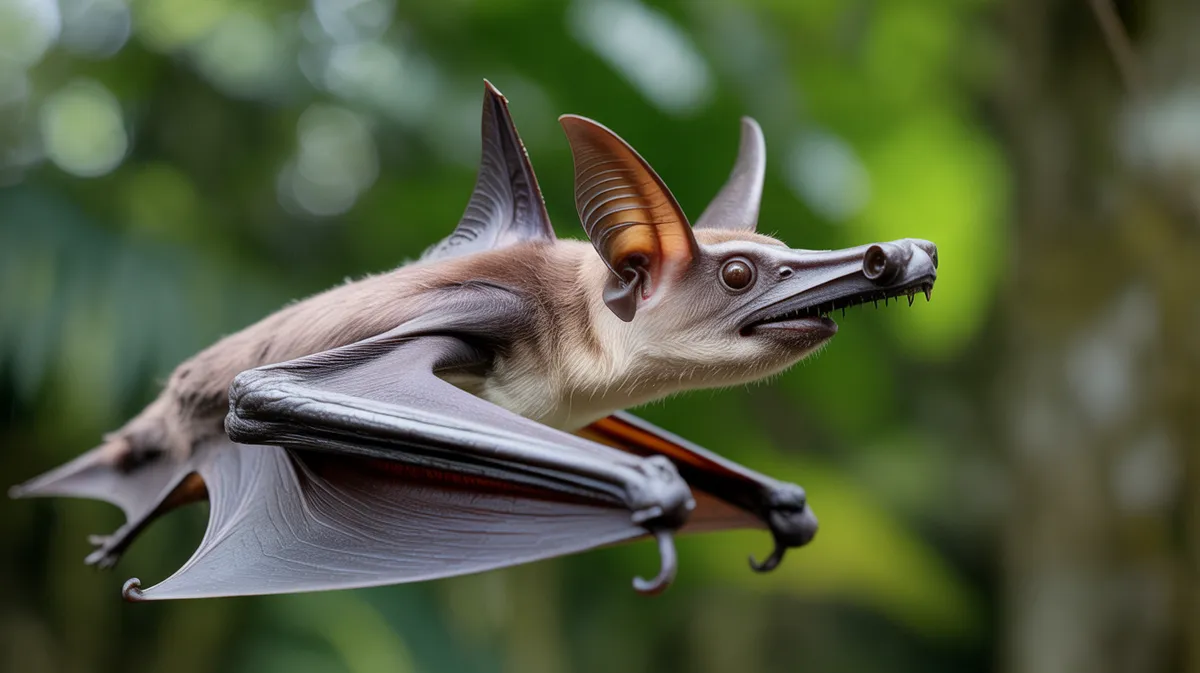
About the Great Hammerhead Bat
The hammer-headed bat, Hypsignathus monstrosus, is Africa's largest bat, with a wingspan near a metre, and the male's head is one of the most extreme cases of sexual dimorphism in mammals. His skull is elongated into a blunt hammer, the muzzle is inflated with enormous resonating chambers, and the larynx is so enlarged that it fills over half the body cavity, shoving the heart, lungs and other organs backward to make room. All of it exists to make noise. Males gather at night in riverside leks along the Congo Basin - traditional display sites where dozens hang in a line along a branch - and honk continuously at up to a few honks per second while flapping their wings, for hours. Females fly the line, inspect, and mate with a small handful of males; in some studied leks fewer than 10 percent of males secure most of the matings. Females look completely different, with narrow fox-like faces, and were originally thought to be a separate species. Despite the demonic appearance the bat is a fruit-eater, favouring figs, and is entirely harmless, though it has attracted attention as a possible Ebola reservoir - a suspicion based on antibody evidence rather than isolated live virus.
Fascinating facts
Largest Bat in Africa
The Great Hammerhead Bat is the largest bat species in Africa, with males reaching wingspans up to 1 meter.
Honking Courtship Calls
Males produce loud, resonant honking calls thanks to their enlarged heads and larynx to attract females during mating season.
Key Seed Disperser
As a frugivore, this bat plays an important role in rainforest ecology by dispersing seeds and pollinating flowers.
Detailed description
The Great Hammerhead Bat (Hypsignathus monstrosus) is a large megabat endemic to the lowland tropical forests and riverine swamps of Central and West Africa. Adult males are notably larger than females, with males reaching forearm lengths of 110–120 mm and weighing up to 420 grams, while females are typically 275–350 grams. The most distinctive feature is the male's enormous, hammer-shaped head, which houses hypertrophied nasal and laryngeal tissues used for producing loud, resonant honking calls. Their pelage is generally brownish to gray, with lighter underparts and a sparse fur covering the wings. The wingspan can approach 97 cm in large males. Their eyes are large and well-adapted for nocturnal vision, and the ears are rounded. The species exhibits pronounced sexual dimorphism, not only in head morphology but also in overall size and vocal apparatus. The dental formula is adapted for a frugivorous diet, with robust molars for crushing fruit pulp. Roosting occurs in groups of 5–25 individuals, often in dense foliage or along riverbanks. The species is primarily arboreal but is capable of long-distance flight, facilitating wide-ranging foraging. Their ecological role as seed dispersers and occasional pollinators is critical for forest regeneration.
Did you know?
The Great Hammerhead Bat is one of the most sexually dimorphic bats in the world, with males often twice the size of females and having a completely different head shape.
Research & sources
Behaviour & social structure
Great Hammerhead Bats are nocturnal, emerging at dusk to forage for fruit, particularly figs (Ficus spp.), bananas, mangoes, and guavas. Males are highly vocal and exhibit lekking behavior, congregating at traditional display sites where they call to attract females. The males' calls, produced by specialized laryngeal structures, can be heard over 1 km away and are used to establish dominance and territory within the lek. Females visit these leks to select mates, typically choosing males with the most vigorous and frequent calls. Outside the breeding season, both sexes forage solitarily or in small groups, using their acute sense of smell to locate ripe fruit. Roosts are generally quiet during the day, with individuals hanging upside down from branches, often concealed by dense leaves. Social interactions are most intense during the mating season, with males engaging in both vocal and physical displays. There is little evidence of cooperative care or complex social hierarchies outside of lekking behavior.
Reproduction & life cycle
Hypsignathus monstrosus exhibits a polygynous mating system centered around lekking. The breeding season typically coincides with the rainy season, varying regionally but often peaking between May and October. Males establish display territories within leks and perform nightly vocalizations to attract females. After mating, females depart to solitary roosts for gestation, which lasts approximately 5–6 months. A single offspring is born per reproductive event, usually at the onset of the dry season when fruit is abundant. Neonates are altricial, clinging to the mother's ventrum for the first few weeks. Maternal care is exclusive, with the mother carrying the pup during foraging trips until it is capable of flight at around 6–8 weeks. Sexual maturity is reached at approximately 6–12 months for females and 18–24 months for males.
Adaptations & survival
The Great Hammerhead Bat's most striking adaptation is the male's enlarged head and larynx, which function as a resonating chamber for producing powerful mating calls. This sexual dimorphism is an example of sexual selection, driven by female choice. Their large, broad wings allow for efficient gliding and maneuverability in dense forest canopies. The elongated snout and robust jaw muscles facilitate consumption of large, tough fruits. Their olfactory system is highly developed, enabling them to detect ripe fruit over considerable distances. Nocturnal vision is enhanced by large eyes with a high rod-to-cone ratio. Behavioral adaptations include lekking, which maximizes reproductive success, and flexible roosting strategies that reduce predation risk.
Cultural significance
In some West and Central African cultures, the Great Hammerhead Bat is associated with folklore and is sometimes regarded with superstition due to its unusual appearance and loud nocturnal calls. In certain areas, it is hunted for bushmeat or used in traditional medicine, though it is not a major target compared to other wildlife. The bat's role in seed dispersal is recognized by some local communities as beneficial for forest health, but overall, its cultural significance is limited compared to more charismatic or economically important species.
Recent research
Recent research has focused on the species' lekking behavior and the biomechanics of its vocalizations, revealing that the male's larynx is among the most hypertrophied of any mammal relative to body size. Genetic studies indicate significant gene flow across populations, suggesting high mobility and dispersal capacity. Ongoing ecological studies are examining the bat's role in forest regeneration and its interactions with fruiting trees. There is also interest in the species' potential as a reservoir for zoonotic viruses, although no direct links to human disease have been established. Conservation research is monitoring population trends in response to habitat changes.
Sources
Lek Mating and Acoustic Communication in the Hammer-headed Fruit Bat, Hypsignathus monstrosus
Bradbury, J.W. (1977)
scientificHypsignathus monstrosus: The IUCN Red List of Threatened Species 2016
Monadjem, A. & Fahr, J.
conservationThe ecology and reproductive biology of the hammer-headed fruit bat (Hypsignathus monstrosus)
Bradbury, J.W. (1977)
scientificSexual selection and the evolution of vocal communication in the hammer-headed bat
Bradbury, J.W. & Emmons, L.H. (1974)
scientificHypsignathus monstrosus: The IUCN Red List of Threatened Species 2016
Monadjem, A. et al.
conservationVideos
Habitat
Tropical rainforest and swamp forest


Conservation
The Great Hammerhead Bat is currently classified as Least Concern on the IUCN Red List.
Threats & challenges
While currently listed as Least Concern by the IUCN, the Great Hammerhead Bat faces localized threats from habitat loss due to deforestation, agricultural expansion, and wetland drainage. Hunting for bushmeat and traditional medicine, though not widespread, poses additional risks in some regions. Disturbance of roosting and lekking sites by human activity can disrupt breeding success. Climate change may also impact fruit availability and habitat suitability. Despite these challenges, the species remains widespread and relatively resilient, but ongoing habitat degradation could lead to future declines if not managed.
Taxonomy
Scientific name
Hypsignathus monstrosus
- Kingdom
- Animalia
- Phylum
- Chordata
- Class
- Mammalia
- Order
- Chiroptera
- Family
- Pteropodidae
- Genus
- Hypsignathus
- Species
- monstrosus
Community notes
Share your observations about the Great Hammerhead Bat.
No community notes yet. Be the first!
Discover more wildlife
More fascinating animals from the encyclopedia.