
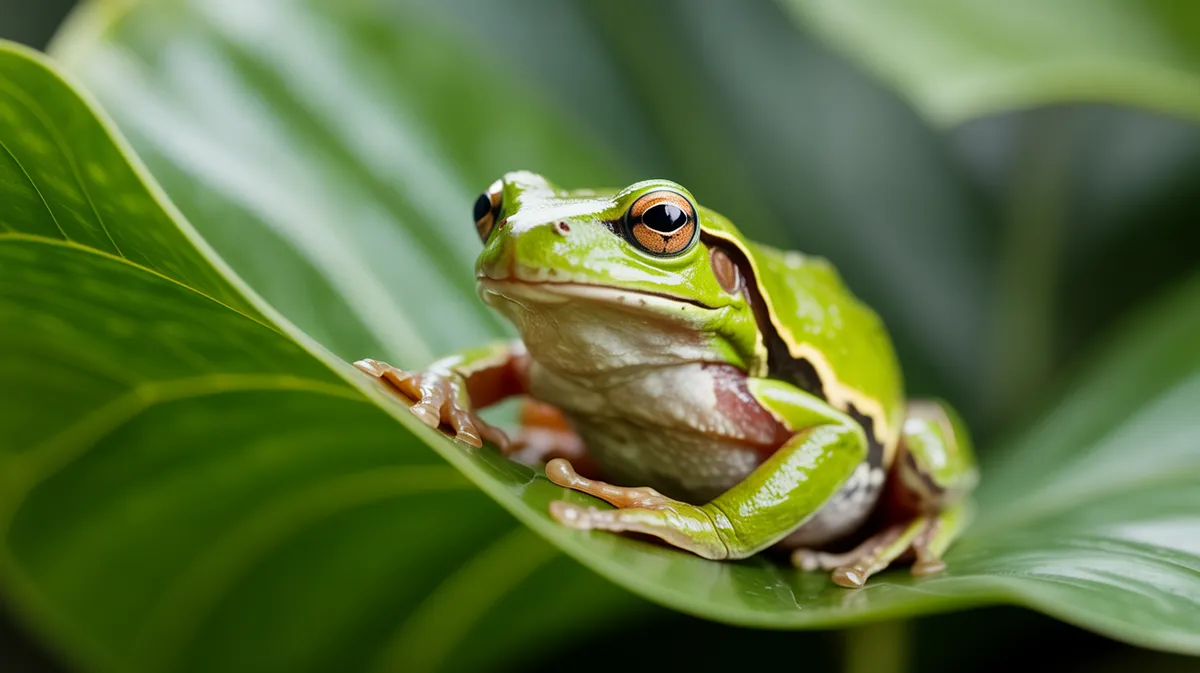
About the Green Tree Frog
The Green Tree Frog is a medium-sized, bright green amphibian native to Australia and New Guinea, recognized for its smooth skin and large toe pads. This species is highly adaptable, often found near human dwellings as well as in natural wetlands and forests. Green Tree Frogs are mostly nocturnal, seeking cool, moist environments during the day and emerging at night to hunt for insects. They are known for their distinctive, loud, and resonant call, especially during the rainy season. Their gentle nature and striking appearance make them a popular pet species worldwide.
Fascinating facts
Sticky Toe Pads
Green Tree Frogs have specialized toe pads that allow them to climb smooth surfaces, aiding their arboreal lifestyle.
Distinctive Calls
During mating season, males produce loud, barking calls that can be heard from a considerable distance, attracting females and deterring rivals.
Rain Lovers
These frogs are most active during humid or rainy weather, when they emerge in large numbers to feed and breed.
Detailed description
The Australian Green Tree Frog (Litoria caerulea), also known as the Dumpy Tree Frog or White's Tree Frog, is a robust amphibian reaching lengths of 7–11 cm (2.8–4.3 in), with females generally larger than males. Its dorsal skin is smooth and waxy, typically bright green but sometimes exhibiting shades of blue, turquoise, or brown, depending on environmental conditions and stress levels. The ventral surface is creamy white, and the frog is distinguished by prominent, adhesive toe pads that facilitate climbing smooth surfaces. Large, horizontal pupils and a distinct tympanum (eardrum) are visible on each side of the head. Litoria caerulea is primarily arboreal but is also found on the ground, especially during wet weather. It is a nocturnal species, spending daylight hours hidden in cool, moist refuges such as tree hollows, under bark, or in human structures like toilets and downpipes. At night, it emerges to hunt, using its keen vision and sticky tongue to capture a variety of prey. This species is known for its docile temperament and tolerance of human presence, often inhabiting gardens and homes. Its skin secretes antimicrobial peptides, providing protection against pathogens and contributing to its longevity, with individuals living up to 16 years in the wild and over 20 years in captivity. The Green Tree Frog's distinctive, deep 'waark-waark' call is most often heard during the breeding season, and it plays a key role in mate attraction and territorial displays.
Did you know?
The Green Tree Frog’s skin secretions were once studied for potential use in developing new antibiotics due to their powerful antimicrobial properties.
Research & sources
Wikipedia summary
Green tree frog is a common name for several different tree frog species:American green tree frog, a frog in the family Hylidae found in the southern United States Australian green tree frog, a frog in the family Hylidae native to Australia and New Guinea Emerald green tree frog, a frog in the family Rhaco to northern Taiwan
Behaviour & social structure
Green Tree Frogs are solitary and territorial, with individuals maintaining defined home ranges. They are opportunistic sit-and-wait predators, feeding primarily on insects such as moths, crickets, and cockroaches, but also consuming spiders, smaller frogs, and occasionally small mammals or reptiles. Hunting occurs at night, with the frog remaining motionless until prey approaches, then striking rapidly with its sticky tongue. During the day, they seek shelter in moist, shaded locations to avoid desiccation. Social interactions are limited outside of the breeding season, though males may congregate at water bodies to call and compete for mates. Vocalizations serve both to attract females and to establish dominance among males. In urban environments, Green Tree Frogs are known to exploit artificial water sources and lights, which attract insect prey.
Reproduction & life cycle
Breeding occurs during the warmer, wetter months (typically November to February in Australia), triggered by heavy rainfall. Males establish calling sites near still or slow-moving water and produce loud advertisement calls to attract females. Amplexus (the mating embrace) is axillary, with the male grasping the female behind her forelimbs. Females lay clutches of 200–2000 eggs on the surface of water, often attached to vegetation. Eggs hatch within 2–7 days, depending on temperature. Tadpoles are herbivorous, feeding on algae and detritus, and undergo metamorphosis after 4–6 weeks. There is no parental care after egg-laying. Sexual maturity is reached at 2–3 years of age.
Adaptations & survival
Litoria caerulea exhibits several adaptations for arboreal life, including enlarged toe pads with specialized mucous glands that enhance grip on smooth surfaces. Its skin secretes potent antimicrobial peptides (caeruleins and caerins), which protect against bacterial and fungal infections—a trait of interest in biomedical research. The species can tolerate a wide range of temperatures and humidity levels, aided by its ability to absorb water through the skin and reduce water loss via a waxy cuticle. During dry periods, it may enter a state of torpor, reducing metabolic activity. Its coloration provides camouflage among foliage, and the ability to change shade helps regulate body temperature and moisture loss.
Cultural significance
The Green Tree Frog holds a special place in Australian culture, often regarded as a symbol of rain and good fortune. It is featured in Aboriginal folklore and is a popular subject in art and literature. Its gentle nature and ease of care have made it a favored pet worldwide, and it is sometimes used in educational programs to promote amphibian conservation. In traditional medicine, skin secretions have been investigated for their potential antimicrobial and analgesic properties.
Recent research
Recent research has focused on the antimicrobial peptides in Litoria caerulea's skin, which show promise for developing new antibiotics. Studies have also examined the species' remarkable adaptability to urban environments, including its use of artificial habitats and tolerance to pollutants. Ongoing monitoring of populations is assessing the impact of chytrid fungus and environmental changes. Genetic studies are providing insights into population structure and evolutionary history, aiding conservation planning.
Videos
Habitat
Forests, wetlands, and urban areas near freshwater sources


Conservation
The Green Tree Frog is currently classified as Least Concern on the IUCN Red List.
Threats & challenges
Although classified as Least Concern by the IUCN, Green Tree Frogs face localized threats from habitat destruction, pollution, and the introduction of invasive predators such as cane toads (Rhinella marina). Disease, particularly chytridiomycosis caused by the chytrid fungus (Batrachochytrium dendrobatidis), poses a significant risk to populations. Urbanization can lead to road mortality and exposure to pesticides, but the species' adaptability allows it to persist in many modified environments. Climate change and altered rainfall patterns may affect breeding success and larval development in the future.
Taxonomy
Scientific name
Litoria caerulea
- Kingdom
- Animalia
- Phylum
- Chordata
- Class
- Amphibia
- Order
- Anura
- Family
- Hylidae
- Genus
- Litoria
- Species
- caerulea
Community notes
Share your observations about the Green Tree Frog.
No community notes yet. Be the first!
Discover more wildlife
More fascinating animals from the encyclopedia.