
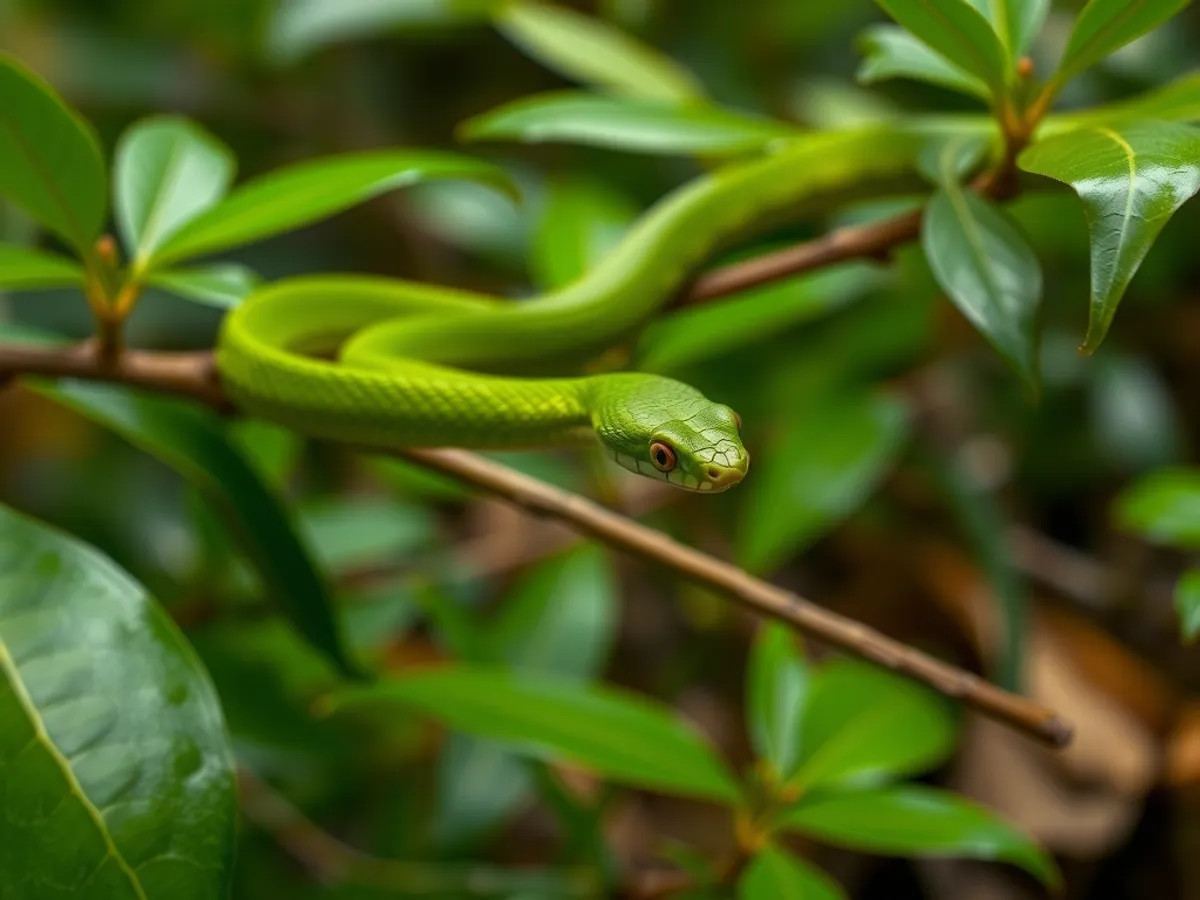
About the Green vine snake
The green vine snake is a slender, arboreal snake native to the forests of South and Southeast Asia. Characterized by its bright green coloration and elongated, pointed snout, this snake expertly camouflages among foliage, making it difficult for both prey and predators to spot. Primarily diurnal, it hunts lizards, frogs, and small birds using its excellent vision and quick strikes. Although mildly venomous, its venom is not considered dangerous to humans, and it relies mainly on stealth and speed for hunting.
Fascinating facts
Expert Camouflage
Their vivid green coloration and slender shape allow them to blend seamlessly with vines and leaves in their forest habitat.
Unique Pupils
Green vine snakes have horizontal, keyhole-shaped pupils, which is rare among snakes and helps them judge distances precisely.
Quick Strikers
They can strike rapidly and with great accuracy, often catching agile prey such as lizards and frogs in mid-movement.
Detailed description
The green vine snake (Ahaetulla nasuta) is a highly specialized arboreal colubrid, recognized for its exceptionally slender, elongated body, which can reach lengths of 1.5 to 2 meters, though most individuals average around 1 meter. Its dorsal coloration is a vivid, leaf-green, often with a pale yellow or white ventral surface, providing remarkable camouflage among foliage. The head is distinctively elongated and pointed, with a pronounced snout and large, laterally positioned eyes featuring horizontal, keyhole-shaped pupils—an adaptation for enhanced binocular vision. This species is diurnal and relies on its acute eyesight to detect prey and predators. The body is laterally compressed, allowing the snake to move effortlessly through branches and twigs. Ahaetulla nasuta is mildly venomous, possessing rear-fanged (opisthoglyphous) dentition; its venom is effective for subduing small vertebrates but poses minimal risk to humans. The snake is solitary outside of the breeding season and exhibits a sit-and-wait predatory strategy, remaining motionless for extended periods. Its cryptic coloration and slow, deliberate movements make it nearly invisible in its leafy habitat. Reproduction is ovoviviparous, with females giving birth to live young. The green vine snake is an important predator in its ecosystem, helping regulate populations of arboreal lizards, frogs, and small birds.
Did you know?
Despite their delicate appearance, green vine snakes are skilled predators that can accurately judge distances before striking at prey.
Research & sources
Wikipedia summary
Vine snake are arboreal species of snakes that are often likened to vines due to their thin, elongate shape and/or coloration. The term can refer to several genera of snake in the taxonomic family Colubridae, including:Ahaetulla, a genus of Asiatic vine snakes Chironius, a Neotropical genus sometimes called vine snake Imantodes, a Neotropical genus known as blunt-headed vine snakes Oxybelis, a Neotropical genus of vine snakes Thelotornis, a genus of African vine snakes also known as twig snakes Uromacer, a genus of Hispaniolan vine snakes
Behaviour & social structure
Ahaetulla nasuta is primarily diurnal, with peak activity observed during the early morning and late afternoon. It spends most of its time in the mid to upper canopy, rarely descending to the ground. The snake employs a combination of ambush and active foraging, often remaining motionless with its head extended, mimicking a vine or twig. When threatened, it may inflate its body to reveal a white or bluish lateral stripe, a defensive display intended to startle predators. Feeding predominantly on lizards (especially agamids and geckos), frogs, and occasionally small birds, it uses rapid strikes and mild venom to immobilize prey. Social interactions are minimal; individuals are highly territorial and avoid conspecifics except during the breeding season. The species is known for its remarkable patience, sometimes waiting hours for prey to approach within striking distance.
Reproduction & life cycle
Green vine snakes are ovoviviparous, with mating typically occurring during the monsoon season (June to September) in South Asia. Courtship involves males engaging in ritualized combat and tongue-flicking displays to attract females. After successful copulation, females undergo a gestation period of approximately 4 to 6 months, depending on environmental conditions. They give birth to 5–10 live young, each measuring about 20–25 cm at birth. Neonates are independent from birth and receive no parental care. Sexual maturity is reached at around 2–3 years of age. Breeding frequency is generally annual, but may vary with climatic conditions and resource availability.
Adaptations & survival
Ahaetulla nasuta exhibits several unique adaptations for arboreal life. Its laterally compressed body and prehensile tail facilitate agile movement through dense foliage. The elongated, pointed snout and forward-facing eyes provide exceptional depth perception, crucial for accurately striking at prey among branches. The cryptic green coloration, sometimes with faint yellow or white markings, enhances camouflage. The snake's slow, deliberate locomotion and tendency to sway gently mimic the movement of vines in the wind, further aiding concealment. Its rear-fanged venom apparatus allows it to subdue prey efficiently without posing significant danger to larger animals or humans. Additionally, the ability to inflate the body as a threat display is a deterrent against potential predators.
Cultural significance
In South Asian folklore, the green vine snake is often associated with myths and superstitions, sometimes believed to be highly venomous or capable of leaping great distances. In some rural communities, it is erroneously feared, leading to unnecessary killing. However, in traditional medicine, there are rare accounts of its use in remedies, though such practices are not widespread or scientifically validated. The snake's striking appearance has made it a subject of fascination in local art and storytelling, and it is sometimes featured in eco-tourism and wildlife education programs as an example of arboreal adaptation.
Recent research
Recent molecular phylogenetic studies have revealed that what was once considered a single widespread species, Ahaetulla nasuta, is actually a complex of several cryptic species with restricted distributions, particularly in the Western Ghats of India and Sri Lanka (Mallik et al., 2020; Deepak et al., 2019). Ongoing research is focused on clarifying species boundaries, venom composition, and ecological requirements. Studies on its visual system have highlighted the evolutionary significance of horizontal pupils and binocular vision in arboreal snakes. There is also growing interest in the role of Ahaetulla nasuta as a bioindicator for healthy forest ecosystems.
Sources
A taxonomic revision of the Ahaetulla nasuta complex (Serpentes: Colubridae: Ahaetullinae) with the description of five new species from Peninsular India
Veerappan Deepak et al. (2019)
scientificCryptic diversity in the green vine snake (Ahaetulla nasuta) in India
Mallik, A.K. et al. (2020)
scientificVideos
Habitat
Tropical and subtropical forests


Conservation
The Green vine snake is currently classified as Least Concern on the IUCN Red List.
Threats & challenges
Currently classified as Least Concern by the IUCN, the green vine snake faces localized threats from habitat loss due to deforestation, agricultural expansion, and urbanization. Road mortality and persecution due to mistaken identity as a highly venomous species also contribute to mortality. While populations remain stable in protected forest areas, fragmentation of habitat can limit dispersal and genetic exchange. The illegal pet trade poses a minor but growing threat in some regions. Climate change, with its impact on rainfall patterns and forest structure, may pose future challenges to the species' survival.
Taxonomy
Scientific name
Ahaetulla nasuta
- Kingdom
- Animalia
- Phylum
- Chordata
- Class
- Reptilia
- Order
- Squamata
- Family
- Colubridae
- Genus
- Ahaetulla
- Species
- nasuta
Community notes
Share your observations about the Green vine snake.
No community notes yet. Be the first!
Discover more wildlife
More fascinating animals from the encyclopedia.