
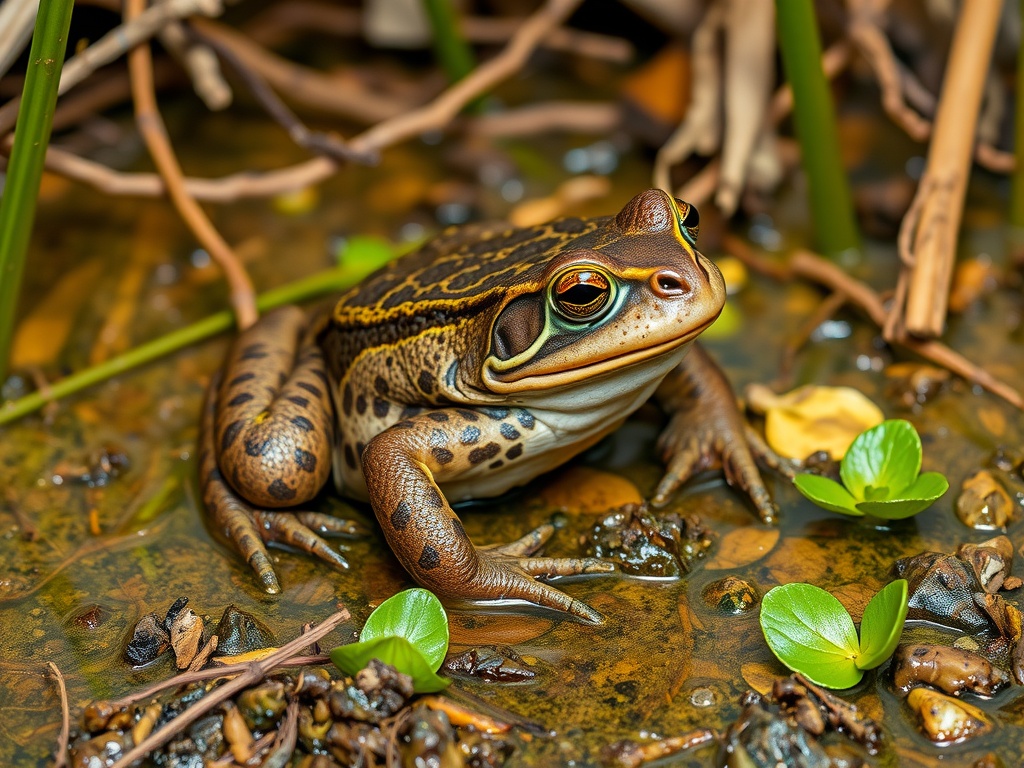
About the Gulf Coast Toad
The Gulf Coast Toad is a medium-sized amphibian native to the Gulf Coast region of the United States and northeastern Mexico. It has a characteristic broad, flattened body with warty skin, and its coloration typically ranges from brown to gray, often featuring a pale stripe down the back and dark blotches along the sides. Adapted to both urban and natural environments, this toad is commonly found in a variety of habitats including gardens, roadside ditches, and marshes. It breeds prolifically after heavy rains, producing long strings of eggs in shallow water. The Gulf Coast Toad is known for its distinctive, loud trill that can be heard during its breeding season.
Fascinating facts
Distinctive Appearance
Gulf Coast Toads have a unique cranial crest and a prominent pale stripe running down their back, helping distinguish them from other toad species.
Loud Mating Calls
During breeding season, males produce a loud trill that can be heard from a considerable distance, attracting females to temporary pools of water.
Breeding After Rain
These toads take advantage of heavy rains to breed, quickly laying eggs in newly formed puddles and ditches to maximize their offspring's survival.
Detailed description
The Gulf Coast Toad (Incilius nebulifer) is a robust, medium-sized toad, typically measuring 6–11 cm (2.4–4.3 in) in snout-vent length, with females generally larger than males. Its body is broad and dorsoventrally flattened, with prominent cranial crests and parotoid glands that secrete defensive toxins. The skin is heavily warty, with coloration ranging from grayish-brown to olive or tan, often featuring a distinct pale dorsal stripe and irregular dark blotches along the sides. The ventral surface is pale, sometimes with scattered dark spots. Adapted to a wide range of habitats, the Gulf Coast Toad is highly tolerant of disturbed environments and can be found in urban gardens, agricultural fields, roadside ditches, and natural wetlands. Its eyes are large with horizontal pupils, aiding nocturnal vision. The species is primarily terrestrial but is frequently encountered near water bodies during the breeding season. Its call is a loud, sustained trill, produced by males to attract females and establish territory. The toad's diet consists mainly of terrestrial invertebrates, and it plays a significant role in controlling pest populations. Notably, this species exhibits remarkable tolerance to desiccation and can survive in arid conditions by burrowing and reducing metabolic activity.
Did you know?
Despite their name, Gulf Coast Toads can be found well inland, sometimes hundreds of miles away from the actual Gulf Coast.
Research & sources
Wikipedia summary
The Gulf Coast toad is a species of toad native to eastern and southeastern Mexico and Central America as far south as Costa Rica.
Behaviour & social structure
Gulf Coast Toads are primarily nocturnal, emerging at dusk to forage for food. They are opportunistic feeders, preying on a variety of insects, spiders, worms, and other small invertebrates. Their hunting strategy involves ambush and active foraging, using their sticky tongues to capture prey. During the day, they seek shelter under rocks, logs, or in burrows to avoid desiccation and predators. Social interactions are most pronounced during the breeding season, when males congregate around temporary pools and engage in vocal displays to attract females and deter rivals. Outside the breeding season, they are largely solitary. When threatened, they may inflate their bodies, secrete toxins from their parotoid glands, or perform defensive postures to deter predators such as snakes, birds, and mammals.
Reproduction & life cycle
Breeding occurs primarily after heavy rains, typically from late spring through summer, though timing varies with regional rainfall patterns. Males arrive at breeding sites first and produce loud trilling calls to attract females. Amplexus (the mating embrace) is axillary, with the male grasping the female behind her forelimbs. Females lay long strings of eggs—often numbering several thousand—in shallow, temporary pools or ditches. The eggs hatch within 2–5 days, depending on temperature, and the tadpoles develop rapidly, undergoing metamorphosis in 3–6 weeks. There is no parental care after egg-laying; survival of offspring is largely dependent on environmental conditions and predation rates. The rapid development of larvae is an adaptation to the ephemeral nature of their breeding habitats.
Adaptations & survival
Incilius nebulifer exhibits several adaptations for survival in variable and often harsh environments. Its warty, cryptically colored skin provides camouflage and physical protection, while the parotoid glands secrete bufotoxins that deter many would-be predators. The species can withstand periods of drought by burrowing into moist soil and entering a state of reduced metabolic activity (aestivation). Its tolerance for urban and disturbed habitats is facilitated by a generalist diet and flexible breeding strategies, allowing it to exploit temporary water bodies. The loud, far-carrying breeding call enables males to attract mates over large distances in noisy or crowded environments. Rapid larval development reduces the risk of desiccation in ephemeral pools.
Cultural significance
The Gulf Coast Toad has been a familiar presence in the folklore and daily life of communities throughout its range. In some cultures, toads are associated with rain and fertility, and their appearance is seen as a harbinger of seasonal change. While not commonly used in traditional medicine or cuisine, their role in controlling insect pests is appreciated by gardeners and farmers. In urban areas, their distinctive calls are a notable feature of the summer soundscape. There are no widespread myths or symbolic uses specific to this species, but toads in general often appear in regional stories and superstitions.
Recent research
Recent research on Incilius nebulifer has focused on its ecological plasticity, genetic differentiation from closely related species (notably Incilius valliceps), and its response to urbanization. Molecular studies have clarified its taxonomic status, distinguishing it from similar toads in Central America. Ongoing studies are examining the effects of contaminants and habitat fragmentation on reproductive success and larval development. The species is also being used as a bioindicator for environmental health in wetland and urban ecosystems. Notably, its resistance to desiccation and pollutants is of interest for understanding amphibian resilience in changing environments.
Videos
Habitat
Wetlands and disturbed areas near fresh water
 Various Continental Regions
Grassland
Open areas dominated by grasses rather than trees, supporting numerous herbivores and their predators.
 Global
Forest
Wooded areas with significant tree cover and diverse plant and animal communities.
 Global
Freshwater
Lakes, rivers, and wetlands with diverse aquatic ecosystems.
Conservation
The Gulf Coast Toad is currently classified as Least Concern on the IUCN Red List.
Threats & challenges
Currently assessed as Least Concern by the IUCN, the Gulf Coast Toad maintains stable populations across much of its range. However, localized threats include habitat loss due to urbanization, pollution (especially from pesticides and fertilizers), road mortality, and competition or predation from invasive species such as the cane toad (Rhinella marina). Climate change poses potential risks by altering rainfall patterns and the availability of breeding sites. Despite these challenges, the species' adaptability has allowed it to persist in many modified landscapes. Continued monitoring is necessary to detect any future population declines, particularly in rapidly developing regions.
Taxonomy
Scientific name
Incilius nebulifer
- Kingdom
- Animalia
- Phylum
- Chordata
- Class
- Amphibia
- Order
- Anura
- Family
- Bufonidae
- Genus
- Incilius
- Species
- nebulifer
Community notes
Share your observations about the Gulf Coast Toad.
No community notes yet. Be the first!
Discover more wildlife
More fascinating animals from the encyclopedia.