
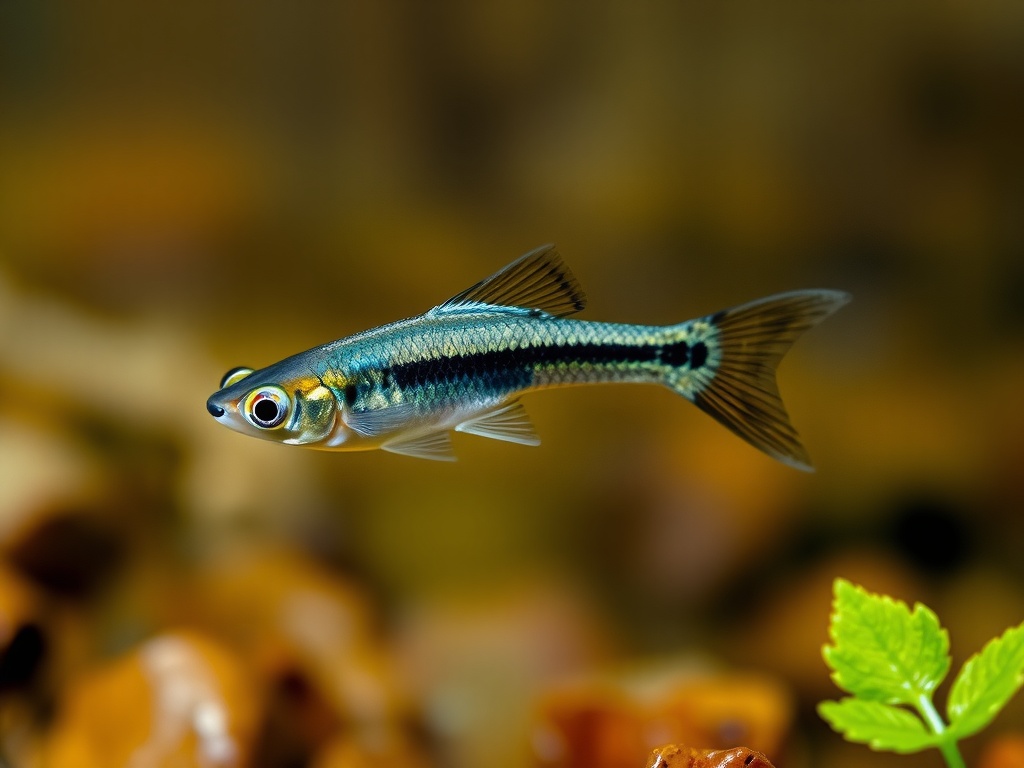
About the Guppy
Poecilia reticulata is the most-studied fish in evolutionary biology, because Trinidad's mountain streams gave researchers a natural experiment repeated dozens of times over. Waterfalls separate downstream pools containing predators such as the pike cichlid from upstream pools that hold only harmless killifish, and guppy populations above and below the same waterfall diverge in exactly predictable ways. Under heavy predation males are drab, mature earlier, stay small, and females make many small offspring; above the falls, freed from predators, males become gaudy with orange, blue and iridescent spots, mature later, grow larger, and females make fewer, bigger young. John Endler and David Reznick then did the crucial thing: they moved guppies between pools and watched the changes happen, in some cases in under a dozen generations - a few years - which helped kill the idea that natural selection is always too slow to observe. The orange in males comes from carotenoids they cannot synthesise, so a bright male is honestly advertising his ability to find scarce food. Guppies are livebearers, and females store sperm for months, producing broods long after any male is present. As introduced mosquito control they now occupy fresh water on every continent but Antarctica, often to the detriment of native fish.
Fascinating facts
Colorful Diversity
Guppies display a remarkable variety of colors and patterns, with males being especially vivid to attract mates.
Livebearers
Unlike many fish, guppies give birth to live, fully formed young instead of laying eggs.
Global Distribution
Originally from South America, guppies have been introduced to freshwater habitats on every continent except Antarctica.
Detailed description
The guppy (Poecilia reticulata) is a small, sexually dimorphic freshwater fish, typically ranging from 1.5 to 3.5 cm in males and up to 6 cm in females. Males are renowned for their vivid coloration and elaborate, fan-shaped caudal and dorsal fins, which serve both as sexual signals and as a means of species recognition. Females are generally larger, with more subdued coloration and rounded bodies. Guppies possess a streamlined body with a terminal mouth, adapted for surface and mid-water feeding. Their scales are cycloid, providing flexibility and protection. Guppies are highly social, forming loose shoals that offer protection from predators. They exhibit complex behaviors such as courtship displays, schooling, and hierarchical interactions. As livebearers, females give birth to fully formed, free-swimming fry. Guppies display remarkable genetic diversity, with over 100 color morphs and fin shapes selectively bred in captivity. Their adaptability allows them to thrive in a wide range of environmental conditions, from soft, acidic waters to hard, alkaline streams. Guppies are eurythermal, tolerating temperatures from 18°C to 32°C, and are capable of rapid population growth due to their short generation time and high fecundity.
Did you know?
Guppies are named after Robert John Lechmere Guppy, who discovered the species in Trinidad in 1866.
Research & sources
Wikipedia summary
The guppy, also known as the millionfish or rainbow fish, is one of the world's most widely distributed tropical fish and one of the most popular freshwater aquarium fish species. It is a member of the family Poeciliidae and, like almost all American members of the family, is live-bearing. Guppies originate from northeast South America, but have been introduced to many environments and are now found all over the world. They are highly adaptable and thrive in many different environmental and ecological conditions. Male guppies, which are smaller than females, have ornamental caudal and dorsal fins. Wild guppies generally feed on a variety of food sources, including benthic algae and aquatic insect larvae. Guppies are used as a model organism in the fields of ecology, evolution, and behavioural studies.
Behaviour & social structure
Guppies are diurnal and highly active, spending much of the day foraging and engaging in social interactions. They are omnivorous, feeding on algae, detritus, zooplankton, insect larvae, and small invertebrates. In the wild, guppies exhibit a preference for shallow, vegetated areas where they can find both food and shelter from predators. Males are persistent courters, performing elaborate sigmoid displays and fin-fanning to attract females. Social hierarchies may form, especially among males competing for mates. Shoaling behavior is pronounced, especially in the presence of predators, as grouping reduces individual predation risk. Guppies are known for their learning ability and can modify their behavior based on prior experiences, such as predator avoidance and foraging efficiency.
Reproduction & life cycle
Guppies are prolific livebearers with internal fertilization. Mating occurs year-round in suitable climates, with males using a modified anal fin (gonopodium) to transfer sperm to females. Females can store sperm in specialized ovarian folds, allowing them to produce multiple broods from a single mating event. Gestation lasts approximately 21 to 30 days, depending on water temperature and environmental conditions. Brood size varies with female size and age, typically ranging from 20 to 50 fry, but can exceed 100 in large, mature females. There is no parental care; fry are independent immediately after birth and often hide among vegetation to avoid predation, including cannibalism by adults. Sexual maturity is reached rapidly, often within 2 to 3 months.
Adaptations & survival
Guppies exhibit several key adaptations for survival. Their rapid reproductive rate and ability to store sperm enable quick population recovery and colonization of new habitats. Color polymorphism in males is an evolutionary response to both sexual selection (female preference for bright colors) and natural selection (predator avoidance). Guppies can alter their coloration and behavior in response to predation pressure, with populations in high-predation environments evolving drabber colors and more cautious behaviors. Physiologically, guppies tolerate a wide range of water chemistries and temperatures, making them highly adaptable. Their omnivorous diet allows exploitation of diverse food resources. Additionally, guppies have evolved resistance to certain parasites and pollutants, enhancing their survival in disturbed habitats.
Cultural significance
Guppies are among the most popular aquarium fish globally, valued for their beauty, hardiness, and ease of breeding. They have played a pivotal role in the development of the aquarium hobby and are often used as introductory species for beginner aquarists. In some regions, guppies have been intentionally introduced for mosquito control, as their larvae predation helps reduce vector-borne diseases. Guppies also feature in educational settings as model organisms for genetics, evolution, and behavioral studies. While not prominent in folklore or mythology, their role in science and public health is significant.
Recent research
Guppies are a classic model organism in evolutionary biology, particularly for studies of sexual selection, natural selection, and life-history evolution. Recent research has focused on the genetic basis of color patterns, the evolution of antipredator behaviors, and the effects of environmental contaminants on reproductive success. Studies in Trinidad have demonstrated rapid evolutionary changes in guppy populations in response to predator regimes. Guppies are also used in research on social learning, mate choice copying, and the evolution of senescence. Genomic studies have revealed extensive genetic diversity and adaptation to local environments. Ongoing research explores the impacts of microplastics, pharmaceuticals, and endocrine disruptors on guppy health and reproduction.
Videos
Habitat
Freshwater streams, rivers, and ponds

Conservation
The Guppy is currently classified as Least Concern on the IUCN Red List.
Threats & challenges
While guppies are classified as Least Concern by the IUCN, localized threats include habitat degradation, pollution, and competition with invasive species. In some introduced regions, guppies may disrupt native ecosystems by competing with or preying on indigenous species. Over-collection for the aquarium trade is not a significant threat due to their high reproductive capacity and widespread captive breeding. However, genetic homogenization from released aquarium strains can impact wild population diversity. Climate change and water quality deterioration may pose future risks, particularly in native habitats.
Taxonomy
Scientific name
Poecilia reticulata
- Kingdom
- Animalia
- Phylum
- Chordata
- Class
- Actinopterygii
- Order
- Cyprinodontiformes
- Family
- Poeciliidae
- Genus
- Poecilia
- Species
- reticulata
Where to see a guppy
1 zoo and aquarium in 1 country are recorded as keeping this species.

Community notes
Share your observations about the Guppy.
No community notes yet. Be the first!
Discover more wildlife
More fascinating animals from the encyclopedia.