
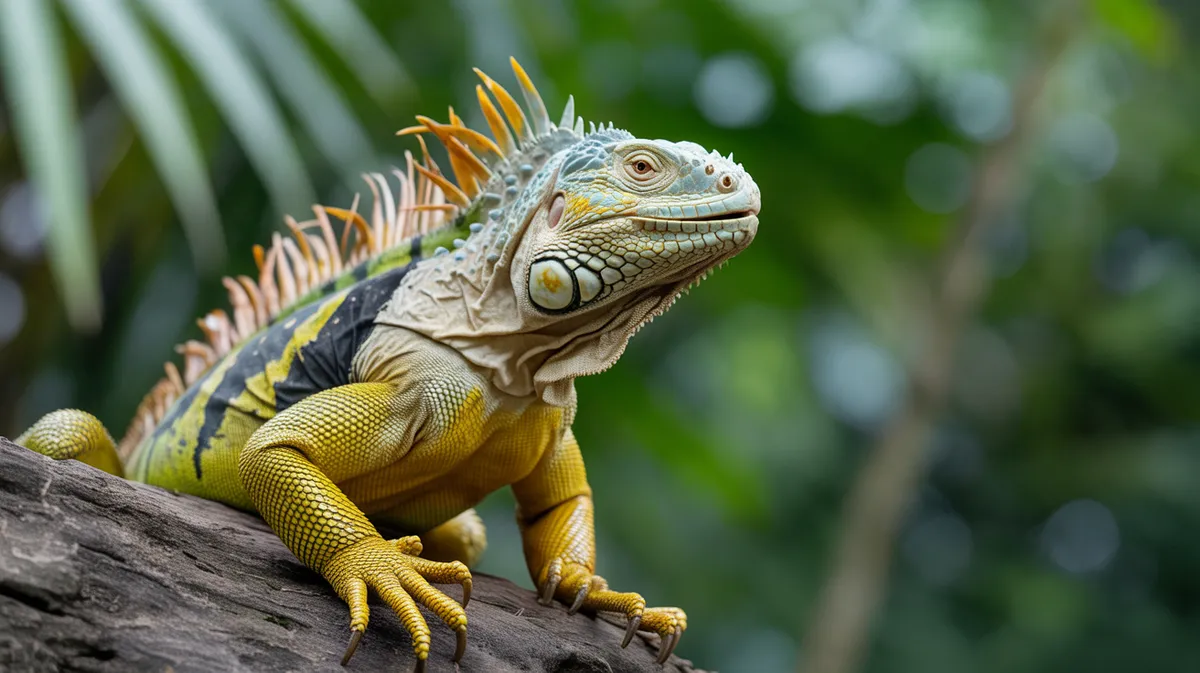
About the Helmeted Iguana
The Helmeted Iguana is a striking lizard known for the prominent, helmet-like crest on its head, which gives the species its common name. Native to the rainforests of Central America, this arboreal reptile is highly adapted for life among dense foliage and tree trunks, blending seamlessly with its environment. It exhibits remarkable camouflage abilities and often remains motionless to avoid predators. Helmeted Iguanas are primarily insectivorous, but they will occasionally eat plant matter and small vertebrates.
Fascinating facts
Distinctive Crest
The helmet-like crest on its head is made of bone and skin, making the Helmeted Iguana easily recognizable among rainforest lizards.
Arboreal Expert
Helmeted Iguanas spend most of their lives in trees and are highly adept climbers, rarely descending to the forest floor.
Insect Hunter
Their diet consists mainly of insects and other invertebrates, but they will also eat fruit, flowers, and occasionally small vertebrates.
Detailed description
The Helmeted Iguana (Corytophanes cristatus) is a medium-sized arboreal lizard, typically reaching a snout-to-vent length of 10–13 cm (4–5 in), with a total length up to 30 cm (12 in) including the tail. Its most distinctive feature is the prominent, laterally compressed cranial crest or 'helmet,' which extends from the back of the head and is more pronounced in males. The body is laterally flattened, aiding in camouflage against tree trunks and branches, and the skin coloration varies from olive green to brown or gray, often with darker mottling that enhances its cryptic appearance. The limbs are long and slender, equipped with sharp claws for gripping bark and climbing. The tail is prehensile and assists in balance and maneuverability in the dense understory. The species has large, expressive eyes with round pupils, facilitating excellent vision for detecting prey and predators. Helmeted Iguanas are primarily diurnal but may exhibit crepuscular activity during periods of low light. They possess a dewlap, though less developed than in some related species, which may be used in communication. Sexual dimorphism is subtle, with males generally having a larger crest and slightly more robust build. The species is highly sedentary, often remaining motionless for extended periods, relying on camouflage rather than flight as a primary defense.
Did you know?
Despite being called an iguana, the Helmeted Iguana is more closely related to basilisks and belongs to the family Corytophanidae.
Research & sources
Wikipedia summary
The smooth helmeted iguana, also known as the helmeted iguana, the helmeted basilisk, the elegant helmeted lizard, and several other common names, is a species of Basilisk and a New World lizard in the family Corytophanidae. The species is native to southern Mexico, Central America, and northwestern South America.
Behaviour & social structure
Helmeted Iguanas are solitary and highly territorial, with individuals occupying overlapping but distinct home ranges in the forest understory and lower canopy. They are sit-and-wait predators, remaining motionless for long periods while scanning for passing insects or small vertebrates. When prey is detected, they execute a rapid strike, capturing it with their sticky, protrusible tongue. Their diet consists mainly of arthropods such as beetles, crickets, and spiders, but they will opportunistically consume small lizards, frogs, and occasionally fruit or leaves. Social interactions are limited outside of the breeding season, though males may display dominance through posturing and crest extension. Daily routines are influenced by ambient temperature and humidity; they may bask in filtered sunlight during cooler mornings but generally avoid open exposure. When threatened, they rely on their camouflage, remaining perfectly still and flattening their bodies against the substrate. If further provoked, they may drop to the forest floor and flee or perform threat displays by extending the crest and opening the mouth.
Reproduction & life cycle
Corytophanes cristatus is oviparous, with breeding typically occurring at the onset of the rainy season (April–June in much of its range). Courtship involves visual displays, including head-bobbing and crest extension by males. Females lay 5–8 leathery eggs in shallow nests dug into moist leaf litter or rotting wood. Incubation lasts approximately 60–75 days, depending on environmental conditions such as temperature and humidity. There is no parental care post-oviposition; hatchlings are independent from birth and exhibit cryptic coloration similar to adults. Sexual maturity is reached at approximately 18–24 months. Clutch size and frequency may vary with resource availability and female condition.
Adaptations & survival
The Helmeted Iguana exhibits several notable adaptations for arboreal life and predator avoidance. The cranial crest not only serves as a display structure for intraspecific communication but may also disrupt the outline of the head, enhancing camouflage. Its laterally compressed body and cryptic coloration allow it to blend seamlessly with tree bark and epiphytes. The prehensile tail and elongated digits with sharp claws facilitate climbing and stability on narrow branches. Behaviorally, its tendency to remain motionless and flatten against substrates reduces detection by predators. The species can also perform caudal autotomy (tail shedding) as an escape mechanism, though this is less common than in some other lizards. Its broad diet and opportunistic feeding behavior are further adaptations to the variable resource availability in tropical forests.
Cultural significance
The Helmeted Iguana does not have significant roles in indigenous folklore or traditional medicine compared to some other Central American reptiles. However, its striking appearance and unique crest have made it a subject of interest among local naturalists and ecotourism guides. In some regions, it is occasionally featured in educational programs to highlight rainforest biodiversity and the importance of habitat conservation. There are no known widespread traditional uses or symbolic associations.
Recent research
Recent research on Corytophanes cristatus has focused on its cryptic behavior, ecological niche modeling, and the functional morphology of its cranial crest. Studies using radio telemetry and mark-recapture have provided insights into its home range size and microhabitat preferences. Molecular phylogenetic analyses have clarified its relationships within Corytophanidae, supporting its distinction from closely related genera such as Basiliscus and Laemanctus. Ongoing research is examining the effects of habitat fragmentation on genetic diversity and population connectivity. There is also interest in the biomechanical properties of the crest and its role in both thermoregulation and social signaling.
Videos
Habitat
Tropical rainforest


Conservation
The Helmeted Iguana is currently classified as Least Concern on the IUCN Red List.
Threats & challenges
Currently assessed as Least Concern by the IUCN, the Helmeted Iguana faces localized threats from habitat loss due to deforestation, agricultural expansion, and urbanization throughout its range in southern Mexico, Central America, and northwestern South America. While the species is relatively adaptable to secondary forest and disturbed habitats, extensive canopy loss and fragmentation can reduce suitable microhabitats and prey availability. Collection for the pet trade is not considered a major threat at present, but ongoing monitoring is recommended. Climate change, particularly alterations in rainfall patterns and humidity, may impact reproductive success and egg survival in the future. Population trends are believed to be stable, but comprehensive long-term studies are lacking.
Taxonomy
Scientific name
Corytophanes cristatus
- Kingdom
- Animalia
- Phylum
- Chordata
- Class
- Reptilia
- Order
- Squamata
- Family
- Corytophanidae
- Genus
- Corytophanes
- Species
- cristatus
Community notes
Share your observations about the Helmeted Iguana.
No community notes yet. Be the first!
Discover more wildlife
More fascinating animals from the encyclopedia.