
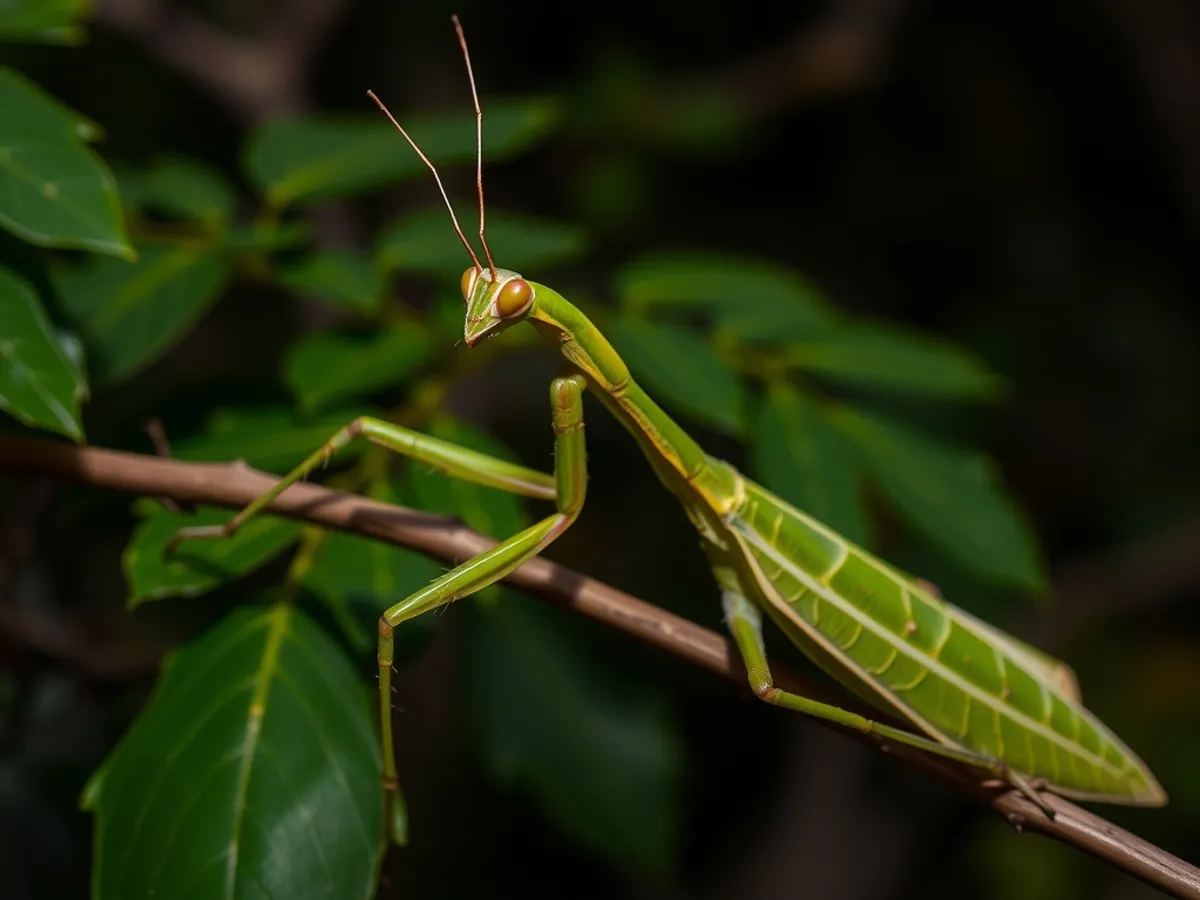
About the Leafy Horned Mantis
The Leafy Horned Mantis is a striking species of praying mantis known for its elaborate, leaf-like body extensions and prominent 'horns' on its head. Native to the tropical forests of Southeast Asia, this mantis is a master of camouflage, blending seamlessly into foliage to evade predators and ambush prey. Its slender body and intricate appendages mimic dried leaves, making it nearly invisible in its natural habitat. This insect is primarily predatory, using its raptorial forelegs to snatch insects and other small arthropods. Despite its intimidating appearance, the Leafy Horned Mantis is harmless to humans and plays an important role in balancing insect populations.
Fascinating facts
Leafy Disguise
Its body and appendages closely resemble dried leaves, making it extremely effective at camouflage.
Efficient Predator
The mantis uses its spiked forelegs to swiftly capture and consume a variety of insect prey.
Horned Head
The species name 'macra' refers to the distinctive horn-like projections on its head, unique among mantids.
Detailed description
The Leafy Horned Mantis (Ceratocrania macra) is a medium-sized mantid, typically reaching lengths of 6–8 cm, with females generally larger and more robust than males. Its most distinctive features are the elongated, leaf-like projections on its thorax and limbs, and the prominent, horn-like extensions on its head, which serve both as camouflage and as a deterrent to predators. The coloration varies from pale brown to olive green, mimicking dried or living foliage, and the body is laterally compressed, enhancing its resemblance to leaves. The raptorial forelegs are equipped with sharp spines for grasping prey, while the hind legs are long and slender, aiding in slow, deliberate movement through the undergrowth. The compound eyes are large and well-developed, providing a wide field of vision crucial for detecting both prey and threats. Ceratocrania macra is primarily arboreal, spending most of its life among shrubs and low branches in humid, tropical forests. It is a sit-and-wait predator, relying on its camouflage to ambush a variety of insects, including flies, moths, and occasionally smaller mantids. The species is solitary and highly territorial, with individuals maintaining and defending small hunting grounds. During the day, it remains motionless or sways gently to mimic the movement of leaves in the breeze, further enhancing its disguise. Despite its predatory lifestyle, the Leafy Horned Mantis is an important prey item for birds, reptiles, and larger arthropods, playing a key role in the forest food web.
Did you know?
The 'horns' on the Leafy Horned Mantis’ head are actually elongated projections that enhance its disguise among dead leaves and twigs.
Research & sources
Behaviour & social structure
Ceratocrania macra exhibits classic ambush predatory behavior, remaining motionless for extended periods and striking rapidly at passing prey with its raptorial forelegs. It is primarily diurnal, with peak hunting activity during the early morning and late afternoon when insect prey is most abundant. The mantis uses a combination of visual cues and vibration sensitivity to detect prey, and its strike is among the fastest movements in the insect world. Social interactions are minimal outside of mating; individuals are highly territorial and may display threat postures—raising their forelegs and spreading their wings—to deter conspecifics or potential predators. Cannibalism can occur, especially during mating or in crowded conditions. When threatened, Ceratocrania macra may employ deimatic displays, revealing brightly colored underwings (if present) or adopting a defensive posture to startle predators. Its daily routine is dominated by periods of stillness interspersed with slow, deliberate movements to new hunting perches.
Reproduction & life cycle
Mating in Ceratocrania macra typically occurs at the onset of the wet season, when food resources are abundant. Males locate females through pheromonal cues and approach cautiously to avoid being mistaken for prey. Courtship is brief, and sexual cannibalism—where the female consumes the male during or after copulation—has been observed, though it is less common than in some other mantid species. Females lay oothecae (egg cases) on the undersides of leaves or twigs, each containing 30–50 eggs. The incubation period varies with temperature and humidity but generally lasts 4–6 weeks. Upon hatching, nymphs resemble miniature adults and undergo 6–8 molts before reaching maturity, a process that takes 3–5 months. There is no parental care; nymphs are independent from birth and highly vulnerable to predation.
Adaptations & survival
The Leafy Horned Mantis is a master of crypsis, with its leaf-like appendages and coloration providing exceptional camouflage against predators and prey alike. The horn-like projections on the head disrupt its outline, making it harder for visual predators to detect. Its laterally compressed body and ability to sway in the wind mimic the movement of leaves, further enhancing its disguise. The raptorial forelegs are highly specialized for grasping and holding slippery or struggling prey. Compound eyes with high spatial resolution allow for precise targeting during hunting. Behavioral adaptations include deimatic displays to startle predators and the ability to remain motionless for hours, reducing detection risk. Evolutionarily, Ceratocrania macra is part of a lineage of mantids that have developed extreme morphological adaptations for camouflage in dense, competitive forest environments.
Cultural significance
While Ceratocrania macra does not have a prominent role in traditional folklore or mythology, mantids in general are often regarded with fascination and respect in Southeast Asian cultures, symbolizing patience, stillness, and predatory skill. In recent years, the species has gained popularity among insect enthusiasts and in the exotic pet trade due to its striking appearance and unique camouflage. Educational programs sometimes use the Leafy Horned Mantis to illustrate concepts of adaptation and evolution in tropical ecosystems.
Recent research
Recent research on Ceratocrania macra has focused on its remarkable camouflage mechanisms and the evolutionary pathways leading to its leaf mimicry. Studies using high-speed videography have documented the biomechanics of its predatory strike, revealing adaptations for rapid acceleration and precision. Genetic analyses are underway to clarify its phylogenetic relationships within the Mantidae family and to explore the genetic basis of its morphological specializations. Conservation biologists are also beginning to assess the impact of habitat loss and the pet trade on wild populations, though comprehensive data are still lacking. Ongoing field studies aim to better understand its ecological role and population dynamics in fragmented forest landscapes.
Videos
Habitat
Tropical forest


Conservation
The Leafy Horned Mantis is currently classified as Least Concern on the IUCN Red List.
Threats & challenges
Currently assessed as Least Concern, Ceratocrania macra faces few direct threats due to its wide distribution and adaptability to various forest habitats. However, ongoing deforestation and habitat fragmentation in Southeast Asia pose long-term risks by reducing available habitat and isolating populations. Pesticide use and collection for the exotic pet trade may also impact local populations. Despite these pressures, the species appears resilient, with stable population trends in most areas. Conservation challenges include the lack of detailed population studies and the potential for rapid habitat loss in parts of its range.
Taxonomy
Scientific name
Ceratocrania macra
- Kingdom
- Animalia
- Phylum
- Arthropoda
- Class
- Insecta
- Order
- Mantodea
- Family
- Hymenopodidae
- Genus
- Ceratocrania
- Species
- macra
Community notes
Share your observations about the Leafy Horned Mantis.
No community notes yet. Be the first!
Discover more wildlife
More fascinating animals from the encyclopedia.