
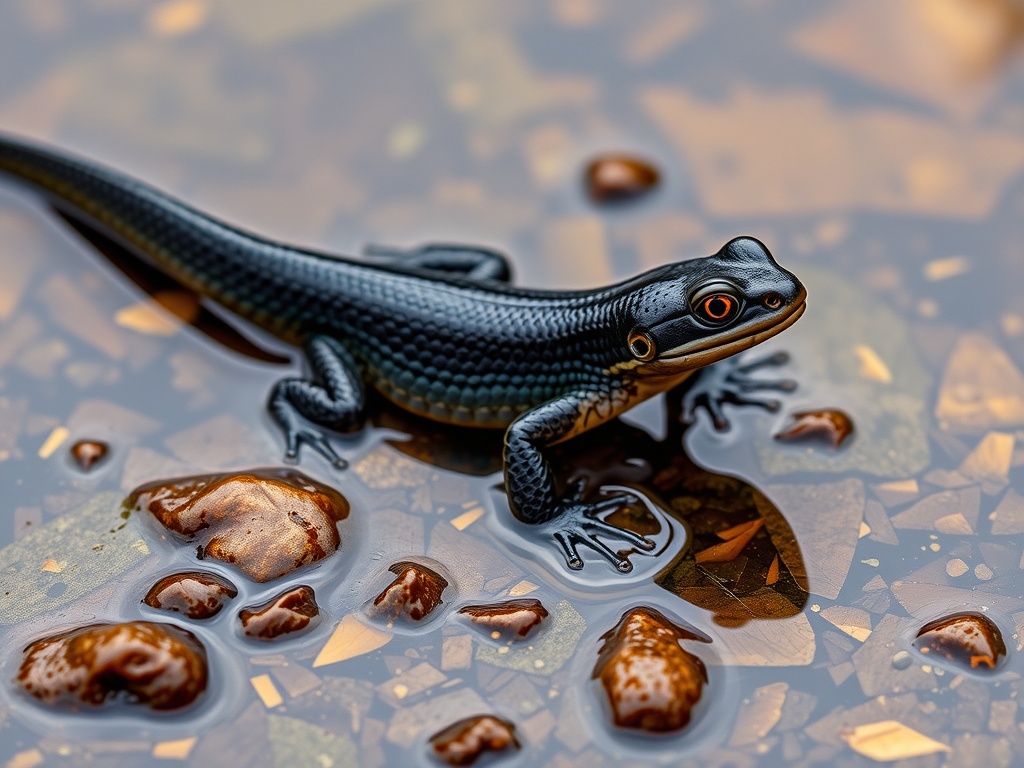
About the Iberian Ribbed Newt
Pleurodeles waltl has one of the most alarming defence mechanisms of any vertebrate: when seized, it swings its sharp-tipped ribs forward and outward, rotating them at the vertebral joints until they pierce right through the skin of its own flanks and protrude as a row of exposed spines. At the same time, glands in that same flank skin secrete a milky poison, so the ribs act as needles delivering it directly into the mouth of whatever bit down. The newt appears to suffer no lasting harm - the punctured skin heals within days, there is no infection, and the animal can do it repeatedly. Confirmed by high-speed X-ray imaging published in 2009, this is the only known case of an animal deliberately using its own skeleton as a piercing weapon in this way. Native to Iberia and Morocco, it is a large, warty, mostly aquatic newt reaching 30 cm, with a broad flattened head. It is a laboratory workhorse for regeneration research, since it can regrow limbs, jaws, eye lenses and parts of the heart, and it was flown on Soviet and Russian Bion and Mir missions to study how spaceflight affects regeneration and development.
Fascinating facts
Unique Defense
The Iberian Ribbed Newt protects itself by pushing its ribs through its skin, secreting toxins to repel predators.
Regeneration Abilities
This newt can regenerate entire limbs, parts of its heart, spinal cord, and even its eye lens if damaged.
Space Traveler
Iberian Ribbed Newts have been sent to the International Space Station to study tissue regeneration in microgravity.
Detailed description
The Iberian Ribbed Newt (Pleurodeles waltl) is a robust, highly aquatic salamander distinguished by its dorsoventrally flattened body and broad, flattened head. Adults typically range from 15 to 30 cm in total length, with females generally larger than males. Their skin is olive-brown to grayish, often mottled with darker spots, and the ventral surface is lighter, sometimes with yellowish or orange hues. The species is named for its unique ribs, which are elongated and tipped with orange; these can protrude through the skin as part of a defensive mechanism. Limbs are relatively short, and the tail is laterally compressed, aiding in swimming. The Iberian Ribbed Newt possesses small, lidless eyes adapted for aquatic vision and external gills are present only in larvae. It is primarily nocturnal, spending daylight hours concealed under debris or submerged vegetation. This newt is capable of remarkable regeneration, able to regrow limbs, tail, ocular tissues, heart, and even parts of the central nervous system. Its skin secretes antimicrobial peptides, contributing to its resilience against infections. The species is long-lived, with individuals in captivity reaching over 20 years of age.
Did you know?
When threatened, the Iberian Ribbed Newt can literally push its ribs through its skin to pierce predators and deliver toxins, all while healing these wounds with little lasting damage.
Research & sources
Wikipedia summary
The Iberian ribbed newt, also known commonly as the Spanish ribbed newt and el gallipato in Spanish, is a species of salamander in the subfamily Pleurodelinae of the family Salamandridae. The species is native to the central and southern Iberian Peninsula and Morocco. It is the largest European newt species. It is known for its defense mechanisms where their sharp ribs puncture through its sides when in a defensive state, and as such is also called the sharp-ribbed newt and the sharp-ribbed salamander.
Behaviour & social structure
Pleurodeles waltl is predominantly aquatic, rarely leaving the water except during periods of drought or when dispersing to new habitats. It is a solitary species outside of the breeding season, exhibiting limited social interaction except for occasional aggressive encounters over territory or mates. The newt is an opportunistic carnivore, feeding on aquatic invertebrates, insect larvae, worms, crustaceans, small fish, and amphibian eggs. Hunting is primarily ambush-based; it remains motionless until prey approaches, then rapidly snaps with its jaws. Feeding occurs mostly at night. During the day, the newt seeks shelter under rocks, logs, or submerged vegetation. When threatened, it exhibits a defensive posture, arching its back and splaying its limbs to expose the rib tips. In the wild, activity levels are closely tied to water temperature and availability, with periods of dormancy during extreme heat or drought.
Reproduction & life cycle
Breeding occurs primarily from late winter to early spring, triggered by rising water levels and temperatures. Males court females through tactile stimulation, nudging and circling them before depositing a spermatophore (sperm packet) on the substrate. The female picks up the spermatophore with her cloaca to fertilize her eggs internally. Females lay between 100 and 1,000 eggs, attaching them singly or in small clusters to aquatic plants or debris. Incubation lasts 7–15 days, depending on water temperature. Larvae are fully aquatic, possessing external gills and feeding on plankton and small invertebrates. Metamorphosis occurs after 2–4 months, but in permanent water bodies, some individuals may retain larval features (paedomorphosis) and remain aquatic throughout life. There is no parental care post-oviposition.
Adaptations & survival
The Iberian Ribbed Newt's most notable adaptation is its unique defense mechanism: when threatened, it contracts its trunk muscles, forcing the sharp rib tips through specialized pores in the skin. These ribs are coated in a milky, toxic secretion from skin glands, deterring predators. The skin is highly permeable, facilitating cutaneous respiration, which supplements lung breathing. Pleurodeles waltl is highly tolerant of variable water conditions, including low oxygen, high salinity, and temporary desiccation; it can aestivate in mud during droughts. Its regenerative abilities are among the most advanced in vertebrates, allowing regrowth of complex tissues without scarring. The species also produces antimicrobial peptides, providing resistance to pathogens in its aquatic environment.
Cultural significance
In Spain, the Iberian Ribbed Newt is known as 'el gallipato' and is sometimes featured in local folklore as a symbol of resilience and transformation, owing to its regenerative abilities. It has been used in traditional medicine in some regions, though this practice is rare today. In modern times, Pleurodeles waltl has gained prominence as a model organism in scientific research, particularly in studies of regeneration, developmental biology, and immune responses. Its unique defense mechanism and regenerative capacity have inspired interest in biomedical fields.
Recent research
Recent research on Pleurodeles waltl has focused on its extraordinary regenerative abilities, with studies revealing the molecular and genetic pathways involved in limb and organ regrowth. The species' immune system and antimicrobial peptides are being investigated for potential applications in medicine. Genomic sequencing projects have provided insights into the genetic basis of regeneration and disease resistance. Conservation genetics studies are underway to assess population structure and genetic diversity, particularly in fragmented habitats. The species is also used in ecotoxicology to monitor environmental pollutants due to its sensitivity to water quality.
Videos
Habitat
Freshwater ponds, lakes, and slow-moving streams

Conservation
The Iberian Ribbed Newt is currently classified as Near Threatened on the IUCN Red List.
Threats & challenges
While currently listed as Least Concern by the IUCN, Pleurodeles waltl faces significant threats in parts of its range. Habitat loss due to agricultural expansion, water pollution, drainage of wetlands, and urbanization are major concerns. The introduction of invasive species, such as predatory fish and crayfish, has led to local population declines. The species is also susceptible to chytridiomycosis, a fungal disease affecting amphibians globally. Climate change poses additional risks through altered precipitation patterns and increased frequency of droughts, leading to habitat fragmentation. Collection for the pet trade and scientific research, though regulated, can impact wild populations if not managed sustainably. Population trends are stable in some areas but declining in others, particularly in Morocco.
Taxonomy
Scientific name
Pleurodeles waltl
- Kingdom
- Animalia
- Phylum
- Chordata
- Class
- Amphibia
- Order
- Urodela
- Family
- Salamandridae
- Genus
- Pleurodeles
- Species
- waltl
Community notes
Share your observations about the Iberian Ribbed Newt.
No community notes yet. Be the first!
Discover more wildlife
More fascinating animals from the encyclopedia.