
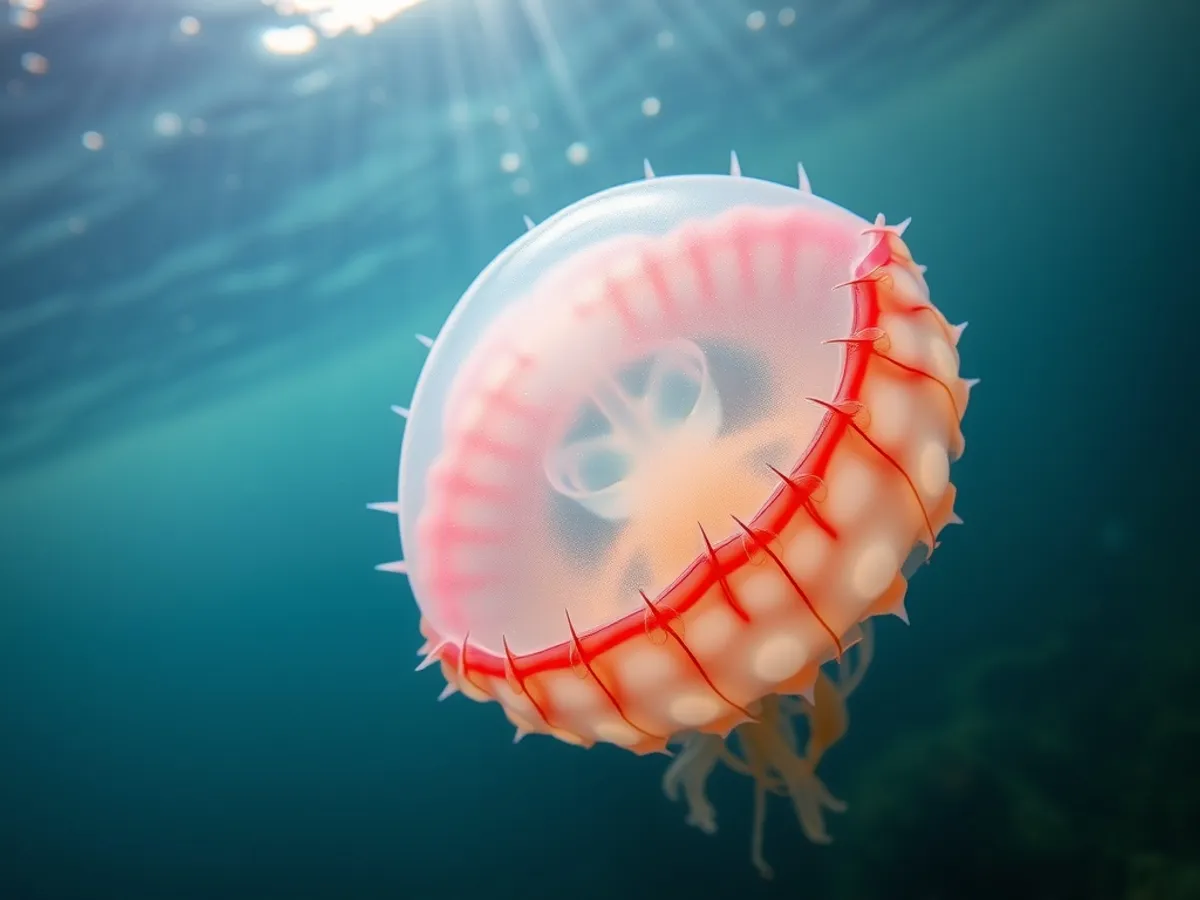
About the Immortal Jellyfish
The immortal jellyfish has found a way out of dying of old age. When it is starved, injured or otherwise stressed, the adult medusa does not simply perish: it settles onto a surface, and its cells transdifferentiate — converting directly from one mature cell type into another, which almost nothing else in the animal kingdom can do — and the animal reverts wholesale to the polyp stage it long ago outgrew. From that polyp it buds new medusae, genetically identical to itself. In effect it rewinds to youth, and it can in principle repeat the trick indefinitely. It is not invincible: it can still be eaten, or killed by disease, and in the wild the overwhelming majority die like anything else — the immortality is an escape from ageing, not from predators. It is only a few millimetres across, and has spread across the world's oceans in the ballast water of ships. It is now studied intently for what it might reveal about ageing and cellular reprogramming.
Fascinating facts
Biological Immortality
This jellyfish can reverse its life cycle, transforming from an adult medusa back into a juvenile polyp, effectively starting its life over.
Tiny Ocean Drifter
The Immortal Jellyfish is extremely small, typically no larger than a human pinky nail, and drifts through warm and temperate seas.
Scientific Inspiration
Its unique ability to transdifferentiate cells has made it a subject of great interest for researchers studying aging and cellular regeneration.
Detailed description
Turritopsis dohrnii, commonly known as the 'immortal jellyfish,' is a minute hydrozoan medusa, typically measuring 4.5 mm in diameter and 4–5 mm in height. Its bell is transparent, dome-shaped, and features a bright red stomach at the center, which is often visible through the body. The species possesses 8–90 fine, hair-like tentacles in adults, while juveniles usually have only 8. The body wall is thin and delicate, providing minimal protection but allowing for efficient nutrient and gas exchange. T. dohrnii is primarily planktonic, drifting with ocean currents, but can exhibit limited swimming by contracting its bell. Its nervous system is simple, consisting of a nerve net and statocysts for balance. The species is capable of both sexual and asexual reproduction, with a remarkable ability to reverse its life cycle from mature medusa back to the polyp stage through cellular transdifferentiation. This process allows it to potentially avoid senescence and theoretically achieve biological immortality. The polyp stage forms colonial structures attached to substrates, while the medusa stage is solitary. T. dohrnii is carnivorous, preying on zooplankton, small crustaceans, and fish larvae using nematocysts to immobilize prey. Its near-invisibility and small size help it evade many predators, though it remains susceptible to disease and environmental hazards.
Did you know?
The Immortal Jellyfish can theoretically repeat its life cycle endlessly, making it one of the few known creatures that can avoid natural death from aging.
Research & sources
Wikipedia summary
Turritopsis dohrnii, also known as the immortal jellyfish, is a species of small, biologically immortal jellyfish found worldwide in temperate to tropic waters. It is one of the few known cases of animals capable of completely reverting to a sexually immature, colonial stage after having reached sexual maturity as a solitary individual.
Behaviour & social structure
Turritopsis dohrnii exhibits largely solitary behavior in its medusa stage, with no evidence of complex social interactions. It is primarily nocturnal, becoming more active at night when it rises in the water column to feed. The jellyfish uses rhythmic contractions of its bell to move, though it relies heavily on passive drifting. Feeding is opportunistic; it captures small planktonic organisms using its tentacles, which are lined with stinging cells (nematocysts) to paralyze prey. After capturing prey, it transfers food to its central mouth for digestion. In the polyp stage, individuals form small, branching colonies on hard substrates, where they reproduce asexually by budding off new medusae. There is little evidence of territoriality or cooperative behavior. Daily routines are dictated by environmental conditions such as light, temperature, and food availability.
Reproduction & life cycle
Turritopsis dohrnii has a complex life cycle that alternates between a sessile polyp stage and a free-swimming medusa stage. Sexual reproduction occurs in the medusa stage, where males and females release sperm and eggs into the water column for external fertilization. Fertilized eggs develop into planula larvae, which settle on substrates and form new polyps. Polyps can reproduce asexually by budding, generating genetically identical medusae. The most unique aspect of T. dohrnii's reproduction is its ability to revert mature medusae back to the polyp stage through transdifferentiation, particularly in response to physical damage, starvation, or environmental stress. This reversal can occur repeatedly, allowing the organism to bypass death from old age. There is no parental care; all life stages are independent after release.
Adaptations & survival
Turritopsis dohrnii's most extraordinary adaptation is transdifferentiation, where differentiated cells transform into other cell types, enabling reversal from medusa to polyp. This process is triggered by environmental stressors and is unique among metazoans. Its transparent, gelatinous body provides camouflage in the water column, reducing predation risk. The presence of nematocysts allows efficient prey capture and defense. The ability to alternate between benthic (polyp) and pelagic (medusa) stages increases ecological flexibility and survival in variable environments. Its small size and low metabolic demands enable survival in nutrient-poor waters. The colonial polyp stage allows rapid population expansion when conditions are favorable.
Cultural significance
The 'immortal jellyfish' has captured the public imagination as a symbol of eternal youth and biological immortality. It is frequently featured in popular science media, documentaries, and literature as an example of nature's extraordinary adaptations. While there are no known traditional uses or roles in mythology, T. dohrnii has become an icon in discussions about aging, regenerative medicine, and the limits of life. Its unique biology has inspired research into cellular reprogramming and potential applications in human medicine.
Recent research
Recent research has focused on the molecular mechanisms underlying transdifferentiation and cellular reprogramming in Turritopsis dohrnii. Studies have identified key genes and signaling pathways involved in the reversal process, including those related to stem cell maintenance and apoptosis suppression. Genomic and transcriptomic analyses are ongoing to better understand the species' unique regenerative capabilities. There is growing interest in the potential biomedical applications of these findings, particularly in aging and tissue regeneration research. Additionally, ecological studies are investigating the species' distribution, population genetics, and potential impacts of climate change on its life cycle.
Videos
Habitat
Warm and temperate ocean waters

Conservation
The Immortal Jellyfish is currently classified as Not Evaluated on the IUCN Red List.
Threats & challenges
Despite its biological immortality, Turritopsis dohrnii faces significant threats from predation, disease, and environmental changes. Natural predators include larger jellyfish, sea anemones, and some fish species. The species is vulnerable to pollution, ocean acidification, and habitat destruction, particularly in coastal regions where polyps settle. Climate change may alter ocean currents and temperatures, impacting distribution and reproductive success. There is currently no evidence of targeted human exploitation, and the species is not evaluated by the IUCN. However, its small size and cryptic lifestyle make population assessments challenging, and its long-term ecological impact remains poorly understood.
Taxonomy
Scientific name
Turritopsis dohrnii
- Kingdom
- Animalia
- Phylum
- Cnidaria
- Class
- Hydrozoa
- Order
- Anthoathecata
- Family
- Oceaniidae
- Genus
- Turritopsis
- Species
- dohrnii
Community notes
Share your observations about the Immortal Jellyfish.
No community notes yet. Be the first!
Discover more wildlife
More fascinating animals from the encyclopedia.