
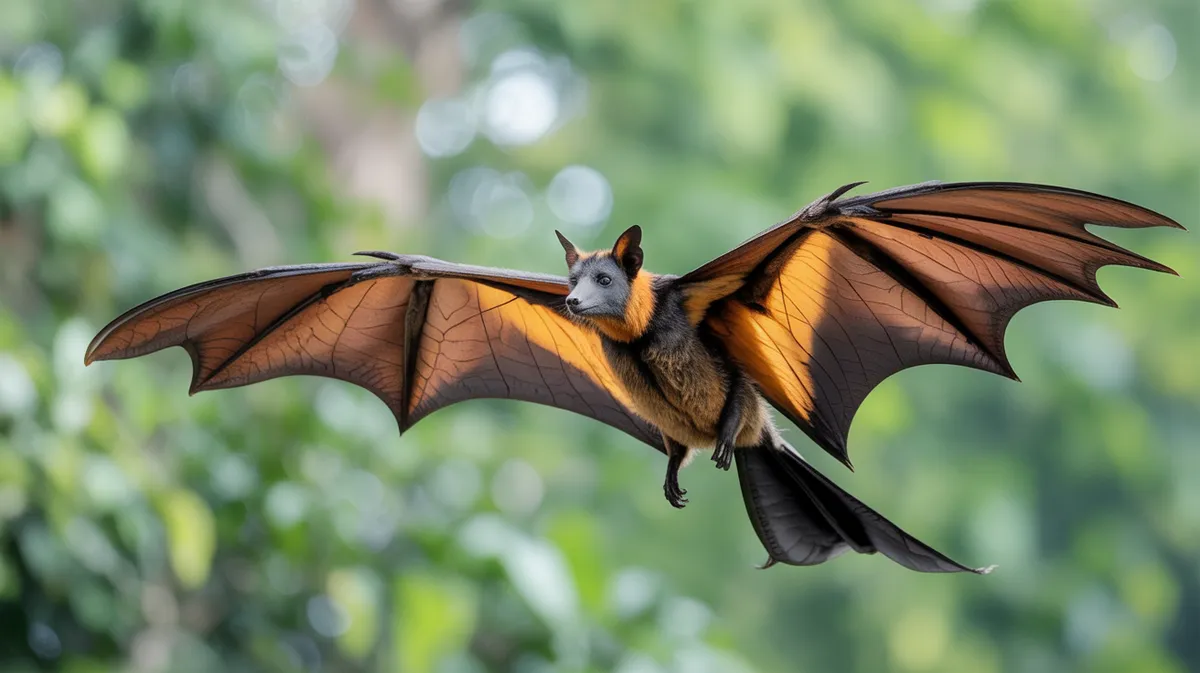
About the Indian Flying Fox
Pteropus giganteus is one of the largest bats in the world, with a wingspan up to about 1.5 m, and it is nothing like the bats most people picture. It does not echolocate at all - megabats navigate by sight, with large forward-facing eyes and excellent low-light vision - and it does not eat insects, living almost entirely on ripe figs, guavas, mangoes and nectar. Colonies of hundreds or thousands hang from a small number of tall, traditional roost trees, often banyans and tamarinds in villages and temple grounds, and the same trees may be occupied for generations, making the species conspicuously public and easily persecuted. Its ecological value is disproportionate: flying foxes fly tens of kilometres a night and carry seeds and pollen far beyond the range of any bird or insect, so they are the long-distance dispersal system for a large number of Asian forest trees, and durians and several commercial fruits depend on Pteropus pollination. The bats' habit of chewing fruit, swallowing the juice and spitting out a compressed pellet of pulp and fibre means they scatter seeds constantly. In India the species is legally classified as vermin under the Wildlife Protection Act, a status conservationists have long argued is indefensible.
Fascinating facts
Giant Wingspan
The Indian Flying Fox can reach a wingspan of up to 1.5 meters (almost 5 feet), making it one of the largest bats globally.
Fruit Lovers
Their diet consists primarily of fruits such as mangoes, bananas, guavas, and figs, as well as flower nectar and pollen.
Colony Roosting
They are highly social bats, forming colonies that sometimes include thousands of individuals roosting together in large trees.
Detailed description
The Indian flying fox (Pteropus medius, formerly Pteropus giganteus) is one of the largest bat species globally, with a wingspan reaching up to 1.5 meters (nearly 5 feet) and a body length of 20–30 cm. Adults typically weigh between 600 and 1600 grams. Their fur is dense and ranges from dark brown to reddish-brown, with a paler mantle around the neck and shoulders, giving a fox-like appearance. The face is elongated with large, dark eyes adapted for nocturnal vision, and the ears are rounded and prominent. Unlike microbats, they lack echolocation and rely primarily on keen eyesight and a well-developed sense of smell to locate food. Indian flying foxes are highly social, roosting in colonies that can number from a few hundred to several thousand individuals, often in tall trees near water sources. Their diet is primarily frugivorous, but they also consume nectar and flowers, making them important pollinators and seed dispersers for many native plant species. They are strong fliers, capable of traveling over 30 km in a single night to forage. The species exhibits complex social structures, including grooming, vocal communication, and coordinated group movements. Their presence is vital for maintaining the health of tropical and subtropical ecosystems across the Indian subcontinent.
Did you know?
Unlike most bats, the Indian Flying Fox does not use echolocation and instead depends on its keen eyesight to find food and avoid obstacles.
Research & sources
Wikipedia summary
The Indian flying fox, also known as the greater Indian fruit bat, is a species of flying fox native to the Indian subcontinent. It is one of the largest bats in the world. It is of interest as a disease vector, as it is capable of transmitting several viruses to humans. It is nocturnal and feeds mainly on ripe fruits, such as mangoes and bananas, and nectar. This species is often regarded as vermin due to its destructive tendencies towards fruit farms, but the benefits of its pollination and seed propagation often outweigh the impacts of its fruit consumption.
Behaviour & social structure
Indian flying foxes are strictly nocturnal, emerging from their communal roosts at dusk to forage. They exhibit strong site fidelity, returning to the same roosting trees for years. Foraging is typically solitary or in small groups, with individuals using visual and olfactory cues to locate ripe fruits, such as mangoes, guavas, bananas, and figs. They feed by biting into fruit and squeezing out the juice, often discarding the pulp. Social interactions within colonies include grooming, vocalizations (ranging from chatters to screeches), and physical displays to establish dominance or defend roosting spots. During the day, bats hang upside down, often wrapping themselves in their wings to regulate temperature and reduce water loss. Aggressive encounters can occur, especially during the breeding season, but are usually resolved through displays rather than physical combat.
Reproduction & life cycle
The breeding season for Indian flying foxes typically occurs from October to January, varying by region. Males establish territories within the roost and compete for access to females through vocalizations and physical displays. After mating, females experience a gestation period of approximately 140–150 days. Births usually occur between March and May, coinciding with the onset of the fruiting season. Females give birth to a single pup per year, which is carried clinging to the mother's belly for the first few weeks. Maternal care is extensive; mothers nurse and groom their young, often leaving them in the roost while foraging. Juveniles are weaned at about 2–3 months but may remain with their mothers for several more weeks before becoming fully independent.
Adaptations & survival
Indian flying foxes exhibit several adaptations for their frugivorous and volant lifestyle. Their elongated forelimbs and flexible wing membranes allow for powerful, sustained flight and agile maneuvering among trees. The large eyes provide excellent night vision, compensating for their lack of echolocation. A highly developed olfactory system aids in detecting ripe fruit over long distances. The tongue is long and brush-tipped, facilitating nectar feeding and pollination. Social adaptations include complex vocalizations and grooming behaviors that reinforce group cohesion and reduce parasite loads. Their ability to thermoregulate by spreading or wrapping their wings helps them cope with temperature fluctuations in their roosting environments.
Cultural significance
Indian flying foxes feature prominently in South Asian folklore and mythology, often symbolizing night, mystery, or transformation. In some Hindu traditions, bats are associated with the goddess Kali and are considered sacred in certain regions. Conversely, they are sometimes viewed with superstition or fear due to their nocturnal habits and association with disease. Traditional uses include consumption as bushmeat and use in folk medicine, though this is less common today. Their ecological role as pollinators and seed dispersers is increasingly recognized in conservation education and community outreach programs.
Recent research
Recent research has focused on the Indian flying fox's role as a reservoir for emerging zoonotic diseases, particularly Nipah virus, with studies examining viral shedding patterns, transmission dynamics, and human-wildlife interfaces. Genetic studies have clarified the taxonomy of the species, leading to the recent reclassification from Pteropus giganteus to Pteropus medius. Ecological studies highlight their importance in maintaining forest diversity through seed dispersal and pollination, especially for economically and ecologically significant trees. Ongoing research is investigating the impacts of urbanization on their behavior, health, and population genetics, as well as the effectiveness of conservation strategies that balance human-wildlife conflict with ecosystem services.
Videos
Habitat
Tropical and subtropical forests, urban parks, and gardens


Conservation
The Indian Flying Fox is currently classified as Least Concern on the IUCN Red List.
Threats & challenges
Despite being classified as Least Concern by the IUCN, Indian flying fox populations face significant threats. Habitat loss due to deforestation, urbanization, and agricultural expansion reduces available roosting and foraging sites. They are often persecuted as agricultural pests, with fruit farmers sometimes destroying colonies to protect crops. Additionally, they are hunted for bushmeat and traditional medicine in some regions. The species is a known reservoir for several zoonotic viruses, including Nipah and Hendra, which has led to culling in response to disease outbreaks. Climate change and extreme weather events also pose emerging threats by disrupting food availability and roosting habitats. Despite these challenges, their wide distribution and adaptability have allowed populations to persist, although local declines have been documented.
Taxonomy
Scientific name
Pteropus giganteus
- Kingdom
- Animalia
- Phylum
- Chordata
- Class
- Mammalia
- Order
- Chiroptera
- Family
- Pteropodidae
- Genus
- Pteropus
- Species
- giganteus
Where to see an indian flying fox
1 zoo and aquarium in 1 country are recorded as keeping this species.
Community notes
Share your observations about the Indian Flying Fox.
No community notes yet. Be the first!
Discover more wildlife
More fascinating animals from the encyclopedia.