
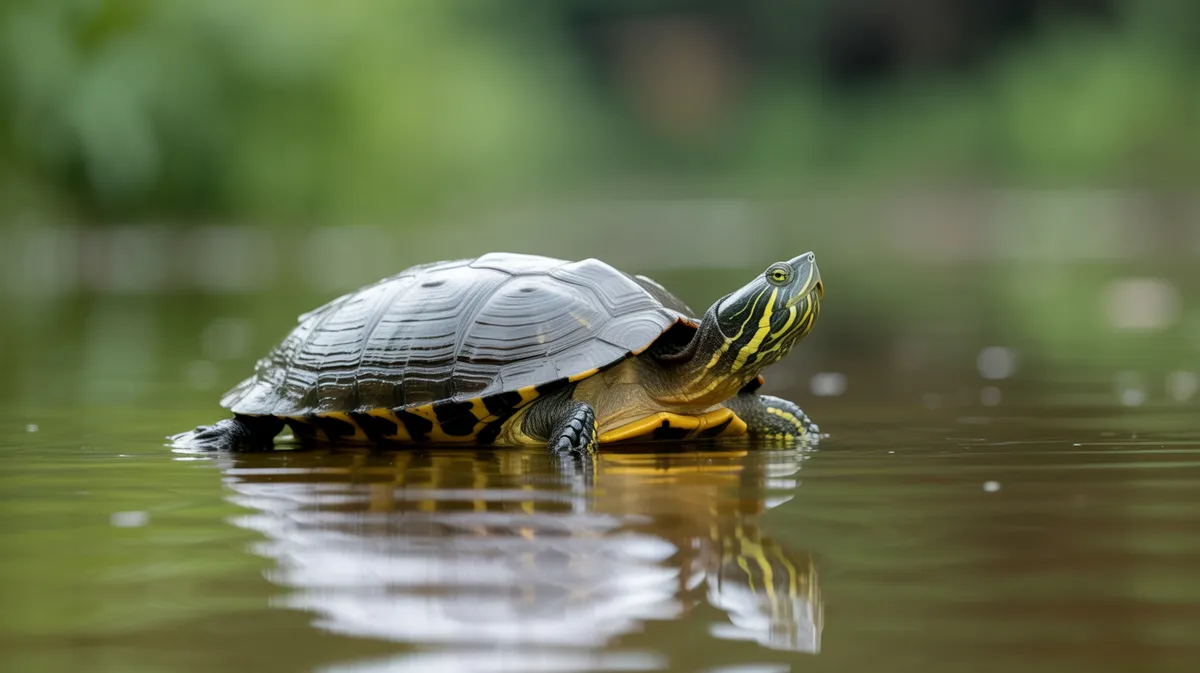
About the Indian Roofed Turtle
The Indian Roofed Turtle is a small to medium-sized freshwater turtle native to the Indian subcontinent. It is easily recognized by the distinctive, raised, roof-like ridge running along the midline of its carapace, especially prominent in males. This species is typically found in slow-moving rivers, ponds, and lakes, where it spends much of its time basking on logs or rocks. Its bright coloration, with yellow and red stripes on the head and neck, makes it a striking sight in its natural habitat.
Fascinating facts
Aquatic Lifestyle
The Indian Roofed Turtle spends most of its life in water, coming to land primarily to bask or lay eggs.
Distinctive Carapace
Its unique 'roofed' shell ridge makes it easy to identify among other freshwater turtles in its range.
Varied Diet
This turtle is an omnivore, feeding on aquatic plants, insects, small fish, and mollusks.
Detailed description
The Indian Roofed Turtle (Pangshura tecta) is a medium-sized freshwater turtle, with adults typically measuring 20–26 cm (8–10 in) in carapace length, though females are generally larger than males. Its most distinctive feature is the prominent, roof-like keel or ridge on the midline of the carapace, which is especially pronounced in males and gives the species its common name. The carapace is olive to dark brown, often with yellow or orange markings, while the plastron is yellow with dark blotches. The head is relatively small, adorned with bright yellow and red longitudinal stripes extending from the snout to the neck. Limbs are webbed, aiding in swimming, and the claws are well-developed, particularly in males. The species exhibits sexual dimorphism: males have longer, thicker tails and a more pronounced dorsal keel, while females are larger and rounder. Indian Roofed Turtles are diurnal, spending much of the day basking on rocks or logs near water bodies. They are highly aquatic but will venture onto land to lay eggs. Their omnivorous diet includes aquatic plants, fruits, insects, mollusks, and small fish. The species is adapted to slow-moving or stagnant freshwater habitats, such as rivers, oxbow lakes, ponds, and marshes, often in lowland floodplains.
Did you know?
The Indian Roofed Turtle can retract its head and limbs fully into its shell, providing effective protection against predators.
Research & sources
Wikipedia summary
The Indian roofed turtle is a species of turtle in the family Geoemydidae. It can be distinguished by the distinct "roof" at the topmost part of the shell. It is found in the major rivers of South Asia. It is a common pet in the Indian Subcontinent.
Behaviour & social structure
Indian Roofed Turtles are primarily solitary but may aggregate in basking sites, especially during the warmer months. Basking is a critical behavior for thermoregulation and parasite control, and turtles can often be seen stacked atop one another on logs or rocks. They are most active during the day (diurnal), foraging in the early morning and late afternoon. Feeding is opportunistic; they graze on aquatic vegetation and scavenge for animal matter, using their sharp beaks to tear food. Juveniles tend to be more carnivorous, while adults consume more plant material. When threatened, they quickly dive into water and may bury themselves in mud. Social interactions are generally limited to the breeding season, with males displaying courtship behaviors such as circling females and gently nipping at their limbs or shell.
Reproduction & life cycle
Breeding occurs primarily during the dry season (October to March), coinciding with lower water levels. Courtship involves tactile and visual cues, with males actively pursuing females in shallow water. Females lay 1–2 clutches per season, each containing 3–14 eggs, in sandy or loamy soil near water bodies. The eggs are elliptical, measuring approximately 30–35 mm in length. Incubation lasts 70–100 days, depending on temperature and humidity. There is no parental care post-oviposition; hatchlings are independent upon emergence and instinctively head toward water. Sex determination is temperature-dependent, a common trait in geoemydid turtles.
Adaptations & survival
The Indian Roofed Turtle possesses several adaptations for an aquatic lifestyle, including a streamlined, hydrodynamic shell and fully webbed feet for efficient swimming. The elevated dorsal keel reduces drag and may aid in camouflage among aquatic vegetation. Bright head and neck stripes may play a role in species recognition or sexual selection. The species' omnivorous diet reflects dietary flexibility, allowing adaptation to seasonal changes in food availability. Behavioral adaptations include basking for thermoregulation and rapid submergence to evade predators. Their ability to tolerate moderate levels of water pollution and habitat alteration has contributed to their persistence in human-modified landscapes.
Cultural significance
The Indian Roofed Turtle holds cultural significance in parts of South Asia, where turtles are sometimes associated with longevity, wisdom, and the cosmic order in Hindu mythology. In some regions, they are kept as pets and occasionally used in traditional medicine, although this practice is less common than with other turtle species. In Hindu iconography, turtles symbolize the Kurma avatar of Vishnu, though the Indian Roofed Turtle is not specifically identified with this deity. Their presence in rural ponds and temple tanks has made them familiar to local communities, sometimes resulting in protective attitudes but also in exploitation.
Recent research
Recent research on Pangshura tecta has focused on population genetics, revealing moderate genetic diversity across its range, which is important for conservation planning. Studies on temperature-dependent sex determination have provided insights into the effects of climate change on hatchling sex ratios. Ecological research has examined the species' role in aquatic food webs and its potential as a bioindicator for freshwater ecosystem health. Ongoing studies are assessing the impact of riverine habitat fragmentation and pollution on reproductive success. There is also interest in the species' adaptability to urban and agricultural landscapes, with some populations persisting in heavily modified environments.
Videos
Habitat
Freshwater rivers, ponds, and lakes

Conservation
The Indian Roofed Turtle is currently classified as Least Concern on the IUCN Red List.
Threats & challenges
Although currently listed as Least Concern by the IUCN, Indian Roofed Turtles face several threats. Habitat degradation from river damming, pollution, and agricultural runoff reduces suitable nesting and foraging sites. Collection for the pet trade, local consumption, and traditional medicine remains a concern, particularly in parts of India, Bangladesh, and Nepal. Incidental capture in fishing gear and predation on eggs and hatchlings by invasive species (e.g., dogs, rats) also impact populations. Climate change, altering rainfall and river flow patterns, may affect breeding success and hatchling survival. While populations remain stable in many areas, localized declines have been reported, underscoring the need for ongoing monitoring and habitat protection.
Taxonomy
Scientific name
Pangshura tecta
- Kingdom
- Animalia
- Phylum
- Chordata
- Class
- Reptilia
- Order
- Testudines
- Family
- Geoemydidae
- Genus
- Pangshura
- Species
- tecta
Community notes
Share your observations about the Indian Roofed Turtle.
No community notes yet. Be the first!
Discover more wildlife
More fascinating animals from the encyclopedia.