
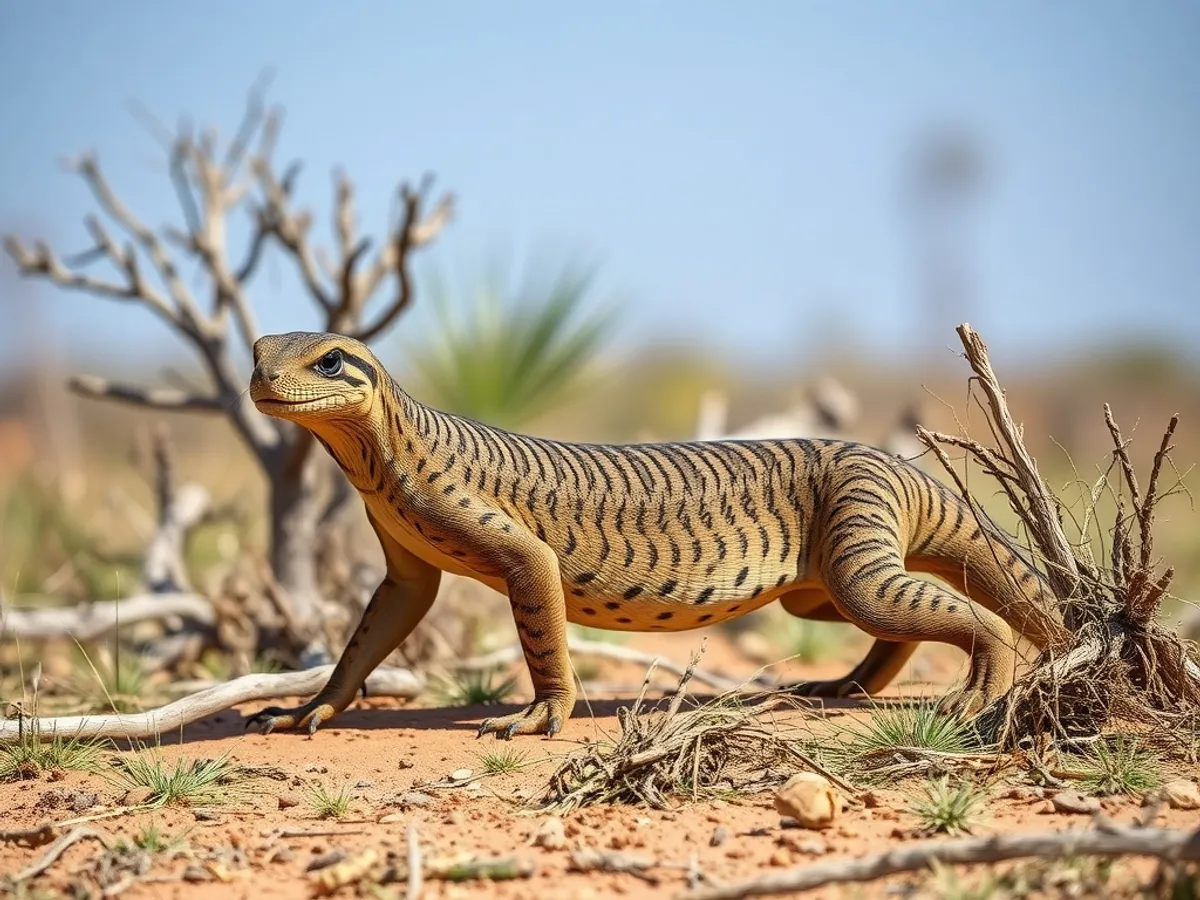
About the Inland Taipan
Oxyuranus microlepidotus of Australia's arid channel country has, by murine LD50, the most toxic venom of any land snake - a single average bite delivers enough to kill many tens of thousands of mice, roughly fifty times more potent than a cobra's - and yet it has never killed a person. That paradox is the whole story of the species. It is shy, reclusive, lives in a nearly unpopulated corner of Queensland and South Australia, and preys almost exclusively on the long-haired rat and other rodents, which it hunts by cornering them in soil cracks and burrows. Because it strikes prey in confined spaces where the rat can bite back, it delivers a very fast, very potent, rapid multiple-strike attack rather than the strike-and-release of most vipers - the toxicity is an adaptation to killing a mammal instantly at close quarters, not to defending itself. The taipan changes colour seasonally, darkening to near-black in winter to absorb heat and paling in summer, with the head going glossy black. Every confirmed human bite - all to snake handlers and researchers - has been survived thanks to antivenom, first produced in 1955. The name "fierce snake" refers to the venom, not the temperament, which is the opposite of fierce.
Fascinating facts
World’s Most Venomous Snake
The Inland Taipan holds the record for the most toxic venom of any snake, with a single bite containing enough neurotoxins to kill over 100 adult humans.
Hidden in the Outback
This species is endemic to remote parts of central Australia, particularly in the Channel Country, where it inhabits deep cracks in the clay soil.
Lightning Fast Strikes
The Inland Taipan can deliver up to eight precise bites in under a second when subduing prey or defending itself.
Detailed description
The Inland Taipan (Oxyuranus microlepidotus) is a medium-sized, slender elapid snake, typically measuring 1.8 to 2.5 meters in length, with some individuals reaching up to 2.7 meters. Its dorsal scales are smooth and small, giving rise to the alternative name 'small-scaled snake.' The coloration is highly variable, ranging from dark brown to olive or even yellowish hues, and shifts seasonally—darker in winter to absorb more heat and lighter in summer to reflect sunlight. The head is usually a darker shade than the body, and the ventral surface is pale cream with occasional orange flecks. The Inland Taipan possesses an exceptionally potent neurotoxic venom, with an average yield of 44 mg per bite, making it the most venomous snake known to science. Despite its lethal venom, the species is highly reclusive, spending much of its life concealed in deep cracks and fissures of clay soils. It is primarily diurnal but may become crepuscular during extreme heat. The Inland Taipan is a solitary species, coming together only for breeding. Its streamlined body and acute sensory organs allow it to move swiftly and detect prey or threats with remarkable efficiency. The species' highly specialized fangs are relatively short but capable of deep envenomation, and its venom acts rapidly on the nervous and circulatory systems of its prey.
Did you know?
Despite its deadly venom, there are virtually no recorded human fatalities from Inland Taipan bites due to its remote habitat and secretive nature.
Research & sources
Wikipedia summary
The inland taipan, also commonly known as the western taipan, small-scaled snake, or fierce snake, is a species of extremely venomous snake in the family Elapidae. The species is endemic to semiarid regions of central east Australia. Aboriginal Australians living in those regions named it dandarabilla. It was formally described by Frederick McCoy in 1879 and William John Macleay in 1882, but for the next 90 years, it was a mystery to the scientific community; no further specimens were found, and virtually nothing was added to the knowledge of the species until its rediscovery in 1972.
Behaviour & social structure
The Inland Taipan is an ambush predator, relying on stealth and precision rather than pursuit. It typically hunts small mammals, especially native long-haired rats (Rattus villosissimus), which are abundant after rainfall events. The snake uses a rapid series of strikes—sometimes delivering up to 8 bites in seconds—to quickly subdue prey, minimizing the risk of injury from struggling animals. It then releases the prey, allowing the venom to take effect before tracking it by scent. Inland Taipans are solitary and territorial, with individuals occupying overlapping home ranges but rarely interacting outside the breeding season. They are most active in the early morning or late afternoon, retreating to deep soil crevices or abandoned animal burrows during the hottest parts of the day. Defensive behavior is rare; the species prefers to flee rather than confront threats, but when cornered, it may adopt a defensive S-shaped posture and strike rapidly.
Reproduction & life cycle
Breeding occurs in late winter to early spring (August to October), coinciding with increased prey availability. Males engage in ritualized combat for access to females, intertwining their bodies and attempting to pin each other. After successful mating, females lay clutches of 12 to 24 eggs in deep, humid soil crevices or abandoned burrows. Incubation lasts approximately 60 days, depending on temperature and humidity. There is no parental care; hatchlings are fully independent and possess functional venom glands from birth. Juvenile snakes are lighter in color and grow rapidly, reaching sexual maturity within 2 to 3 years under favorable conditions.
Adaptations & survival
The Inland Taipan exhibits several remarkable adaptations for survival in arid environments. Its seasonal color change aids in thermoregulation, allowing efficient absorption or reflection of solar radiation. The snake's highly potent venom is an evolutionary specialization for quickly immobilizing fast-moving mammalian prey, reducing the risk of injury. Its cryptic coloration and secretive behavior minimize detection by both predators and prey. The species is capable of surviving long periods of drought by retreating into deep soil fissures, where humidity is higher and temperatures are more stable. Its metabolic rate can be adjusted in response to environmental conditions, allowing it to endure periods of food scarcity.
Cultural significance
The Inland Taipan holds significance in the traditional knowledge of Aboriginal Australians, who refer to it as 'dandarabilla.' It features in local oral histories as a creature to be respected and avoided, but there is little evidence of it being used for food or medicine due to its dangerous reputation. In modern times, the Inland Taipan has become a symbol of Australia's unique and formidable wildlife, often featured in educational materials and documentaries. Its venom is of great interest to medical science, contributing to research on antivenoms and neurotoxicology.
Recent research
Recent studies have focused on the molecular composition of Inland Taipan venom, revealing a complex mixture of neurotoxins, procoagulants, and myotoxins, some of which are unique to the species. Advances in antivenom production have been made possible through the study of its venom components. Ecological research has highlighted the snake's dependence on boom-and-bust cycles of native rodents, linking its reproductive success to rainfall-driven prey abundance. Ongoing field studies aim to better understand its population dynamics, habitat preferences, and responses to environmental change. Genetic analyses have clarified its evolutionary relationships within the Oxyuranus genus, confirming its distinct status from the coastal taipan (Oxyuranus scutellatus).
Videos
Habitat
Arid grasslands and clay plains


Conservation
The Inland Taipan is currently classified as Least Concern on the IUCN Red List.
Threats & challenges
Although currently classified as Least Concern by the IUCN, the Inland Taipan faces several localized threats. Habitat degradation from agriculture, overgrazing, and land clearing can reduce the availability of suitable shelter and prey. The introduction of invasive species, such as feral cats and foxes, may also impact prey populations. Climate change poses a potential long-term threat by altering rainfall patterns and the frequency of rodent population booms, which the snake relies on for food. Human encounters are rare due to the snake's remote habitat and secretive nature, but illegal collection for the exotic pet trade and scientific research can pose additional risks. Population trends are difficult to assess due to the species' elusive behavior and the vastness of its range.
Taxonomy
Scientific name
Oxyuranus microlepidotus
- Kingdom
- Animalia
- Phylum
- Chordata
- Class
- Reptilia
- Order
- Squamata
- Family
- Elapidae
- Genus
- Oxyuranus
- Species
- microlepidotus
Community notes
Share your observations about the Inland Taipan.
No community notes yet. Be the first!
Discover more wildlife
More fascinating animals from the encyclopedia.